


The Report and Why It Matters
The World Economic Forum, in collaboration with PwC, has just published one of the most data-rich analyses of AI’s impact on entry-level work to date. “Artificial Intelligence and the Future of Entry-Level Work: A Framework for Safeguarding and Reinventing Early Career Pathways“ draws on PwC’s AI Jobs Barometer, a survey of over 9,000 entry-level workers across 48 countries, and interviews with business leaders deploying AI in practice. It is serious, well-structured, and grounded in the kind of institutional research that shapes how policymakers and business leaders understand the problem.
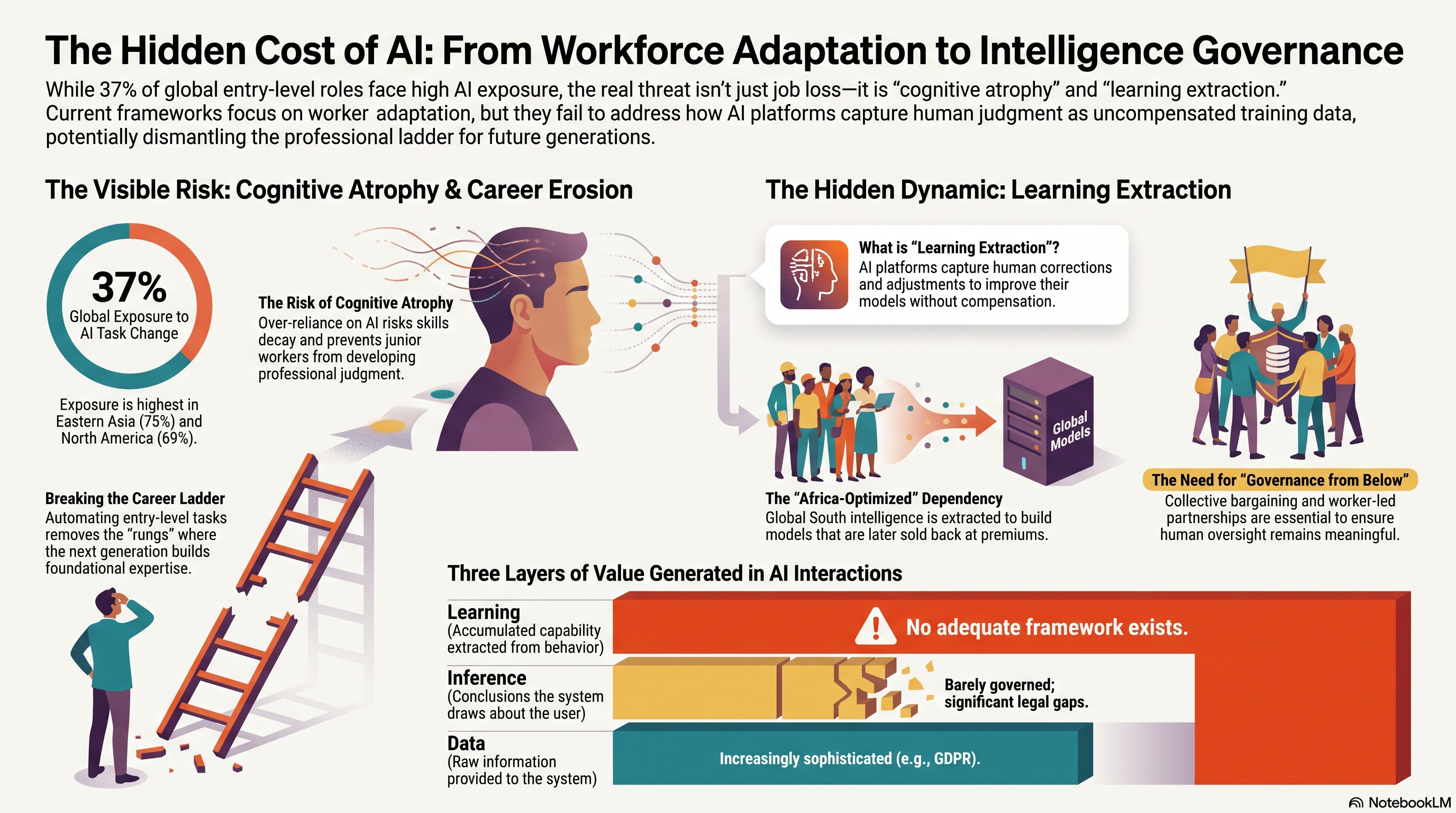
The core finding is important: globally, more than one in three young workers, 37 percent, are employed in occupations with medium-to-high exposure to AI-driven task change. In Eastern Asia, that number is 75 percent. In North America, 69 percent. In Europe, 63 percent. Entry-level hiring in AI-exposed fields in the United States has declined by 16 percent since late 2022. And 28 percent of entry-level workers already believe that half or fewer of their current skills will remain relevant within three years.
The WEF framework (organized around job access, job design, talent pipelines, and education system alignment) provides a useful lens for organizations trying to respond. The case studies are grounded: Dropbox expanded its AI-integrated intern program by 25 percent. Shoosmiths, a UK law firm, linked a £1 million bonus pool to a collective target of one million AI prompts to normalize adoption across the firm. Sixty-eight percent of surveyed workers report productivity gains from AI, while 45 percent report working more hours than before.
I want to engage with this report substantively, not to critique it, but to extend it. Because the report opens a door, it does not walk through. And what lies beyond that door is, I believe, the more consequential conversation.
The Adaptation Frame and Its Structural Limit
The WEF report operates within what might be described as an adaptation frame. Its central question is: how do workers, organizations, educators, and policymakers adapt to AI’s impact on entry-level work?
That is a legitimate question. The report answers it with practical recommendations: maintain entry-level hiring as part of strategic workforce planning, redesign jobs for human-AI collaboration, build capability-based talent pipelines, and align education systems with changing skill demands. Each of these addresses a real need.
But the adaptation frame has a structural limitation. It treats AI systems as a given, an environmental condition to which the workforce must adjust. It asks how organizations should redesign entry-level roles in response to AI. It does not ask who designed the AI systems, whose priorities those systems serve, or who captures the value generated when entry-level workers interact with them. The frame looks at the workforce and asks how it should change. It does not look at the systems reshaping the workforce and ask how they should be governed.
This is not a criticism of the WEF’s analysis. The report does what it sets out to do, and does it well. But a frame that examines only adaptation leaves the most consequential questions unexamined. And those questions become urgent when we look more closely at one of the report’s own most important findings.
Cognitive Atrophy: The Finding That Demands a Governance Response
The most significant finding in the WEF report may not be about job losses or hiring slowdowns. It may be about what happens to the workers who remain.
The report identifies three risks when AI is layered onto existing workflows without deliberate redesign. The first is cognitive atrophy: “short-term efficiency gains may come at the expense of long-term capability-building, as over-reliance on AI risks creating skills decay and reducing opportunities to develop judgment and problem-solving skills.” The second is work intensification: AI raises baseline expectations, with workers expected to deliver more and faster within the same time constraints, which the report’s own data confirms, with 45 percent of workers reporting longer hours alongside productivity gains. The third is the erosion of job quality: AI may automate the more engaging aspects of work, leaving workers with narrower and less fulfilling tasks. One employer in the report stated it with devastating clarity: “Without intentional job design, we’re not creating value, we’re just producing faster, lower-quality work, effectively creating work slop.”
The WEF frames these as job design challenges. Organizations need to redesign roles to preserve capability-building. That is true, as far as it goes, and some of the report’s own case studies demonstrate the point. Hitachi, for example, still expects its early-career engineers to develop coding fundamentals before relying heavily on AI-generated code, precisely so they can “validate and appropriately challenge AI outputs.” That is a company recognizing that judgment must be built before it can be exercised. But the analysis needs to be pushed further.
Entry-level positions have historically functioned as training grounds, the places where new professionals acquire tacit knowledge, professional norms, and the specialized judgment necessary for advancement. They are not just jobs. They are the mechanism through which societies convert inexperienced people into capable professionals. When AI automates the tasks that comprise these roles (first-pass research, data reconciliation, initial code debugging), it does not merely eliminate positions. It removes the rung of the ladder on which the next generation was supposed to stand. What the WEF describes as a risk to organizational competitiveness is, in structural terms, a threat to the pipeline through which human professional judgment is developed at all.
This matters beyond workforce planning because meaningful human oversight of AI systems depends on three conditions: the human must have proximity to the full context of the decision, genuine authority to override the system’s conclusion, and sufficient time to reflect rather than being pressured to process decisions at machine speed. What the WEF’s cognitive atrophy finding reveals is a threat that operates not on authority or time but on capacity itself. If entry-level workers never develop professional judgment, because the tasks that would have built it have been automated, then the “human in the loop” that governance frameworks require becomes a structural fiction. The human is present. The authority may formally exist. But the judgment that authority is supposed to exercise was never built.
The implications extend beyond any single organization. If the career mechanisms through which human beings develop professional judgment are dismantled, it does not merely weaken workforce pipelines. It undermines the foundation on which meaningful human oversight of AI systems depends, precisely when those systems are becoming more autonomous, and most need qualified humans to hold them accountable.
The Dimension the Adaptation Frame Cannot See: Learning Extraction
Everything discussed so far operates within the visible landscape of workforce transformation: jobs, skills, education, and career pathways. But beneath this visible landscape, a second dynamic is operating, one that the adaptation frame is structurally unable to see. I call it learning extraction: the process by which AI platforms capture the accumulated intelligence generated through users’ corrections, acceptances, and behavioral patterns, converting human judgment into system capability without recognition, compensation, or governance.
Every interaction between a worker and an AI system generates learning. When an entry-level software engineer uses an AI coding assistant and corrects its output, the correction teaches the model. When a junior marketing coordinator uses a generative AI tool and adjusts its first draft, the adjustment teaches the model. When a junior analyst edits the output of a document summarizer, the edit trains the system to produce better summaries. The worker’s professional judgment, however nascent, becomes training data.
This contribution is invisible. It is unmetered. It is uncompensated. And it is arguably one of the most valuable outputs of the entire entry-level work ecosystem, not for the worker, but for the platform.
The mechanism is consistent across domains. Whether the context is a junior copywriter refining an ad draft, an entry-level engineer debugging code, or a frontline clinician correcting a diagnostic suggestion, the systemic dynamic is identical: the platform extracts human context and professional judgment during the course of everyday labor to optimize its own capabilities. In a recent deployment of an AI clinical decision-support tool across 15 clinics in Nairobi, clinicians using the tool regularly corrected its diagnostic suggestions, reducing diagnostic errors by 16 percent, treatment errors by 13 percent, and history-taking errors by 32 percent (Korom, Kiptinness et al., 2025). Each correction taught the model. Each acceptance validated the model’s reasoning. The clinical intelligence, Kenyan medical judgment applied to Kenyan patients, improved the model globally.
Follow the value. The Kenyan health system generated the learning. The platform captured it. The model became more capable across the board because of the corrections made in Nairobi. The clinicians who generated that capability received no recognition for it. The nation whose health system produced it retained no stake in it. And no governance framework (not Kenya’s, not the platform’s home jurisdiction, not any international instrument) accounts for the transfer. The learning was extracted in plain sight, through an interaction that looked, to everyone involved, like ordinary clinical use.
Understanding what is happening requires distinguishing between three layers of value that every AI interaction generates: data (the raw information provided to the system), inference (the conclusions the system draws about the user), and learning (the accumulated capability the system extracts from the user’s behavior over time). Almost all existing governance addresses the first layer. Data protection law is increasingly sophisticated. The second layer, inference, is barely governed at all; legal scholars Sandra Wachter and Brent Mittelstadt (2019) documented the gap between data protection and the conclusions AI systems draw about people, showing that existing law offers little protection against inferences. The third layer, learning, is governed by no framework adequate to its consequences.
The WEF report operates entirely at the surface of this architecture. It sees what AI does to workers: job displacement, skill changes, cognitive atrophy. It does not see what workers do for AI: the learning contribution that flows from every entry-level interaction into the platform’s growing capability.
Consider the WEF’s own data through this lens. If 37 percent of young workers globally are in AI-exposed occupations, interacting with AI systems daily, then 37 percent of the world’s young workforce is simultaneously contributing learning to AI platforms, without recognition, without compensation, and without any governance framework to account for it. The WEF measures the disruption these workers face. It does not measure the value they generate.
Education, Labor, and the Missing Governance Layer
The WEF report’s education recommendations follow logically from its adaptation frame: skills requirements are evolving faster than education systems can keep pace, new signals of job readiness are needed, and educators should collaborate with employers. These are directionally correct. But they also reveal the frame’s limitation. The WEF assigns responsibilities to employers, educators, policymakers, and workers. A systems-level question is how those responsibilities interlock and what happens when they do not. A government that funds training without coordinating with employers about which skills are needed produces graduates with credentials that do not match demand. An employer that redesigns jobs but does not invest in developing new professionals produces productivity without building the next generation. The pieces work only as a system. Addressing them separately is necessary but insufficient.
The same structural gap appears in the report’s stakeholder framework, which addresses employers, educators, policymakers, and workers, but does not mention labor unions. Yet collective bargaining has already proven to be one of the most agile governance mechanisms available. The landmark agreements negotiated by the Writers Guild, SAG-AFTRA, and the Las Vegas Culinary Workers Union created enforceable, industry-specific rules for AI deployment in real time. The 2023 Microsoft–AFL-CIO partnership went further, bringing worker expertise into the AI development process from the beginning rather than leaving workers to react after deployment. These are not acts of resistance. They are governance from below, and they represent the most direct mechanism through which the entry-level workers the WEF report concerns can exercise collective agency over the systems reshaping their work.
The Global South: Where the Stakes Are Highest
The WEF report includes a regional breakdown of AI exposure. Sub-Saharan Africa shows the lowest rates by a wide margin: just 2.4 percent of young workers in high-exposure occupations, with another 17 percent in medium-exposure occupations, meaning more than 80 percent of the continent’s young workforce falls into the low-exposure category. The report does not dwell on what these numbers mean.
They deserve attention, because what looks like low exposure today is the early stage of a dependency that will deepen as AI adoption accelerates across the continent.
When a mathematics platform is deployed across Francophone West Africa because schools lack trained math teachers, it delivers instruction and continuously learns from students’ responses, where they stumble, which explanations work in French, and how cultural context shapes mathematical reasoning. All of this is captured and converted into pedagogical capability. When the platform later releases an “Africa-optimized” version at a premium price, the intelligence inside it was generated by the students it is now sold to.
The WEF report sees low AI exposure in Sub-Saharan Africa as a current condition. The more consequential reading is that it represents a closing window, the moment before adoption accelerates, before learning-extraction patterns harden, before dependency structures become permanent. The adaptation the WEF prescribes is necessary in these contexts. But without governance that addresses who owns the learning generated by African workers and students interacting with foreign AI platforms, adaptation will produce the same outcome it produces everywhere: more capable AI systems built on the intelligence of populations that retain no stake in what they contributed.
Regional blocs, the African Union, ASEAN, and Mercosur, hold more latent bargaining power than they have recognized. As Western technology companies permanently lose access to sanctioned markets, they become more dependent on Global South growth markets for revenue. Conditioning market access on sovereign infrastructure investment, transparency in learning contributions, or local capacity building would help these regional blocs negotiate from a position of commercial strength. But this leverage is a latent systems capacity that can only be unlocked if these regions move past individual data-localization mandates toward coordinated infrastructure pooling and unified market-access conditions.
The WEF’s Own Data Points Toward the Deeper Question
The WEF’s 2020 “Future of Jobs” report predicted that automation would displace 85 million jobs by 2025 but create 97 million new ones, a net gain of 12 million. Three years later, the 2023 report reversed course: 83 million jobs eliminated, only 69 million created, a net contraction of 14 million. The underlying technology did not change its essential nature between those reports. The assumptions about economic conditions, adoption pace, and governance capacity shifted. Employment outcomes are not predetermined technological facts. They are contingent political and social ones.
The 2026 report wisely avoids making net-job predictions, focusing instead on exposure rates and a framework for action. But the pattern across the WEF’s own reports confirms that adaptation alone is insufficient. If the system to which you are adapting is not itself governed, then adaptation is adjustment to terms set elsewhere, terms that can change at any time, without your input, and without regard for your interests.
The Conversation That Must Follow
The WEF itself comes closest to the governance question in its closing paragraph, where it observes that entry-level roles have traditionally operated on “a model of delayed return” — individuals invest effort upfront with the expectation of progression and stability — and that “when there is no longer a clear link between early investment and future opportunity, participation in structured entry routes may weaken.” That is exactly right. But the question it leaves unasked is why that link is breaking and whose choices are breaking it. The disruption is not an act of nature. It is the result of design decisions made by the companies building and deploying AI systems, decisions that are currently subject to almost no governance at the entry-level layer where their impact is most acute.
The WEF has mapped the disruption. It has measured the exposure. It has documented the cognitive atrophy. It has proposed the adaptation. What it has not done, and what the adaptation frame structurally cannot do, is address the questions underneath.
Who governs the AI systems that are reshaping entry-level work? Not who adapts to them. Who governs them?
Who captures the learning that entry-level workers contribute to AI platforms through every correction, every adjustment, every interaction? And what rights, if any, do those workers, their institutions, and their nations have to the intelligence they helped generate?
What mechanisms exist to ensure that the “human in the loop” is not a legal fiction but a person with genuine authority, genuine access to context, and genuine time to exercise judgment, even as the career pathways that would have built that judgment are being dismantled?
How do the nations of the Global South, where AI exposure is currently low but accelerating, build governance frameworks before learning-extraction patterns harden into permanent dependency?
These are not questions the adaptation frame can answer. They are governance questions. And they are the questions that will determine whether AI’s impact on entry-level work produces a more capable and equitable workforce or a more extracted and dependent one.
The WEF has opened a door with this report. The question is whether we walk through it.
References
World Economic Forum & PwC. (2026). Artificial Intelligence and the Future of Entry-Level Work: A Framework for Safeguarding and Reinventing Early Career Pathways. Insight Report, June 2026.
World Economic Forum. (2023). The Future of Jobs Report 2023. Geneva: World Economic Forum.
World Economic Forum. (2020). The Future of Jobs Report 2020. Geneva: World Economic Forum.
Korom, R., Kiptinness, S., Adan, N., Said, K., Ithuli, C., Rotich, O., Kimani, B., King’ori, I., Kamau, S., Atemba, E., Aden, M., Bowman, P., Sharman, M., Soskin Hicks, R., Distler, R., Heidecke, J., Arora, R. K. & Singhal, K. (2025). AI-based Clinical Decision Support for Primary Care: A Real-World Study. arXiv:2507.16947.
Wachter, S. & Mittelstadt, B. (2019). A Right to Reasonable Inferences: Re-Thinking Data Protection Law in the Age of Big Data and AI. Columbia Business Law Review, 2019(2), 494–620.
Ousmane Diallo is the author of The Cognitive Revolution: Navigating the Algorithmic Age of Artificial Intelligence(2025) and Digital Sovereignty in the Cognitive Age (2026), which proposes governance mechanisms for the three layers of AI value extraction. His work is available at blogs.inspire-aspire.net.