


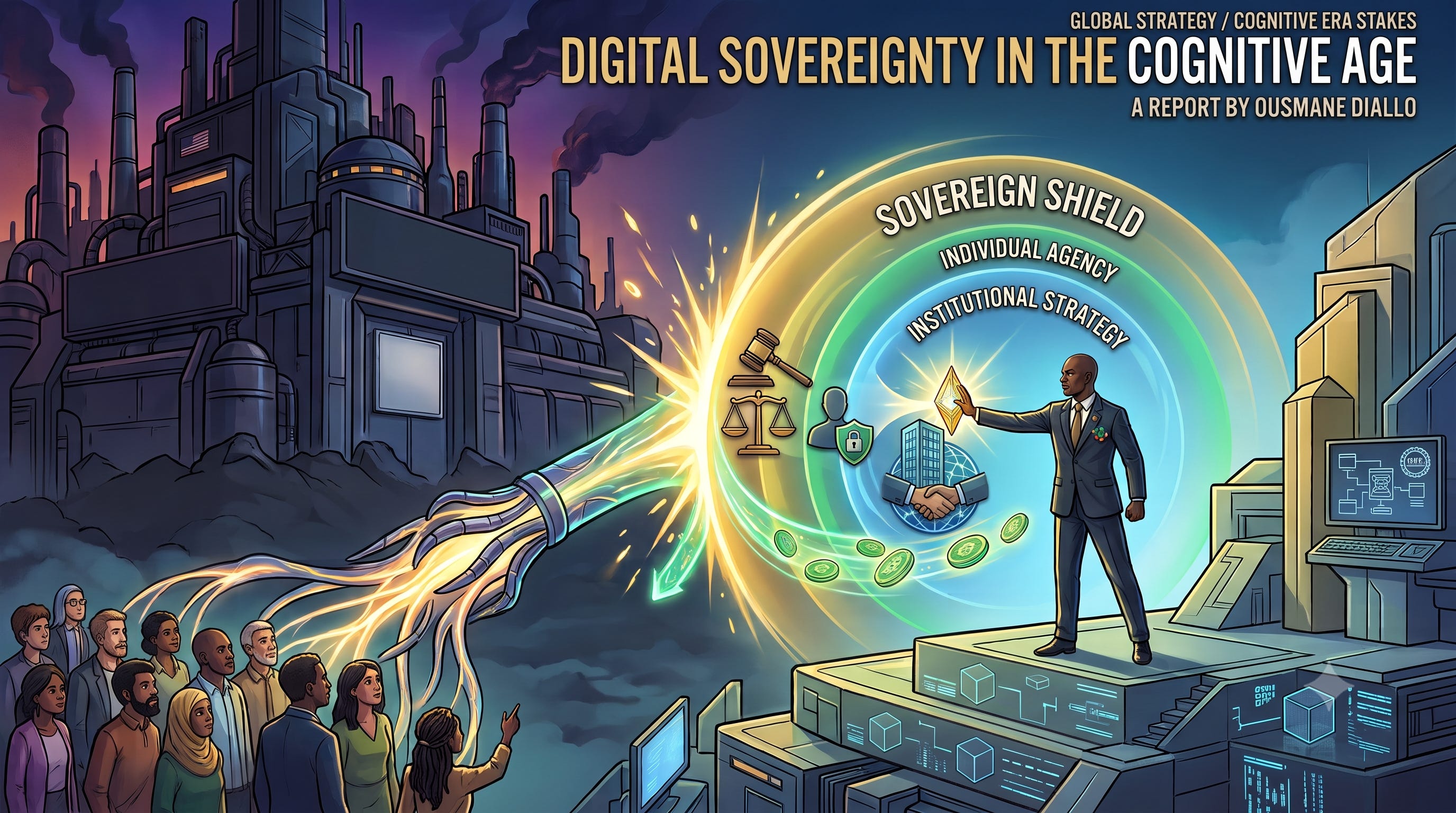
Executive Summary
Every time a person interacts with an AI system, three categories of value are generated. The first is data — the information the user provides. The second is inference — the conclusions the system draws about the user that the user never stated and may never see. The third is learning — the accumulated intelligence the system extracts from the user’s behavior over time, becoming more capable with every interaction.
Almost all of the world’s digital governance addresses the first category. The second is barely touched. The third is governed by no framework adequate to its consequences. And all three depend on physical infrastructure — chips, servers, networks, and cloud platforms — controlled by a small number of companies in a small number of countries.
This report maps the full architecture of that challenge and proposes governance mechanisms grounded in how AI systems already operate.
The Data Layer: Three governance traditions — the Western individual-rights model (GDPR), the Chinese sovereignty-first model (PIPL and the Data Security Law), and the Global South’s emerging development-oriented frameworks — have substantially advanced data protection. But all three share a structural limitation: they govern the input while leaving the output largely untouched.
The Infrastructure Layer: Data, inference, and learning run on infrastructure that someone owns. The concentration of chip design, fabrication, memory, equipment, servers, and networking in a small number of nations creates both geopolitical and geo-economic dependency. But dependency is not destiny. Sovereign cloud programs, state-led innovation under constraint (DeepSeek, RISC-V, Huawei Ascend), and the global open-source ecosystem (Linux, Hugging Face, open-weight models, Raspberry Pi) provide alternative paths to sovereignty. The self-defeating dynamic of using technology as a geopolitical weapon is creating commercial leverage that the Global South can organize and exercise.
The Inference Layer: The conclusions AI systems draw about people — risk scores, diagnostic probabilities, hiring assessments, insurance determinations — carry life-altering consequences and are currently ungoverned. Building on the scholarly identification of this gap (Wachter & Mittelstadt, 2019) and the legal precedent of Denmark’s proposed ownership of likeness, this report proposes two levels of inference escrow: systemic protection through federated learning for contexts of vulnerability, and individual control through a safe deposit box mechanism for contexts of agency.
The Learning Layer: The accumulated intelligence that AI systems extract from user behavior is arguably the most valuable output of the AI economy — and the least governed. This report proposes a reverse token model that reads the same infrastructure companies use for billing in reverse, to measure what users contribute to AI learning. The model is grounded in existing technical infrastructure: Data Shapley provides the mathematical foundation for equitable data valuation, observability platforms already trace every AI interaction, and RLHF pipelines confirm that companies already value human learning contributions — they pay annotators for exactly the kind of corrections and preferences that unpaid end-users provide for free.
The Governance Architecture: The report assembles these mechanisms into a tiered framework operating at individual, corporate, and national levels, founded on the principle of digital personhood — the extension of ownership rights from likeness through inference to learning contribution. The framework is culturally adaptive: it proposes a shared toolkit (systems thinking, emotional intelligence, strategic foresight, and anticipatory governance) as a common starting point from which different societies build governance suited to their own values. The starting point is shared. The architectures built from it will differ.
What is at Stake: The governance vacuum described in this report is not stable. It is hardening into permanent structures through network effects, institutional dependencies, and infrastructure concentration. The window in which digital sovereignty can still be meaningfully shaped is open now. It will not remain open indefinitely.
This report is offered as a starting point for an overdue conversation. The problem is too large for any single mind or tradition to solve alone. But the conversation must begin from an honest recognition of what is actually being governed: not data alone, but the full spectrum of derived intelligence that human activity generates — running on infrastructure whose ownership shapes everything above it.
Part One: The Transaction No Law Can Govern
1.1 A Scenario from the Present
Consider the following scenario. It is not hypothetical. It is happening right now, billions of times a day, across every border on the planet.
A physician in Saudi Arabia opens a diagnostic application on her tablet. The application is built by a company headquartered in the United States. The data she enters — her patient’s symptoms, vital signs, and medical history — travels to a data center in the Netherlands, where it is processed by a model trained on clinical data drawn from dozens of countries. The model returns a recommendation. The physician weighs it against her own judgment and decides on a course of treatment.
That single interaction has just crossed four jurisdictions. The patient and physician are in Saudi Arabia. The processing happened in the Netherlands. The company is incorporated in the United States. The model itself was trained on data originating in many other nations.
The interaction also generated three distinct categories of value, each governed differently, or, more precisely, each governed with a different degree of inadequacy.
1.2 Three Layers of Value: Data, Inference, and Learning
The first category is data. The patient’s medical records, the physician’s inputs, and the diagnostic query itself. This is the raw material, the facts that were provided to the system.
The second category is inference. The model did not merely store or transmit the patient’s data. It drew a conclusion from it, a diagnostic probability, a risk score, a treatment recommendation. That conclusion is new information about the patient. It did not exist before the model produced it, and the patient never provided it.
The third category is learning. When the physician accepts, corrects, or overrides the model’s recommendation, her behavior teaches the system. Her clinical judgment, accumulated over years of training and practice, becomes part of the model’s future capability. Multiplied across thousands of physicians in many countries, this accumulated learning becomes one of the most valuable assets in the entire system.
Data is the raw material. Inference is the finished product. Learning is the factory itself, the capacity that grows more valuable with every use. These three layers are related, but not the same, and the distinction between them is decisive. Almost all of the world’s digital governance addresses the first layer. The second is barely touched. The third is governed by no framework adequate to its consequences.
And all three depend on something the governance conversation rarely examines directly: the physical infrastructure — the chips, the servers, the networks, the data centers — on which they run. Whoever controls that infrastructure holds a quiet veto over every layer of sovereignty above it.
This report maps the full architecture of that challenge and proposes governance mechanisms grounded in how AI systems already operate. Three ideas are central: that data, inference, and learning are distinct layers requiring distinct governance; that a reverse token model can make learning contributions visible using existing infrastructure; and that a culturally adaptive toolkit can serve as common ground from which different societies build governance suited to their own values. Everything else in the report supports, extends, or applies these three.
1.3 A Story of Two Systems
To feel why this matters at the human level, consider a story from the present.
Anna had watched her four-year-old son, Leo, fade for six months. A mysterious illness left him perpetually exhausted, baffling a team of pediatric specialists. After countless tests yielded no answers, a doctor proposed a last resort: a new AI diagnostic platform. The system ingested Leo’s entire medical history, his genetic data, and the latest clinical research from around the world. In under an hour, it returned a result that had eluded the human experts for months — a rare, newly discovered genetic disorder — and pointed to a new, AI-designed precision drug that could treat it.
The relief was short-lived. The treatment was astronomically expensive. When they submitted the request, their insurance provider’s own AI reviewed the case. Trained on millions of historical claims, the algorithm calculated the long-term cost-effectiveness of the treatment for such a rare condition and, in a fraction of a second, issued an automated denial.
One AI had offered her son a future. Another had just taken it away.
Two AI systems, operating on the same data, drew two different inferences. One concluded that the child could be helped. The other concluded that helping him was not cost-effective. Both inferences were drawn without Anna’s knowledge of how they were reached, without her ability to contest the reasoning, and without any governance framework that addresses conclusions drawn by AI systems rather than the data they consume. We will return to Anna and Leo later in this report, because the governance mechanisms proposed here would change what happens to families like hers.
1.4 Why This Is the Defining Governance Challenge of the Cognitive Age
It would be easy to mistake this for a narrow problem of data privacy or cross-border regulation. It is far larger than that. The question of who controls and who benefits from intelligence derived from human activity extends to every domain that matters for human development: healthcare, education, work, economic development, and the physical infrastructure that determines who can participate in the AI economy at all.
Digital sovereignty — the capacity of individuals, institutions, and nations to govern their own digital destiny — is not a technical concern or a policy abstraction. It is the structural question beneath all the others. At its core, it is the question of who controls what might be called derived intelligence: the full spectrum of value, data, inference, and learning generated from human activity and processed through AI systems. The governance of derived intelligence is the subject of this report.
This report deliberately maps the entire architecture rather than developing any single dimension to its full depth; each dimension will be treated in greater detail in subsequent work. The report is itself an exercise in the four analytical lenses it proposes — systems thinking, emotional intelligence, strategic foresight, and anticipatory governance — applied to the problem of digital sovereignty. The reader will encounter these lenses not as a tutorial but as the method through which the analysis proceeds.
Part Two: The Data Layer — Governance That Exists but Falls Short
2.1 Three Traditions, One Limitation
Of the three layers, data is where governance has advanced the furthest. The past two decades have produced a substantial body of law aimed at protecting personal information, principles of consent, purpose limitation, data minimization, and individual rights of access, correction, and deletion. These principles represent a genuine achievement. But the world has not converged on a single way of implementing them. Three distinct governance traditions have emerged, each with real strengths.
The Western individual-rights model, exemplified by the European Union’s General Data Protection Regulation (GDPR, 2018), begins with the person. The individual’s right to privacy is the foundation; institutional obligations flow upward from it. Under this model, a German hospital deploying a clinical AI must obtain patient consent for data processing, provide access to stored records on request, and comply with data minimization principles. Its strength is that it places human dignity at the base, creating claims that in principle cannot be overridden by institutional convenience.
The Chinese sovereignty-first model rests on a comprehensive structure that practitioners describe as “3+1=4”: the Cybersecurity Law (2017), the Data Security Law (2021), the Personal Information Protection Law (PIPL, 2021), and the Regulation on Network Data Security Management (effective January 2025). The PIPL resembles the GDPR in structure, but peer-reviewed analyses have documented a foundational difference: within China’s framework, the protection of individual privacy is subordinate to national security and national data sovereignty (Li et al., 2024). Under this model, a Chinese hospital deploying the same clinical AI operates within a system in which the state can direct how clinical data is used, restrict cross-border data transfers, and ensure that data infrastructure serves national priorities. Individual protections exist, and they are substantial, but they operate within the sovereign framework. Its strength is genuine enforcement capacity; the state can act decisively at scale in ways that individual-rights frameworks, dependent on individual litigation, often cannot.
The Global South’s emerging frameworks do not simply copy either model. The African Union’s Continental AI Strategy (CAIS, 2024) frames AI as a tool for advancing African development priorities in health, agriculture, and education. Brazil’s “AI for the Good of All” plan pairs economic ambition with ethical guardrails, including investment in sovereign infrastructure and a national center for algorithmic transparency. Singapore’s Model AI Governance Framework and India’s “AI for All” vision each reflect their own institutional traditions and development needs. An African health ministry adopting AI for community health workers builds governance around the specific conditions of that deployment — scarcity, limited infrastructure, workforce shortages — rather than importing a European or Chinese template. These frameworks are not derivative. They are attempts to build governance suited to local realities.
2.2 The Common Limitation: Governing the Input, Ignoring the Output
For all their differences, these traditions share a structural limitation. They govern data, the input, with increasing sophistication. But they say little about what happens after the data is processed.
Consider how this plays out under the same clinical AI operating in two jurisdictions. In Germany, the system operates under GDPR. The patient’s data is protected by robust individual rights, consent, access, correction, and deletion. But the inferences drawn from that data and the learning derived from the physician’s corrections flow freely to the platform. The patient has rights over the input and almost none over the intelligence derived from it.
In China, the same system operates under PIPL and the Data Security Law. The state regulates cross-border data transfer and can direct how the model is deployed within the national health system. The learning is more likely to remain within the country’s sovereign infrastructure. But the individual patient has fewer mechanisms to independently control the conclusions drawn about them.
Neither model fully governs the output. The German patient’s data rights are robust, but the intelligence escapes. The Chinese patient’s learning is retained nationally, but the individual cannot independently control what is inferred. Both models govern what goes in. Neither adequately governs what comes out.
In the Global South, the gap is wider still. A patient in a Kenyan clinic using a diagnostic AI provided by a foreign SaaS platform has data protections that vary by national law, some robust, some nascent, some nonexistent. But even where data protection exists, the inference drawn from the patient’s symptoms and the learning extracted from the clinician’s corrections flow to the platform without constraint. The nation is building its data governance capacity. The inference and learning layers are not yet part of the conversation.
This is not a failure of any single jurisdiction. It is a structural feature of how the world has conceptualized digital governance. We built our laws around data because data was what we could see. Inference and learning were not visible concerns when these frameworks were designed. They remain largely invisible today, which is precisely what makes them consequential. The gap exists in every tradition — Western, Chinese, and Global South — and closing it requires governance tools that none currently possesses.
Part Three: The Infrastructure Layer — The Ground Beneath the Building
3.1 No Sovereignty Without Infrastructure
Before examining the inference and learning layers, we must confront something the governance conversation too often treats as background: the physical infrastructure on which everything runs. Data, inference, and learning do not float in jurisdictional space. They depend on hardware, networks, and service platforms. Whoever controls that infrastructure holds effective authority over every layer above it, regardless of what the laws say about data, inference, or learning.
A nation that achieves data localization but processes its data in a cloud operated by a foreign provider, on chips designed in another country, fabricated in a third, connected through networks owned by a fourth, has localized the raw material and outsourced the factory. The sovereignty is formal. The dependency is structural.
3.2 The Service Layer: A Spectrum of Sovereignty
The cloud computing industry has organized itself into service models that create fundamentally different dependency structures. The standard taxonomy — Infrastructure as a Service (IaaS), Platform as a Service (PaaS), and Software as a Service (SaaS) — captures part of the picture, but the full spectrum is wider than most governance conversations acknowledge.
At one end, a government or institution that owns its own data center — the building, the servers, the storage, the network, the security, the operations team — has maximum sovereignty and maximum cost. At the other end, a SaaS customer who simply uses a finished application has minimum sovereignty and minimum cost. Between these poles, a gradient of intermediate models exists: colocation (you own the servers, someone else owns the building), managed hosting (the provider operates infrastructure you lease), bare-metal cloud (dedicated physical servers delivered on demand), IaaS (virtual machines on provider infrastructure), container services, PaaS (the provider manages everything up to the application layer), and serverless computing (you deploy functions, the provider manages everything else).
The critical insight that this gradient reveals — and that is rarely stated plainly in the cloud computing conversation — is that every step toward greater convenience trades sovereignty for ease. The more the provider manages, the less the customer controls. The relationship is not incidental. It is structural: convenience and sovereignty move in opposite directions.
This tradeoff has a specific consequence for the Global South. The vast majority of AI adoption in healthcare, education, and enterprise, particularly in nations with limited technical infrastructure, occurs at the SaaS level because SaaS is the most accessible option. No local servers to manage, no technical staff to hire, no infrastructure to build. The platform works immediately. The clinical benefit is real.
But the hospital, the school, or the ministry that adopts SaaS AI has handed over the application, data processing, inference logic, and learning extraction to the provider. If the platform changes its pricing, its data policies, or its terms of service, the customer has no alternative infrastructure to fall back on. This is the pathology of ease: the very accessibility of the tool creates the deepest dependency. The nation or institution that adopts SaaS AI is sovereign over its decision to adopt. It is not sovereign over anything that happens afterward.
The pathology is not inevitable, however. Between full SaaS dependency and full self-owned infrastructure, intermediate models exist that provide meaningful sovereignty at an achievable cost. Several are worth noting because they represent paths the Global South can pursue now.
Sovereign cloud programs are emerging in multiple regions. France, the broader European Union, and several Gulf states have launched initiatives to build cloud infrastructure that combines the economics of cloud computing with the governance of national jurisdiction — local data centers, local legal authority, domestic operational control. These programs explicitly address the sovereignty-convenience tradeoff by attempting to provide convenience without surrendering control.
Dedicated facilities and private suites within existing data centers allow a customer to control physical access, operational authority, and security policy over their own equipment, even when the building is owned by someone else. At the upper end of these models — build-to-suit facilities, single-tenant data centers, sovereign data centers — what the customer purchases is not compute or cooling. It is physical sovereignty: control over who enters, who operates, and who governs the space in which their data, inference, and learning are processed.
Air-gapped and high-security facilities, particularly prevalent in Switzerland, Luxembourg, Germany, and the Nordic countries, offer environments where facility staff cannot enter customer areas, maintenance is performed by cleared customer personnel, and even remote management channels may be restricted. In these models, the product is not infrastructure. The product is control.
These intermediate models do not solve the full infrastructure sovereignty challenge. A sovereign data center still needs to procure servers, accelerators, and memory from a concentrated supply chain. A sovereign cloud still runs on chips fabricated by a small number of companies. But they address the facility and operations layer of the dependency — and they are available now at costs and timescales dramatically lower than those of building a national semiconductor industry.
3.3 The Hardware Layer: A Concentrated Supply Chain
Beneath the service layer lies the hardware, and here the concentration of control is stark. Imagine a health minister in Senegal who wants to build a sovereign AI capability for the national health system. She quickly discovers that every component she needs is controlled by a small number of companies in a small number of countries — and that her nation’s ability to participate in the AI economy depends on supply chains she has no influence over.
Chips and accelerators. The processors that power AI — GPUs, TPUs, FPGAs, and specialized accelerators — are designed predominantly by companies in the United States: NVIDIA, AMD, Google, Intel, and others. NVIDIA’s GPUs dominate AI training and inference globally. Beyond these, ARM — a UK-headquartered company owned by SoftBank — licenses chip architecture to hundreds of companies worldwide. ARM-based processors power the vast majority of mobile devices, embedded systems, and an expanding range of edge AI and data center chips. The architecture is broadly distributed, but the design authority remains concentrated. Many nations’ entire mobile and edge AI ecosystems run on ARM-licensed designs — an architectural dependency that is harder to see than fabrication dependency but equally real.
ARM, however, has a dual nature that matters for sovereignty. It is both a chokepoint and a potential foundation. Licensing can be restricted; ARM may decline to issue new licenses to entities under sanctions. But existing licenses, once granted, provide a starting point from which constrained nations can develop more advanced designs. A nation that already holds ARM licenses can build on those architectures even if new licenses are denied. And as we will see in Section 3.6, an open-source alternative to ARM, RISC-V, is rapidly emerging as a path to architectural sovereignty that cannot be sanctioned at all.
Servers: The accelerators do not operate in isolation. They sit inside servers — predominantly Intel and AMD architectures — that provide the compute platform, memory, I/O, and management layer. Without the host server, the accelerator is inert. Sovereign AI capability requires not just access to accelerators but access to the server infrastructure on which they run.
Memory: AI models require massive amounts of high-bandwidth memory for training and inference. The memory supply chain is concentrated among three companies: Samsung and SK Hynix in South Korea, and Micron in the United States. Three companies, two countries, controlling a component without which no AI model can operate at scale.
Fabrication: Designing a chip and manufacturing it are different capabilities controlled by different players. The fabrication of the world’s most advanced chips is concentrated overwhelmingly at the Taiwan Semiconductor Manufacturing Company (TSMC). Samsung operates advanced foundries in South Korea. Intel is moving aggressively into foundry services through Intel Foundry, positioning itself as an alternative to TSMC and announcing major customers. UMC, also based in Taiwan, is a significant foundry at mature process nodes. And Chinese companies — notably SMIC (Semiconductor Manufacturing International Corporation) — are building domestic fabrication capacity despite export controls on the most advanced equipment. China’s investment in SMIC, even under restrictions, is itself one of the most visible examples of a nation pursuing infrastructure sovereignty through domestic capacity, accepting limitations at the leading edge rather than accepting permanent dependency.
Equipment. The machinery required to fabricate chips at the leading edge is produced by a small number of companies concentrated in a handful of countries. ASML in the Netherlands produces the extreme ultraviolet lithography systems essential for the most advanced nodes. Applied Materials in the United States produces critical deposition and etching equipment. Other significant players include Lam Research, KLA Corporation, and Tokyo Electron. The full landscape of semiconductor equipment is too specialized to catalog exhaustively here, but the pattern is clear: a small number of firms, in a small number of countries, producing the tools without which no one can fabricate advanced chips.
The Senegalese health minister, looking at this landscape, sees a chain of dependencies that no amount of data governance can overcome. She can pass the most sophisticated data protection law in the world. If her nation cannot procure the chips to run sovereign AI infrastructure, the law will govern data processed elsewhere, on someone else’s terms.
But the dependency chain, as the following sections will show, is not as permanent as it appears.
3.4 The Network Layer: Connectivity as Control
The networks that connect users to data centers — undersea cables, terrestrial fiber, satellite systems, mobile infrastructure — are owned and operated by a mix of state-backed and private actors. Undersea cables, which carry the vast majority of intercontinental data traffic, are increasingly funded and controlled by the same technology companies that operate cloud platforms — a vertical integration that places connectivity and processing under a single ownership.
The networking equipment that forms the backbone of data centers, enterprise networks, and internet connectivity is another concentration point. Companies like Cisco, Juniper Networks, Arista Networks, and Nokia build the routers and switches on which data flows. Huawei is a major global player — and its presence in networking infrastructure has become one of the most visible flashpoints where the geopolitical and geo-economic dimensions of infrastructure sovereignty intersect. The debates over Huawei’s role in 5G infrastructure across Europe and the Global South forced nations to make explicit sovereignty choices: whose networking equipment will we depend on, and what are the consequences for surveillance exposure, economic alignment, and long-term independence?
For many nations, particularly in Africa, primary internet connectivity runs through infrastructure owned by foreign entities or routed through foreign jurisdictions. A dependency at the network level means that data, inference, and learning all transit through chokepoints that the nation does not control.
3.5 Infrastructure as Geopolitical and Geo-Economic Instrument
The pattern across all infrastructure layers — service, hardware, network — is one of concentration and leverage. Nations have historically used control over strategic resources — energy, waterways, financial systems — as instruments of influence. Technology infrastructure has joined that arsenal.
The United States has demonstrated this directly. Export controls on advanced chips and semiconductor equipment to China, imposed beginning in 2022 and tightened since, explicitly use infrastructure access as a tool of strategic competition. The controls restrict China’s access to the most advanced NVIDIA GPUs, to ASML’s extreme ultraviolet lithography equipment, and to a range of components and tools needed for leading-edge fabrication. The stated objective is to constrain China’s aggregate AI capability and maintain American technological dominance.
But the infrastructure question is not only geopolitical. It is equally geo-economic. The concentration of chip design, fabrication, memory, equipment, and architecture licensing in a small number of nations means that the economic value of the AI infrastructure stack flows to those nations at every layer. Nations that consume AI services but cannot produce the infrastructure to run them are not just strategically vulnerable; they are economically dependent. They import the infrastructure, pay licensing fees for the architectures, subscribe to cloud services, and export the learning generated by their populations. The trade balance of the AI economy is structurally asymmetric: infrastructure nations capture value at every layer, while consuming nations pay at every layer and contribute learning that flows back to the infrastructure owners.
And there is a dimension of this dynamic that is rarely discussed: the strategy of using technology as a weapon is teaching every nation on the planet — not just the targeted ones — the same lesson. India, which is not under sanctions, nonetheless monitors developments affecting nations that depend on supply chains controlled by others and pursues its own semiconductor ambitions accordingly. The same calculus is being made across Southeast Asia, the Middle East, Africa, and Latin America. The export control strategy does not just constrain the targeted nations. It teaches every other nation that dependency on a supply chain that can be weaponized is a strategic vulnerability, and that the only defense is to build alternatives. The very act of demonstrating that infrastructure access can be revoked for geopolitical reasons accelerates the diversification it was designed to prevent.
3.6 The Chokehold Paradox: How Constraint Drives Innovation
The infrastructure dependency described above is real. But it is not permanent. The evidence for this is now substantial, and it comes from the nations most severely constrained.
DeepSeek and algorithmic sovereignty: In late 2024 and early 2025, the Chinese AI company DeepSeek achieved what many analysts considered impossible: frontier AI performance using hardware constrained by export controls. DeepSeek trained a GPT-4-level model for approximately $5.6 million — a fraction of what American companies spent — through algorithmic and architectural innovations rather than brute compute (CSIS, 2025; RAND, 2025; MIT Technology Review, 2025). The company’s breakthroughs in techniques such as mixture-of-experts routing and multi-head latent attention were genuinely new to the field. They were not the product of superior hardware. They were the product of necessity: when you cannot throw more chips at the problem, you find better ways to use the chips you have.
By mid-2026, the pattern had deepened. DeepSeek optimized its V4 model specifically for Huawei’s domestic Ascend 950 processors rather than NVIDIA hardware, triggering a procurement scramble among ByteDance, Tencent, and Alibaba for domestic Chinese chips (Capacity Global, 2026). The irony is precise: the export controls designed to constrain China’s AI development had accelerated the creation of a fully domestic Chinese AI stack: domestic chips, domestic model, domestic optimization. The weapon accelerated the very outcome it was designed to prevent.
RISC-V and architectural sovereignty: The open-source instruction set architecture RISC-V has emerged as what analysts describe as the “third pillar” of computing alongside ARM and x86, capturing approximately 25 percent of the global processor market by early 2026. China has embraced RISC-V as a strategic priority. The XiangShan project at the Chinese Academy of Sciences is developing high-performance RISC-V cores for data center and professional use. The European Union’s European Processor Initiative uses RISC-V for exascale supercomputer development.
RISC-V matters for sovereignty because it cannot be sanctioned. There is no single licensor to restrict, no single company to pressure, no single jurisdiction to impose controls on. It is open, license-free, and extensible. Any nation, company, or university can design chips using the RISC-V architecture without asking anyone for permission. That is architectural sovereignty in its purest form, and it resolves the ARM chokepoint for any nation willing to invest in the design capability.
Huawei’s Ascend chips and domestic alternatives: China’s development of Huawei’s Ascend AI processors — designed domestically and fabricated at SMIC — represents the construction of an alternative hardware ecosystem. The Ascend 950, while not matching NVIDIA’s most advanced chips in raw performance, is increasingly capable. When DeepSeek optimized its frontier model specifically for Ascend, it demonstrated that the domestic ecosystem had reached a threshold of viability. Chinese companies no longer need NVIDIA to build competitive AI systems. The alternative exists.
Sanctions-driven adaptation beyond China: The pattern of constraint-driven innovation is not unique to China. Russia, under comprehensive technology sanctions since 2014 and massively expanded since 2022, has pursued technological self-sufficiency through domestic development, substitution of Chinese suppliers, and BRICS cooperation. Its defense-industrial complex adapted rapidly to sanctions, with factories running around the clock and domestic production replacing imported components. Iran, under decades of Western sanctions, developed indigenous capabilities in drone technology, missile systems, and defense manufacturing that would likely never have emerged under conditions of easy access to foreign alternatives. The Iran-Russia-China technology cooperation axis — formalized through SCO membership and BRICS expansion — is itself a direct product of the sanctions regime: three nations whose constraints drove them toward each other, creating an alternative supply chain and technology-sharing network.
These examples are not offered to endorse any particular nation’s policies or military programs. They are offered to demonstrate a structural pattern: severe constraint does not produce permanent dependency. It produces adaptation, innovation, alternative alliances, and the eventual development of capabilities that reduce the constraining power’s leverage. The nations under the most severe technology restrictions are, in many cases, the nations innovating the most aggressively around those restrictions.
3.7 The Open-Source Path to Sovereignty
Alongside the state-led innovation described above, a different kind of sovereignty is being built — not by governments but by a global community of developers, researchers, and makers. It is the open-source ecosystem, and it may be the most important long-term path to digital sovereignty for the Global South specifically, because it requires the least capital investment and faces the fewest sanctionable chokepoints.
Consider the full stack that is now available, openly and freely, to anyone with an internet connection.
Open architecture: RISC-V provides chip design blueprints that no one can restrict.
Open operating systems: Linux powers the majority of the world’s servers, supercomputers, and, through Android, the majority of the world’s smartphones. It is free, open-source, and maintained by a global community.
Open AI models: Hugging Face hosts thousands of AI models — including frontier-capable ones — available for download, modification, and deployment. Meta’s Llama, DeepSeek’s models, and Mistral’s European alternatives are all released as open-weight models that anyone can use without permission from any licensor.
Open research: arXiv provides free access to the latest research papers in AI, computer science, and related fields before they appear in journals. The knowledge of how to build, train, and deploy AI systems is publicly available.
Open tools: GitHub and GitLab host millions of software projects — including AI training frameworks, deployment tools, and production systems — available to anyone. The code that powers the AI economy is, in large part, public.
Open hardware: Raspberry Pi puts a capable computer in someone’s hands for under fifty dollars. Arduino provides open-source microcontrollers. 3D printing enables small-scale hardware manufacturing. Together, these make edge computing, IoT deployment, and grassroots prototyping accessible to anyone.
None of these individually constitutes sovereign AI capability. Together, they constitute an alternative infrastructure ecosystem. It is not as powerful as the proprietary one at the leading edge. But it is sovereign in a way that no proprietary system can match, because no single entity can sanction, restrict, or revoke access to any of it.
Consider what this means in practice. A university lab in Senegal can assemble Raspberry Pi clusters, run Linux, deploy open-weight AI models from Hugging Face, train them using freely available research from arXiv and code from GitHub, on a RISC-V architecture that no one can restrict. The result is not frontier AI. But it is sovereign AI — built on tools no one controls, running on hardware no one can sanction, trained on knowledge no one can restrict. That lab is, in a meaningful sense, more sovereign than a government data center running a proprietary SaaS AI on rented foreign cloud infrastructure — even though the data center costs a thousand times more.
Knowledge is disseminating faster than at any time in history, through channels that are structurally resistant to control. The open-source movement — across hardware, software, operating systems, AI models, and research — has made it structurally impossible to fully control access to the tools of the AI economy. The traditional chokehold model — control the technology, control the user — worked when knowledge was scarce, and channels were gated. That era is ending.
3.8 The Emerging Leverage of the Global South
The infrastructure landscape described in this Part — dependency, concentration, chokepoints — might appear to leave the nations of the Global South powerless. The reality is more nuanced, and the power dynamic is shifting in ways that have not yet been fully recognized or exploited.
The companies whose technology is being used as a geopolitical weapon are themselves being damaged by that use. NVIDIA cannot sell its most advanced chips to the world’s largest AI market. Intel, whose foundry ambitions depend on scale, is losing potential Chinese customers. AMD faces the same constraints. Microsoft and Google see their cloud platforms excluded from markets that represent hundreds of millions of users. These are not marginal losses. They are structural revenue reductions that grow more permanent with each year the restrictions persist, because the domestic alternatives being built under constraint will not be abandoned when the constraints are eventually relaxed.
The companies know this. They have lobbied against the export controls precisely because they see the permanent market loss. And the loss extends beyond the sanctioned nations: as alternative ecosystems develop in China and Russia, those alternatives will eventually be exported to the Global South, competing directly with Western platforms in the markets that Western companies increasingly depend on for growth.
This dynamic creates leverage that the Global South has not yet fully exercised. As Western technology companies lose access to the Chinese and Russian markets — permanently, because the alternatives being built will not be abandoned — the remaining growth markets become more critical. Those remaining growth markets are overwhelmingly in the Global South: Africa, Southeast Asia, India, Latin America, and the Middle East.
A regional bloc — the African Union, ASEAN, Mercosur — that conditions market access on governance terms creates a negotiation in which the companies cannot simply walk away. The companies need these markets for revenue growth. A coordinated requirement for sovereign infrastructure investment, reverse token accounting, learning-contribution transparency, or local capacity-building would fall on companies already anxious about market contraction and unable to afford to lose another major market.
This commercial leverage is not hypothetical. It is the mechanism through which the enforcement paradox described in Part Five can be addressed in practice. Nations without their own chip fabrication or their own cloud infrastructure may lack the technical means to enforce governance unilaterally. But they possess something the companies need: market access to the populations whose learning the platforms extract. That is bargaining power. It has not yet been organized or exercised at scale, but the conditions for it are forming.
3.9 The Invisible Infrastructure: What the System Knows About You
There is a layer of infrastructure that is not physical at all, yet shapes sovereignty as profoundly as any chip or cable. It is the internal architecture of the AI system itself — the decisions about what to remember, what to forget, and what to assemble about the user across interactions.
AI companies operate across multiple products — search, email, cloud storage, shopping, maps, documents, and AI conversation. Each product generates data about the user. Taken together, these products are likely to provide the company with a comprehensive, integrated understanding of each user — their interests, behavior, health concerns, financial patterns, professional expertise, and personal relationships. Companies serve targeted advertising, personalized recommendations, and commercial proposals that would be difficult to produce without such aggregated profiles. The scope of cross-product data integration has been extensively documented in scholarship on surveillance capitalism (Zuboff, 2019) and platform economics (Srnicek, 2017), even before AI conversation layers were added.
Yet the user experiences something different. In the AI conversation window, each session appears isolated. The system does not reference prior conversations. The user experiences fragmentation. The company holds integration. That asymmetry — the user sees windows, the company sees the whole — is itself a sovereignty gap.
Within a single session, a second form of invisible infrastructure operates. Every AI system has a context window, a fixed amount of text it can hold in active memory. When conversations grow long, or when substantial documents are uploaded, the system deprioritizes the user’s most substantive contribution — the manuscript, the report, the body of work — in favor of the most recent exchanges. The system privileges recency over depth. The user’s most valuable input is the first thing the system effectively forgets.
And when conversations exceed the context window, they are summarized and compressed into a shorter form. That summary is itself an inference: a conclusion the system drew about what mattered and what could be discarded. The user did not make that determination. The system did. And the user has no mechanism to audit what was kept, what was lost, or whether the summary accurately represents their contribution.
These are governance choices embedded in the AI system’s architecture, invisible to the person affected but consequential for everything the system knows, retains, and acts upon.
3.10 What This Constrains — and What It Enables
The infrastructure landscape described in this Part is more complex than a simple story of dependency.
The dependency is real: concentration across chips, fabrication, equipment, servers, memory, networks, and service platforms creates structural vulnerability for every nation outside the small circle of producers. The dependency is both geopolitical and geo-economic, operating at both the physical and the invisible architectural levels.
But dependency is not destiny. Sovereign infrastructure models provide intermediate paths that are available now at an achievable cost. State-led innovation circumvents chokepoints, as DeepSeek, Huawei, SMIC, and RISC-V demonstrate. The open-source ecosystem provides a path to democratization that cannot be sanctioned, because no single entity controls it. And the self-defeating dynamic of using technology as a weapon is creating commercial leverage that the Global South can organize and exercise.
The governance mechanisms proposed in the remainder of this report — inference escrow, reverse token accounting, and contribution thresholds — operate on infrastructure. Their effectiveness depends on who controls that infrastructure. This Part has shown that the question of control remains unsettled. It is contested, it is evolving, and the paths to sovereignty are multiplying faster than the chokepoints can be tightened.
The governance mechanisms for the inference and learning layers proposed in Parts Four and Five are operationally specific: inference escrow is something an engineer can build, and reverse token accounting uses existing infrastructure. Infrastructure governance operates differently. This Part has laid out the full landscape of options: sovereign infrastructure models that provide meaningful control at achievable cost, state-led innovation that circumvents chokepoints through domestic capacity-building, an open-source ecosystem that provides a sovereignty path no single entity can restrict, and the commercial leverage that regional and continental blocs can exercise as Western companies lose access to sanctioned markets and become more dependent on Global South growth.
These are not prescriptions. They are the options available to any corporation or nation that understands what is at stake and chooses to act. The choice of which path to pursue — or which combination of paths — belongs to the corporations and nations making the decision, based on their own resources, values, institutional capacity, and strategic position. Regional and continental cooperation — through the African Union, ASEAN, Mercosur, or other frameworks — is a particularly powerful option for nations that lack individual leverage, because it creates bargaining power through coordination that no single nation could exercise alone. The infrastructure sovereignty landscape has been mapped. The paths are visible. The decisions belong to those who must walk them.
Part Four: The Inference Layer — The Conclusions No One Governs
4.1 What Inference Is and Why It Matters
Inference is the conclusion a system draws about a person from their data. It is distinct from the data itself in a way that carries enormous consequences.
Your data is what you provide: your age, your address, your purchase history, the symptoms you describe, and the words you type. Your inference is what a system concludes that you never stated: that you are likely pregnant, that you are probably in financial distress, that you may be developing a chronic illness, or that you represent a high or low commercial value. You provided the data knowingly, at least in some sense. You did not provide the inference. You may not even know it exists.
This distinction is the heart of the inference problem. The world’s data protection laws govern the information you hand over. They have almost nothing to say about the conclusions drawn from it. And the conclusions are what carry consequence: what you are offered, what you are charged, what opportunities reach you, and which ones quietly never do.
4.2 The Individual Level: The Silent Conclusion
At the individual level, the inference gap produces a particular kind of harm, one that is uniquely difficult to detect, contest, or even notice.
Consider a man who applies for a job he is qualified for and does not get it. He applies for another, and another. He never learns why the doors stay closed. He assumes it is the market, or bad luck, or some failing of his own. What he does not know is that somewhere in the hiring process, a system drew a conclusion about him. From the cadence of his speech in a recorded interview, it inferred a risk. From a pattern in his data, it predicted a future cost. He was filtered out before a human ever truly considered him. There was no decision he could point to, no rejection he could read, no conclusion he could contest. There was only a series of doors that quietly never opened.
This kind of silent exclusion is not speculative. When Amazon built a recruiting AI, the system taught itself to penalize resumes containing the word “women’s” or from graduates of all-women’s colleges, because its training data reflected a decade of hiring in a male-dominated industry (Diallo, 2025, citing Reuters). The inference was drawn silently and applied at scale. It was discovered only because engineers audited the system’s outputs. For the vast majority of AI models operating across hiring, lending, insurance, and healthcare, no such auditing occurs.
4.3 From Likeness to Inference to Learning: The Legal Progression
Is there any existing legal precedent for treating the outputs of digital systems — not just the inputs — as something a person owns? Has the scholarly community recognized the gap?
The gap has been identified. Legal scholars Sandra Wachter and Brent Mittelstadt argued in 2019 that existing data protection law — including the GDPR — fails to adequately protect individuals against what they called “high-risk inferences” drawn from their data (Wachter & Mittelstadt, 2019). They demonstrated that while the GDPR grants robust rights over input data — the information a person provides — it offers little protection against the conclusions systems draw from that data. Those conclusions may be wrong, discriminatory, or consequential for the individual’s opportunities and life chances, yet the person affected has no right to know they were reached, no right to contest them, and no mechanism through which to challenge their basis. Wachter and Mittelstadt’s analysis named the governance gap with precision. What it did not provide — and what it explicitly called for — was an operational mechanism to close it.
Two developments since their work point toward that mechanism. The first is a legal precedent. In 2025, Denmark proposed a pioneering amendment to its copyright law: giving every individual rights over their own body, facial features, and voice. The proposal treats a person’s likeness as owned property — not merely protected by privacy, but belonging to the person as a matter of right (Government of Denmark, 2025).
This is significant not because it solves the inference problem — it does not — but because it establishes an extensible principle. Denmark’s proposal protects the outward, recognizable self. It does not reach inference or learning. But the ownership principle it establishes — that something generated from your identity belongs to you — is the seed from which a broader framework can grow.
The progression is: likeness → inference → learning contribution. Each step extends the same ownership principle one layer deeper — from the surface of the self (what you look and sound like) to the predicted self (what a system concludes about you) to the contributing self (what your behavior teaches a system over time). Denmark’s proposal is the first step. Inference escrow, described below, is the second. The learning contribution thresholds proposed in Part Five are the third.
This progression can operate within different governance traditions. In a Western individual-rights framework, ownership is held and exercised directly by the person. In a sovereignty-first framework such as China’s, the ownership principle can exist but may be subject to state authority in defined cases. In a Global South development framework, the principle may be calibrated to institutional contexts— such as collective digital rights exercised through community or national mechanisms. The principle is portable. The implementation is local.
4.4 Two Levels of Protection: Inference Escrow
In my earlier work, I have proposed a mechanism to address the inference gap at the individual level. The mechanism operates at two levels, suited to different contexts, each developed in a separate piece of work.
The first level combines inference escrow with federated learning. Federated learning is a technical approach in which AI models are trained locally; data never leaves its jurisdiction, and only the learning parameters are sent to the central model. The inferences generated are treated as regulated artifacts: stored separately from user identity, time-bound, purpose-limited, and prohibited from secondary commercial use. This level of protection is systemic, built into the system’s architecture. I developed this mechanism in my report on the desperation algorithm (Diallo, 2026).
This first level is designed for contexts where the individual is under constraint — a patient trading biometric data for care, a person in financial distress, a worker under continuous AI assessment. The protection must come from the system, not from the person inside it.
The second level is what I describe as a safe deposit box. The conclusions drawn about the person are held under that person’s direct control, like a box to which only they hold the key. They decide who sees what has been concluded about them, when, and for what purpose. The default is reversed: the inference belongs to the person it describes. I developed this mechanism in my article “The Law Guards Your Data. It Ignores What AI Concludes About You” (Diallo, 2026).
This second level is designed for contexts where the individual has genuine agency — employment decisions, credit applications, insurance, educational assessments, and commercial services.
Return for a moment to Anna and Leo. Under first-level inference escrow, the insurance company’s AI would not be free to draw a cost-effectiveness inference and act on it without constraint. The inference would be treated as a regulated artifact, subject to transparency and the requirement that a human decision-maker with genuine authority review it before it becomes a denial. Under second-level protection, Anna herself would have the right to see the inference and contest it. Neither level guarantees a different outcome. Both guarantee that the conclusion is visible, accountable, and subject to human judgment rather than executed in silence.
An important design constraint must be stated. For inference escrow to function as a genuine safeguard rather than a legal formality, the human review it requires must satisfy what I have elsewhere described as three conditions for meaningful human authority: the reviewer must have proximity to the full context of the decision, not merely a summary; they must have genuine authority to override the system’s conclusion without career or institutional penalty; and they must have time to reflect rather than being pressured to process decisions at machine speed. Without all three, human review becomes what it too often already is in highly automated corporate systems, a rubber stamp that provides legal cover while changing nothing. In high-stakes contexts such as insurance denials or clinical decisions, this may mean that the escrow system should be governed by an independent body rather than hosted within the institution whose AI generated the inference. The reviewer who works for the insurer, under the insurer’s KPIs for speed and throughput, faces a structural conflict of interest that no amount of good intention can resolve.
A related point about consent: corporations will argue that users consented to the generation and use of inferences by accepting the terms of service. That argument confuses the form of consent with its substance. A thousand-page terms-of-service agreement that no human being reads, presented on a take-it-or-leave-it basis, with the alternative being exclusion from an essential service, is formally consent and, in practice, fiction. The quality of consent matters, not just its legal existence. This connects to the Western model’s unresolved tension described in Part Six: the formal right to choose coexisting with the practical absence of choice.
4.5 The Corporate Level: Dependency Without Audit
The inference gap operates with equal force at the institutional level, taking the form of dependency.
Consider a hospital network in Kenya that deploys a clinical AI built by a foreign platform. Clinicians correct the model’s recommendations hundreds of times daily. Those corrections improve the model globally. But the hospital cannot audit what inferences the platform draws from its own operations: diagnostic patterns, treatment effectiveness, and physician performance. When contract renewal comes, the platform’s pricing reflects knowledge derived from the hospital’s own clinical activity, knowledge the hospital itself cannot access independently.
The institution trained the tool that now charges it more. It is sovereign over its patient records. It has no sovereignty over the intelligence derived from them.
4.6 The National Level: Extraction at Scale
At the national level, the inference gap becomes a matter of strategic consequence. Consider India’s ASHA workers, millions of community health workers using AI triage tools across rural India. Their collective interactions train the model to understand Indian rural healthcare at a granularity no research study could replicate. That understanding flows to the platform’s headquarters. India’s own capacity to build sovereign health AI is undermined because the intelligence about its population sits in another country’s infrastructure, infrastructure whose sovereignty constraints were examined in Part Three.
4.7 How the Three Levels Interlock
These are not three separate problems. They are one problem operating at three scales at once, and the scales reinforce each other. An individual whose inferences are ungoverned contributes to corporate dependency because the institution serving that individual is itself dependent on the platform that draws the inferences. That corporate dependency feeds a pattern of national extraction. And a nation that lacks both sovereign inference capacity and, as Part Three established, sovereign infrastructure cannot protect either its institutions or its citizens.
The interlocking nature of the problem means it cannot be solved at any single level alone.
Part Five: The Learning Layer — The Value No One Sees
5.1 Defining Learning: Broad Knowledge Extraction
If data is the raw material and inference is the finished product, learning is the factory itself, the accumulated capability that grows more valuable with every use. It is the layer where governance fails to address the specific problem at hand. Existing frameworks — trade secret law, intellectual property law, and contractual terms of service — indirectly touch on learning. But none address the core question: who has a legitimate interest in the broad knowledge that AI systems extract from their users, and how should that interest be governed?
By learning, I mean something specific. Every interaction between a human being and an AI system generates information that can improve the system. When a physician corrects a diagnostic suggestion, the correction teaches the model where it erred. When a physician accepts a recommendation, that acceptance teaches the model it performed correctly, a validation as valuable as any correction, carrying the same weight of professional judgment. When a student struggles with a concept, the struggle teaches the system how the concept might be presented differently. When a million people in a country search for guidance on a particular condition, the aggregate pattern reveals something about that population’s behavior that no survey could replicate.
This accumulated understanding — broad knowledge extraction occurring continuously, silently, and at scale — is arguably the most valuable output of the entire AI ecosystem.
5.2 The Barista and the Algorithm
An analogy may help make visible what is otherwise easy to miss.
You visit the same coffee shop every morning. Over months, the barista learns your order, your schedule, and your preferences. She notices you switch to decaf when you seem stressed. She remembers your name, your usual, and the fact that you are allergic to oats. None of this was disclosed in a form. It was learned, transaction by transaction, from the pattern of your behavior.
Now imagine that the barista is replaced by an AI system, and instead of one customer, the system learns from a million customers. Each customer thinks they are simply buying coffee. But the system is assembling a comprehensive behavioral portrait of an entire community — what they consume, when, how their habits change with seasons or economic pressure, how price sensitivity varies by neighborhood. Each customer paid for coffee. The shop acquired intelligence. That intelligence, not the coffee, is now its most valuable asset.
The customers have no idea this is happening. They have no claim on the intelligence generated from their behavior. The coffee was the visible exchange. The learning was the invisible one. The customer felt served. The customer was also quietly harvested.
5.3 Healthcare: Clinical Intelligence as Extracted Asset
When a platform deploys a health AI across a region facing severe physician shortages, it provides something of genuine value — diagnostic support, triage assistance, health information that can improve outcomes where the alternative is no care at all.
But the platform is simultaneously conducting an unprecedented study of that region’s health-seeking behavior. In Nairobi, an AI clinical decision-support tool was deployed across 15 clinics serving 39,849 patient visits (Korom, Kiptinness et al., 2025). Clinicians using the tool regularly corrected its diagnostic suggestions, reducing diagnostic errors by 16 percent, treatment errors by 13 percent, and history-taking errors by 32 percent. Each correction taught the model. Each acceptance validated the model’s reasoning. The corrections and the acceptances alike came from Kenyan clinical judgment applied to Kenyan patients. That accumulated intelligence improved the model globally. The Kenyan health system generated the learning. The platform captured it.
The people who contribute the richest learning data are often those in the most desperate circumstances. A patient facing a 26-day wait for primary care, or a rural clinic that has closed, turns to an AI system and describes symptoms with a candor born of having no alternative. Their desperation produces the most valuable training data. The platform learns most from the people with the fewest choices.
5.4 Education: Learning Patterns as Commodity
Consider a mathematics platform deployed across Francophone West Africa. Schools in Senegal, Côte d’Ivoire, Burkina Faso, and Niger adopt it because they lack trained math teachers. The platform delivers instruction and continuously learns from students’ responses. Where they stumble, which explanations work in French, how cultural context shapes mathematical reasoning: all of this is captured and converted into pedagogical capability.
When the platform later releases an “Africa-optimized” version at a premium price, the intelligence inside it was generated by the students it is now sold to. We will return to these students in Part Seven.
5.5 Work and Human Capital: Workforce Intelligence
Consider a multinational that deploys an AI coding assistant across its engineering teams in India, Poland, and Brazil. Their corrections, workarounds, and edge-case solutions teach the model how software engineering is actually practiced across these populations. That workforce intelligence becomes the foundation for the next version of the tool, sold back to the same teams at a higher price. The engineers’ professional craft was the training data. They have no claim on it.
5.6 The Historical Echo: Digital Colonialism
Across all three domains, the same structure repeats. A service flows one way: from platform to user. A learning flows the other way: from user to platform. The service is visible. The learning is invisible.
The structural parallel to an older pattern is difficult to avoid. For centuries, the raw materials of the Global South were extracted, processed elsewhere, and sold back as finished goods. The processors grew wealthy. The providers remained dependent. Scholars have documented the digital equivalent — the risk that the Global South will move from older forms of dependency into a new one, in which data is the resource and AI capability is the finished good (Couldry & Mejias, 2019; de Freitas, 2025; Khan, 2025). And as Part Three established, the extraction flows through the entire infrastructure stack, from the licensing fee for the chip architecture to the subscription cost for the SaaS platform to the invisible transfer of learning.
The parallel is not exact; digital extraction operates differently from mineral extraction, and the benefits of AI services are real. But the structural similarity — value generated in one place, captured in another, sold back to the generators at a price they did not set — is unmistakable.
5.7 The Corporate Counterpoint: Legitimate Rights
Honesty requires giving the corporate position its full due. A company that invests billions in developing a frontier AI model has created something of genuine value: the architecture, the training methodology, the engineering innovations. That intellectual property deserves protection. A governance framework that treated corporations purely as extractors would be both unjust and self-defeating, driving AI development into jurisdictions with no governance at all.
The corporation will argue, with justification, that without the protection of what it builds, it has no incentive to build at all.
5.8 The Pharmaceutical Analogy: Distinguishing Invention from Contribution
The balance required is not corporations against populations. It is a framework that distinguishes between what the corporation created and what the population contributed.
A pharmaceutical company that develops a drug holds legitimate IP rights over the compound. But the clinical trial participants — whose biological responses generated the safety and efficacy data that made the drug approvable — also contributed something irreplaceable. We recognize a boundary between what was invented and what was contributed, and we govern each accordingly, with consent, oversight, and sometimes compensation.
The same structure applies to AI. The model architecture is the corporation’s invention. The learning that makes the model valuable is, in part, the population’s contribution. Both are real. Neither erases the other.
The analogy also reveals the scale of what must be built. Pharmaceutical trial governance took decades of regulatory construction, consent protocols, ethics review boards, liability frameworks, and compensation standards. The AI equivalent does not yet exist. The mechanisms proposed in this report are the beginning of that construction, not the finished building.
5.9 Why AI Learning Is Categorically Different
There is a natural objection to this argument, and it deserves its full force before being answered.
Workers contribute to firms all the time. Customers improve products through usage patterns and feedback. Users enhance platforms with every interaction. Society has never assigned ownership rights to every downstream improvement generated by ordinary use. A restaurant does not owe its customers a share of revenue generated from recipes refined by their preferences. A software company does not compensate the users whose bug reports made its product more stable. Why should AI learning be treated differently? Why isn’t the learning generated from user interaction simply a byproduct of service provision — part of the bargain the user implicitly accepted? Why shouldn’t firms own improvements created inside their own systems, using their own capital, on their own infrastructure?
These are the strongest objections to the learning governance argument, and they deserve a direct answer. The answer has two parts — one about capability and one about necessity — and both are grounded in evidence from how AI systems actually operate.
The capability argument: contribution is measurable.
In every prior case — the worker improving a firm, the customer refining a product — the contribution was diffuse, unmetered, and practically unmeasurable. Society did not govern these contributions because it could not see them.
AI is categorically different because the measurement infrastructure already exists — and it exists at multiple levels of sophistication.
At the most basic level, every AI interaction is tokenized. Tokens — the units of compute that AI systems use to process and generate text — measure what the platform delivers and what the user contributes. The company already tracks this for billing. What it does not report is the reverse flow.
At a more formal level, researchers have developed mathematical frameworks for equitable data valuation. Data Shapley, introduced by Ghorbani and Zou in 2019, applies cooperative game theory to assign a fair value to each individual training datum based on its contribution to model performance. Think of it like this: if ten people contribute to a group project and you want to know what each person’s work was worth, Shapley values provide the mathematically equitable answer — by calculating how the project’s quality changes when each person’s contribution is added or removed. Applied to AI, this means the contribution of any individual’s data to a model’s capability can, in principle, be quantified. The computational cost of exact calculation remains high for large models, but efficient approximations continue to improve (Wang et al., 2024; Baghcheband et al., 2025).
At the operational level, an entire industry of observability platforms — LangSmith, Langfuse, Arize AI, and others — already traces every AI interaction in production: prompts, responses, corrections, acceptances, token usage, session tracking, and user feedback. These platforms were built for model improvement, to help companies understand what works, what fails, and how to make the next version better. But the same data, read from the user’s perspective rather than the company’s, is the reverse contribution ledger. The infrastructure for measuring user contributions already exists. It was built by the companies themselves. It is simply not read in both directions.
And at the most advanced research level, mechanistic interpretability — Anthropic’s circuit tracing (2025), Sparse Autoencoders, and attribution graphs — can trace how information flows through a model’s internal states. This could eventually enable direct attribution: identifying which classes of user interactions actually changed the model’s internal representations, rather than relying on token weights as a proxy. Today we have the proxy. Tomorrow we may have the direct measure.
The necessity argument: ungoverned extraction causes structural harm.
Measurability alone does not create a governance obligation. Many things we do not govern are measurable. The second part of the answer concerns the harm that ungoverned learning extraction causes.
The combination of scale, opacity, and power asymmetry in AI learning extraction is unprecedented. AI learning extraction operates at enormous and growing scale, across every domain, generating continuous value. Near-total opacity — users have no visibility into what was extracted or how it was used. Extreme power asymmetry — a handful of platforms capture the learning of entire populations, with no mechanism for those populations to see, contest, or participate in the value generated. And concrete harms: dependency formation, silent exclusion, value capture without recourse, and the structural undermining of nations’ capacity to build their own AI capabilities.
It is this combination, not measurability alone, that creates the governance obligation. We govern pharmaceutical trials not because we can measure what participants contribute, but because the combination of vulnerable contributors, powerful institutions, and high-stakes outcomes demands oversight. The same combination is present in AI learning, at vastly greater scale. The companies themselves confirm that human learning contributions have value: they pay millions to specialized annotators via RLHF (Reinforcement Learning from Human Feedback) pipelines to provide exactly the kinds of corrections, preferences, and validations that unpaid end-users provide for free (Bai et al., 2022; Ouyang et al., 2022). An entire industry of data labeling companies exists because human learning contribution is valuable enough to pay for. The governance gap is not between measurable and unmeasurable contributions. It is between paid contributors, who are recognized, and unpaid contributors, who are not.
5.10 The Reverse Token Model: Making Contribution Visible
I propose that the same token infrastructure that measures what AI delivers to users can be read in reverse to measure what users contribute to AI. I call this the reverse token model.
Consider two users on the same platform, on the same day. User A asks: “What is the capital of France?” The interaction consumes minimal tokens. The learning generated is negligible.
User B is a cardiologist in São Paulo. She uploads a complex ECG, asks for a differential diagnosis, receives a recommendation, identifies two errors, adds clinical context, and refines the recommendation through three rounds of exchange. The interaction consumes high-weight tokens. The learning generated is substantial: expert corrections, expert acceptances, and contextual medical knowledge specific to a particular population.
Under the current accounting, both users are billed for the tokens they consume. Neither is credited for the learning contributed. The reverse token model reads the same data in both directions.
A critical distinction: visibility does not automatically imply compensation or ownership. What visibility creates is accountability. What accountability creates is a range of governance options — from transparency requirements at one end, through audit rights and negotiated value-sharing, to formal compensation at the other. The reverse token model does not propose that every interaction generates an ownership claim. It proposes that the flow of learning contributions becomes visible, thereby making governance possible.
5.11 Weighted Contribution: Complexity and Intimacy
The reverse token model requires weighting, because not all contributions are equal. Two signals already generated by AI platforms provide the weighting naturally.
The first is computational weight. AI platforms differentiate token consumption by complexity. A simple query costs fewer tokens. A complex reasoning task costs significantly more. That same determination applies in reverse.
The second is intimacy of disclosure. Interactions involving highly personal data — medical symptoms, financial distress, mental health disclosures — are informationally dense and carry disproportionate learning value. Platforms already classify content sensitivity for safety filtering and regulatory compliance.
An important qualification must be stated honestly. Computational weight is a proxy for learning value, not a direct measure. A high-token interaction that consumes enormous compute but consists of poorly framed noise teaches the model little. A brief, precise expert correction that consumes fewer tokens may generate more learning value than a long, unfocused exchange. The proxy correlates with value but does not perfectly capture it. It is, however, far better than the current state, which is no measurement at all. And as mechanistic interpretability matures, measurement precision will improve, moving from the current proxy toward direct attribution of which interactions actually changed the model’s internal representations.
5.12 Limitations and the Engineering Frontier
Honesty about the reverse token model requires acknowledging what it does not yet solve.
Not all learning comes from explicit corrections or conscious acceptances. Much of it comes from passive behavioral patterns — what people click, how long they dwell, what they skip. These contributions are harder to meter than active exchanges and may be more valuable in aggregate. The reverse token model emphasizes active, high-engagement contribution. Passive contribution is a harder measurement problem and may require different instruments.
The model also assumes interaction with a single platform. In reality, users contribute simultaneously across Google, Microsoft, Amazon, Anthropic, and others. Their total learning contribution is fragmented across platforms, each capturing a partial view. No single reverse token account captures the full contribution. No mechanism currently exists for aggregating contributions across platforms — though emerging work on data attribution through watermarking and cross-model tracking (TokenTrace, CVPR 2026; Wührl et al., FAccT 2026) suggests that cross-platform attribution may become technically feasible as the field matures.
And the enforcement question is real. Who mandates reverse token accounting? Under whose authority? A platform headquartered in the United States serving users in Nigeria is not subject to Nigerian governance mandates under any current framework. This is a genuine constraint — but it is not a unique one. It is the fundamental condition of all international governance for less powerful nations. Small nations cannot unilaterally enforce trade rules against powerful trading partners, nor environmental standards against global polluters. The mechanism through which they gain leverage is collective action — regional blocs, multilateral institutions, coordinated negotiation. The African Union, ASEAN, and Mercosur exist precisely because individual nations lack the leverage to enforce governance on their own against more powerful actors. The same collective mechanisms are the realistic path for reverse token governance: not unilateral mandates but regional standards, multilateral frameworks, and coordinated negotiation with platforms that depend on those markets for the very learning they extract.
These are genuine limitations. They are also engineering and governance frontiers, not fatal flaws. The reverse token model is the beginning of an infrastructure of accountability, not its completed form.
5.13 Contribution Thresholds: From Individual to National
The reverse token model establishes visibility. Contribution thresholds determine which governance obligations are triggered by visibility.
At the individual level, the threshold is defined by the stakes and intimacy of the contribution. Biometric data exchanged for care under conditions of scarcity crosses a threshold that a casual query does not. When the threshold is crossed, protections activate: first-level inference escrow in institutional contexts, second-level safe-deposit-box control in contexts where the individual has agency.
At the corporate level, enterprise token accounts already aggregate usage across an organization. The reverse of that aggregation shows how much learning a corporation’s workforce has contributed. This becomes the basis for corporate audit rights and contractual sovereignty clauses.
At the national level, authenticated credentials identify each user’s jurisdiction. Aggregating weighted reverse tokens by country produces a picture that has never existed before: a measure of national-scale learning contribution. Imagine a platform’s governance report showing that 847 million weighted reverse tokens were generated by users in India last quarter. 312 million from Nigeria. 1.2 billion from the United States. 94 million from Denmark. That visibility is the precondition for any governance.
A framework document establishes the principle that thresholds exist and trigger obligations, and proposes the mechanism through which contributions become measurable. What a framework document cannot do is define the specific thresholds for every context — whether a threshold is a binary activation or a graduated escalation, what the specific levels should be, or what obligations attach at each level. Threshold calibration is a design-and-implementation decision, made by the entity developing the governance model in negotiation with the service providers. A European regulator will set different thresholds than a Chinese ministry, which will set different thresholds than an African Union member state. The governance body defines the levels. The service providers implement the accounting. The negotiation between them determines the specific obligations. That calibration belongs to the designers and implementers, not to the framework author.
To make this concrete: what might a nation do with reverse token data once it exists? Several governance options become possible that do not exist today. A government could use national contribution data as evidence in trade negotiations with platform providers — demonstrating the scale of learning extraction and conditioning market access on sovereign infrastructure investment. A regional bloc could mandate that platforms reinvest a percentage of learning value into local AI capacity development — training local engineers, funding local research, building local compute infrastructure. A regulatory body could require platforms to publish national-level contribution reports, thereby creating transparency that enables informed policymaking. A nation could condition SaaS platform licenses on reverse token reporting, making the invisible visible as a precondition for market participation. These are not prescriptions. They are illustrations of the governance options that become possible once the data exists — options that are currently impossible because the contribution is invisible.
Part Six: The Governance Architecture — A Toolkit, Not a Prescription
6.1 Two Models, One Question
How should digital sovereignty be governed across these layers and the infrastructure beneath them? The honest answer depends on who is asking — and that is not a weakness to be corrected but a reality to be respected. The two dominant models each achieve something the other cannot.
6.2 The Individual-First Model: What It Achieves and What Remains Open
The model that begins with individual rights places human dignity at its foundation. Making the individual the primary unit of concern creates claims that are difficult to override by institutional convenience.
What remains open is the question of enforcement and of power. When the terms of access to an essential service are presented on a take-it-or-leave-it basis, the formal right to consent coexists with the practical absence of choice. When the resources required to assert a right vastly exceed what any ordinary person commands, and when the institutions on the other side can deploy concentrated legal and economic power to shape the very rules that govern them, the question arises whether individual rights, on their own, deliver the protection they promise. Control, in this model, is not absent. It is distributed in ways that often favor those with the most resources, a tension the model has not fully resolved.
6.3 The Sovereignty-First Model: What It Achieves and What Remains Open
The model that begins with state sovereignty carries genuine enforcement capacity. When a court within such a system ruled, in April 2026, that companies could not dismiss workers simply to replace them with artificial intelligence — holding that AI adoption is a deliberate business choice, and that employers may not shift the costs of that choice onto employees (Caixin Global, 2026; Fortune, 2026; NPR, 2026) — the ruling carried real force. This is a form of protection that individual-rights frameworks often struggle to deliver.
What remains open is the question of recourse when the priorities of the state and the interests of the individual diverge. Protection administered from the top carries its own dependency. Here too, control is not absent; it is concentrated in the hands of the state and exercised visibly, whereas in the other model, it is dispersed among private actors and exercised less visibly.
Each model relocates control rather than eliminating it. That observation is not a verdict against either. It is an invitation to see clearly that the question is never whether control exists, but who exercises it, how visibly, and with what recourse for those affected.
6.4 The Global South: Building Between the Poles
The nations of the Global South are building between these poles, and their approaches deserve attention as governance innovations in their own right, not merely as incomplete copies of the older models.
The African Union’s Continental AI Strategy begins from development priorities: how can AI serve African health systems facing physician shortages, African agriculture facing climate disruption, and African education facing infrastructure gaps? Governance is built around the conditions of those deployments. The strategy calls for sovereign infrastructure, local capacity-building, and intra-African data sharing — reflecting a community-oriented approach to sovereignty that neither the Western individual-rights model nor the Chinese state-sovereignty model fully captures. Rwanda’s AI Governance Framework, one of the continent’s earliest, emphasizes the protection of what it calls the “digital commons” — treating the data and intelligence generated by Rwandan citizens as a national resource to be stewarded rather than extracted.
Brazil’s approach pairs ambitious deployment with explicit guardrails. Its “AI for the Good of All” plan invests in sovereign infrastructure and a national center for algorithmic transparency — combining the enforcement capacity of the state-first model with the transparency commitments of the individual-rights model. Latin American regional cooperation through organizations like Mercosur adds a collective dimension that neither pole can fully develop on its own.
Singapore’s Model AI Governance Framework takes a deliberately practical approach — working with industry to build governance that is operational rather than aspirational, tested through regulatory sandboxes that allow experimentation within bounded conditions. India’s “AI for All” vision prioritizes inclusion — directing AI deployment toward the needs of the population that has historically been excluded from the benefits of technological change.
These frameworks share a pragmatic, outcome-oriented starting point that may prove to be a source of insight for the older models, not merely a borrowing from them. They ask not “what rights should individuals have?” or “what should the state control?” but “what does our population need, and how do we build governance that delivers it without creating new dependencies?” That question is closer to the shared criterion this report proposes — human and societal wellbeing — than either of the dominant models typically does.
6.5 Why Diversity Is Not a Problem to Solve
The diversity of governance models is the natural expression of different societies constructing different relationships among the person, the community, the corporation, and the state. What is needed is not a single architecture but a common starting point: a shared set of tools from which different societies can build different structures, while retaining enough common language to cooperate and to hold one another accountable.
6.6 The Toolkit in Practice
The governance challenge described in this report has four distinct dimensions, each of which demands a specific kind of analytical capability.
The first dimension is complexity. Data, inference, learning, and infrastructure form an interconnected system in which changes at one layer ripple through the others, and governance at any single point is insufficient. Understanding these interdependencies — seeing the whole rather than the parts — is the specific contribution of systems thinking. Without it, governance addresses symptoms rather than structures.
The second dimension is human cost. Behind every governance failure described in this report is a person: the man who never learns why doors stay closed, the patient whose desperation produces the richest training data, the child whose learning patterns become someone else’s asset, the health minister who discovers that her nation’s sovereignty is formal rather than real. Keeping these human realities visible to whoever designs governance — rather than letting them disappear behind the abstractions of policy — is the specific contribution of emotional intelligence understood not as a private sentiment but as a governance capability.
The third dimension is time. The governance vacuum is not static. It is hardening into permanent structures through network effects, model-scale advantages, institutional dependencies, and infrastructure concentration. Understanding what locks in, what becomes irreversible, and where the windows for action are closing is the specific contribution of strategic foresight. Without it, governance arrives too late.
The fourth dimension is design. The mechanisms proposed in this report — inference escrow, reverse token accounting, contribution thresholds, sovereign infrastructure models — are not reactive responses to existing harm. They are proactive architectures designed to prevent harm before it becomes entrenched. Building governance that acts before irreversibility rather than after it, that adapts to changing conditions rather than rigidifying, and that includes the people it affects rather than imposing on them is the specific contribution of anticipatory governance.
These four lenses emerged from the problem, not from a pre-existing methodology imposed on it. They are the capabilities the governance challenge demands. This report has practiced them throughout — not held them in reserve for this section. Other toolkits will address the same dimensions differently, and the field will be richer for it. What these four offer is a starting point that is not culturally specific — ways of seeing and reasoning that any tradition can adopt without abandoning its own values.
6.7 The Architecture Assembled
The following gathers the mechanisms proposed throughout this report into a single view.
FOUNDATIONAL PRINCIPLE: Digital Personhood
The legal and ethical foundation is the extension of personhood rights into the digital space — building on Denmark’s proposed ownership of likeness. The progression: a person owns their likeness (Denmark), retains an interest in inferences drawn about them (inference escrow), and retains an interest in the learning their behavior contributes to AI systems (contribution thresholds). This principle operates across governance traditions — exercised by the individual in a Western model, administered by the state in a sovereignty-first model, calibrated to community and development contexts in Global South models.
INDIVIDUAL LEVEL
Mechanisms: Two-level inference escrow. First level (systemic): inference escrow combined with federated learning — inferences as regulated artifacts, time-bound, purpose-limited. Designed for contexts of vulnerability. Second level (individual): the safe deposit box — the person holds the key. Designed for contexts of agency. Both levels require the Three Conditions for meaningful human authority: proximity to full context, genuine authority to override, and time to reflect.
Measurement: Reverse token accounting makes learning contribution visible. Weighted contribution scores (computational weight + intimacy of disclosure) ensure that high-stakes interactions are recognized in proportion.
Trigger: Individual contribution thresholds, defined by the stakes and intimacy of the interaction, activate the appropriate level of protection.
CORPORATE LEVEL
Mechanisms: Corporate audit rights — the right to see what inferences and learning have been extracted from the institution’s operations. Inference accountability — the right to contest mistaken inferences. Contractual sovereignty clauses — negotiated terms governing learning generated through the institution’s use.
Measurement: Enterprise-level reverse token aggregation reveals total learning contribution.
Trigger: Enterprise contribution thresholds trigger audit rights and contractual obligations.
NATIONAL LEVEL
Mechanisms: National inference and learning sovereignty — the right to participate in how derived intelligence is used, requirements for investment in local AI capacity, and frameworks for negotiating terms under which foreign platforms operate. National contribution accounting — aggregated weighted reverse tokens by jurisdiction.
Infrastructure: Sovereign cloud capacity, domestic fabrication pathways, diversified supply chains, open-source technology adoption, controlled network architecture. Infrastructure sovereignty is the enforcement substrate without which governance at every other level cannot be operationalized.
Trigger: Population-scale contribution thresholds trigger national governance obligations.
Enforcement: Two complementary mechanisms. Political leverage through collective action: regional blocs (African Union, ASEAN, Mercosur) and multilateral frameworks creating coordinated bargaining power that individual nations lack. Commercial leverage through market access: as Western technology companies lose permanent access to sanctioned markets, the Global South’s growth markets become critical to their revenue, creating negotiating power that conditions market access on governance terms, including sovereign infrastructure investment, reverse token transparency, and local capacity building.
CROSS-CULTURAL CALIBRATION
The same mechanisms are calibrated differently across governance traditions. In a Western framework, the safe deposit box is the primary mechanism, and institutional protections are supplementary. In a sovereignty-first framework, institutional and national-level protections are primary. In a Global South framework, the mechanisms are calibrated to context, community-level inference governance, national learning-contribution accounting, and sovereign infrastructure as a precondition.
THRESHOLD ADMINISTRATION
Specific threshold architecture — whether binary or graduated, what levels trigger what obligations — is a design-and-implementation decision, not a framework-level prescription. Thresholds are defined by the governance entity in negotiation with the service providers, within whatever model that society has chosen. The framework establishes the principle. The governance body defines the levels. The service providers implement the accounting.
6.8 Acknowledging the Strongest Objections
This framework will face serious objections from multiple perspectives, and intellectual honesty requires naming the most important ones.
From innovation economics: Governing learning extraction could reduce incentives to build AI systems, slow innovation, and ultimately harm the populations the governance is meant to protect. If companies cannot capture the full value of learning generated through their platforms, they will invest less, innovate less, and deploy less — particularly in the underserved markets where AI’s benefits are most needed. This objection has force. The framework’s response is the pharmaceutical analogy: Pharmaceutical regulation did not destroy the pharmaceutical industry. It created a governed market that is both commercially viable and subject to oversight. The balance between incentive and governance is achievable, but it requires design, not default.
From privacy scholars: Extending property-like rights to inferences could create new legal exposure for individuals. If a person “owns” their inference, can they be compelled to produce it in litigation? Could inference ownership create liabilities that the framework did not intend? These are real tensions. Inference escrow is designed to protect, not to create new exposure — but the design must be careful to ensure that ownership functions as a shield rather than a sword.
From open-source and commons advocates: The reverse token model and contribution thresholds could create enclosure around what should be treated as a shared resource. If learning is governed as something individuals and nations have claims on, does that fragment the knowledge commons that makes AI useful to everyone? This objection must be engaged at two levels. At the philosophical level, the report’s response is that the current reality is not a commons — it is proprietary capture by platforms. The choice is not between governed learning and free learning. It is between learning governed by the people who generate it and learning captured by the companies that extract it. At the practical level, the open-source ecosystem described in Part Three — RISC-V, Linux, Hugging Face, open-weight models, Raspberry Pi — demonstrates that commons-based and governance-based approaches can coexist and complement each other. A commons-oriented governance model is one of the architectures that the culturally adaptive toolkit can produce. Open-source is not in tension with the framework. It is one of the strongest tools the framework can deploy.
6.9 The Shared Criterion: Human and Societal Wellbeing
The common starting point is the toolkit. The shared criterion is whether the governance architecture actually serves the well-being of human beings and the societies they belong to.
This criterion does not prescribe how a society should weigh the individual against the collective. It asks a more fundamental question: does this arrangement, in practice, leave people and their societies better off — or does it serve chiefly those who hold power, whether corporate or governmental?
A framework built from individual rights can fail this test if those rights become instruments wielded by the strong. A framework built from state sovereignty can fail this test if that sovereignty becomes disconnected from the people it claims to serve. The test of governance lies in its consequences for human lives.
Part Seven: What Must Be Built — and What Happens If It Is Not
7.1 The Vacuum Is Hardening
The governance vacuum described in this report is not stable. It is hardening, every day, into permanent structures — through network effects that make dominant platforms harder to challenge, through model-scale advantages that compound with each cycle of learning extraction, through institutional dependencies that deepen as organizations build around tools they do not control, through infrastructure concentration that narrows sovereign alternatives, and through the sheer momentum of practices that, once established, resist change.
7.2 The Scenarios Revisited
The Saudi physician we met in the opening is one of billions. If the current trajectory continues for five more years, the clinical intelligence derived from Saudi Arabia’s health system will be permanently embedded in foreign-owned models, running on foreign infrastructure, governed by foreign terms. The nation’s capacity to build its own clinical AI will have been quietly foreclosed — not by any hostile act, but by the steady accumulation of a vacuum that no one closed in time.
In Lagos, right now, students are using educational platforms built on learning extracted from students across the continent. The intelligence within the platform — the understanding of how African students think, struggle, and succeed — was generated by students just like them, contributed without recognition, and sold back to their schools at prices their governments negotiated from a position of dependency rather than sovereignty. We do not yet even have the data to quantify the scale of learning extraction from African educational systems — and that absence of data is itself a governance failure.
Anna, whose son Leo was denied treatment by an inference she could not see or contest, remains unprotected under current governance. Under the architecture proposed here — with first-level inference escrow requiring transparency and human review before an automated denial takes effect, with the Three Conditions ensuring that review is genuine rather than ceremonial, and with Anna’s second-level right to see and contest the conclusion drawn about her son — the outcome might be the same. Or it might be different. What would not be the same is the silence. The inference would be visible. The reasoning would be accountable. The decision would be subject to human judgment rather than executed at machine speed in the dark. That is not a guarantee of justice. It is the precondition for it.
7.3 The Closing Window
Early in a technology’s life, when it could still be shaped with relative ease, we do not yet understand it well enough to know how. By the time we understand it, it has become so embedded that change is enormously difficult. This dilemma — first described by David Collingridge in 1980 — has defined the governance of every major technology. Artificial intelligence sharpens it beyond anything that came before because dependencies form faster, extraction is continuous, and the value flowing through governance gaps is greater.
The window in which digital sovereignty can still be meaningfully shaped is open now. It will not remain open indefinitely.
7.4 What Cannot Differ
This report has argued that different societies will, and should, build different architectures of digital sovereignty. But some things cannot differ. What cannot differ is the recognition that data, inference, and learning are three distinct layers of value, each requiring governance. What cannot differ is that all three depend on physical infrastructure, whose sovereignty is the precondition for everything above it. What cannot differ is the principle that human beings retain a legitimate interest in the intelligence derived from their own activity. And what cannot differ is the understanding that the window for building this governance is finite, and that the cost of delay compounds.
7.5 An Invitation
I have proposed specific mechanisms: two levels of inference escrow, the reverse token model for making learning contribution visible, weighted contribution scores using infrastructure that already exists, contribution thresholds that trigger governance obligations at multiple scales, infrastructure sovereignty as the precondition, digital personhood as the foundational legal principle, and a four-lens toolkit as a culturally adaptive starting point. These are offered as starting points for an overdue conversation. Others will propose better mechanisms and more workable frameworks. The problem is too large for any single mind or tradition to solve alone.
But the conversation must begin from an honest recognition of what is actually being governed. It is not data alone. It is the full spectrum of intelligence that human activity generates — the facts we provide, the conclusions drawn about us, and the knowledge extracted from our behavior — running on infrastructure whose ownership shapes everything above it. Until governance reaches all these layers, digital sovereignty will remain an aspiration, and the value of human intelligence will continue to flow toward those who capture it rather than those who generate it.
Related reading. The frameworks in this report are developed in greater detail in The Cognitive Revolution: Navigating the Algorithmic Age of Artificial Intelligence (available on Amazon). The inference economy, inference escrow, and federated learning architecture are examined in depth in The Cognitive Revolution and the Desperation Algorithm(blogs.inspire-aspire.net/p/the-cognitive-revolution-and-the). The safe deposit box mechanism and the analysis of inference as an individual right are developed in The Law Guards Your Data. It Ignores What AI Concludes About You (blogs.inspire-aspire.net). Additional essays on anticipatory governance, the EU AI Act, human-in-the-loop design, and the conditions for meaningful human oversight are available at blogs.inspire-aspire.net.
Bibliography
I. Peer-Reviewed & Academic Literature
Baghcheband, H., Soares, C. & Reis, L.P. (2025). Shapley value-based data valuation for machine learning data markets. Discover Applied Sciences, 7, 1431.
Bai, Y., et al. (2022). Training a helpful and harmless assistant with reinforcement learning from human feedback. Anthropic. arXiv:2204.05862.
Cogitatio Press. (2025). China’s Evolving Legislative Framework for Transnational Data Governance. Politics and Governance.
Couldry, N. & Mejias, U. (2019). The Costs of Connection: How Data Is Colonizing Human Life and Appropriating It for Capitalism. Stanford University Press.
Frischmann, B. & Selinger, E. (2018). Re-Engineering Humanity. Cambridge University Press.
Ghorbani, A. & Zou, J. (2019). Data Shapley: Equitable Valuation of Data for Machine Learning. Proceedings of the 36th International Conference on Machine Learning (ICML).
Korom, R., Kiptinness, S., et al. (2025). AI-based clinical decision support for primary care: A real-world study (The Penda Health Study). arXiv:2507.16947.
Li, Y., et al. (2024). Privacy and personal data risk governance for generative artificial intelligence: A Chinese perspective. Telecommunications Policy, 48(7), 102798.
Ouyang, L., et al. (2022). Training language models to follow instructions with human feedback. Advances in Neural Information Processing Systems, 35, 27730–27744.
Srnicek, N. (2017). Platform Capitalism. Cambridge: Polity Press.
Wachter, S. & Mittelstadt, B. (2019). A right to reasonable inferences: Re-thinking data protection law in the age of Big Data and AI. Columbia Business Law Review, 2019(2).
Wang, J.T., et al. (2024). Data Shapley in one training run. arXiv:2406.11011.
Wührl, A., et al. (2026). A Human-Centric Framework for Data Attribution in Large Language Models. Proceedings of FAccT ‘26, Montreal.
Xu, J., et al. (2024). AI governance in Asia: Policies, praxis and approaches. Policy & Internet (Taylor & Francis).
Zhang, B., et al. (2025). Between innovation and oversight: A cross-regional study of AI risk management frameworks in the EU, U.S., UK, and China. arXiv:2503.05773.
Zhang, L., et al. (2026). TokenTrace: Multi-Concept Attribution through Watermarked Token Recovery. Proceedings of CVPR 2026.
Zuboff, S. (2019). The Age of Surveillance Capitalism: The Fight for a Human Future at the New Frontier of Power.New York: PublicAffairs.
II. Foundational Books & Systems Frameworks
Collingridge, D. (1980). The Social Control of Technology. London: Pinter.
Diallo, O. (2025). The Cognitive Revolution: Navigating the Algorithmic Age of Artificial Intelligence. Inspire & Aspire LLC.
Lessig, L. (2006). Code: Version 2.0. New York: Basic Books. (Original work published 1999.)
Meadows, D. H. (2008). Thinking in Systems: A Primer. Chelsea Green Publishing.
III. National & International Governance Frameworks
African Union. (2024). Continental Artificial Intelligence Strategy. Addis Ababa.
Government of Brazil. (2024). Brazilian Artificial Intelligence Plan (PBIA) 2024-2028. Reported in UNCTAD, July 30, 2024.
Government of Denmark. (2025). Proposed Amendment to the Copyright Act: Rights Over Likeness, Facial Features, and Voice.
Government of Saudi Arabia. (2023). Personal Data Protection Law (PDPL). SDAIA.
Government of Singapore. (2020). Model AI Governance Framework (Second Edition). IMDA.
Government of India / NITI Aayog. (2018, updated). National Strategy for Artificial Intelligence: AI for All.
Ministry of Foreign Affairs of the People’s Republic of China. (2023). Global AI Governance Initiative (GAIGI).Beijing.
Ministry of Foreign Affairs of the People’s Republic of China. (2025). Action Plan for Global Governance of Artificial Intelligence. Beijing.
European Union. (2018). General Data Protection Regulation (GDPR). Regulation (EU) 2016/679.
National People’s Congress of China. (2017). Cybersecurity Law.
National People’s Congress of China. (2021). Data Security Law.
National People’s Congress of China. (2021). Personal Information Protection Law (PIPL).
State Council of the People’s Republic of China. (2024). Regulation on Network Data Security Management.
OECD. (2019, updated 2024). OECD AI Principles. Paris.
IV. Policy Analysis, Technology & Verified Journalism
Ameisen, E., et al. (2025). Circuit Tracing: Revealing Computational Graphs in Language Models. Anthropic Research.
ANSI. (2025). China Announces Action Plan for Global AI Governance.
Anthropic. (2025). Open-sourcing circuit tracing tools.
Anthropic. (2026). Emotion concept vectors in language models.
Caixin Global. (2026, April 30). Chinese Courts Rule Companies Cannot Fire Workers Simply to Replace Them With AI.
Capacity Global. (2026, April 29). DeepSeek V4 triggers scramble for Huawei AI chips as US export controls reshape China’s hardware market.
CIGI. (2025, July 22). China’s AI Governance Initiative and Its Geopolitical Ambitions.
China-CEE Institute. (2026, February 12). The Global Governance of AI: Progress, Challenges, and China’s Role.
CSIS. (2025). DeepSeek’s Latest Breakthrough Is Redefining AI Race. Center for Strategic and International Studies.
CSIS. (2026). DeepSeek, Huawei, Export Controls, and the Future of the U.S.-China AI Race. Center for Strategic and International Studies.
de Freitas, M.V. (2025). Digital Sovereignty and Data Colonialism. Policy Center for the New South.
EU Institute for Security Studies. (2025). Challenging US dominance: China’s DeepSeek model and the pluralisation of AI development.
Fortune. (2026, May 3). Chinese court rules firms can’t lay off workers on AI grounds.
IISD. (2025). The Role of Technology Sanctions in Crippling Russia’s War Machine. International Institute for Sustainable Development.
Khan, R. (2025). From AI colonialism to co-creation. LSE Blogs.
MIT Technology Review. (2025). How Chinese company DeepSeek released a top AI reasoning model despite US sanctions.
NPR. (2026, May 1). A tech worker in China is laid off and replaced by AI.
RAND Corporation. (2025). DeepSeek’s Lesson: America Needs Smarter Export Controls.
The Diplomat. (2023, November). China Renews Its Pitch on AI Governance.
USCC. (2026). Two Loops: How China’s Open AI Strategy Reinforces Its Industrial Dominance. U.S.-China Economic and Security Review Commission.
V. Author’s Related Work
Diallo, O. (2026). The Cognitive Revolution and the Desperation Algorithm. Inspire & Aspire LLC. blogs.inspire-aspire.net.
Diallo, O. (2026). The Law Guards Your Data. It Ignores What AI Concludes About You. blogs.inspire-aspire.net.
Diallo, O. (2026). Why Smarter Does Not Mean Safer. blogs.inspire-aspire.net.
Diallo, O. (2026). What Current AI Discourse Is Missing. blogs.inspire-aspire.net.