


Consider the following scenario. It is not hypothetical. It is happening right now, billions of times a day, across every border on the planet.
A physician in Saudi Arabia opens a diagnostic application on her tablet. The application is built by a company headquartered in the United States. The data she enters — her patient’s symptoms, vital signs, and medical history — travels to a data center in the Netherlands, where it is processed by a model trained on clinical data drawn from dozens of countries. The model returns a recommendation. The physician weighs it against her own judgment and decides on a course of treatment.
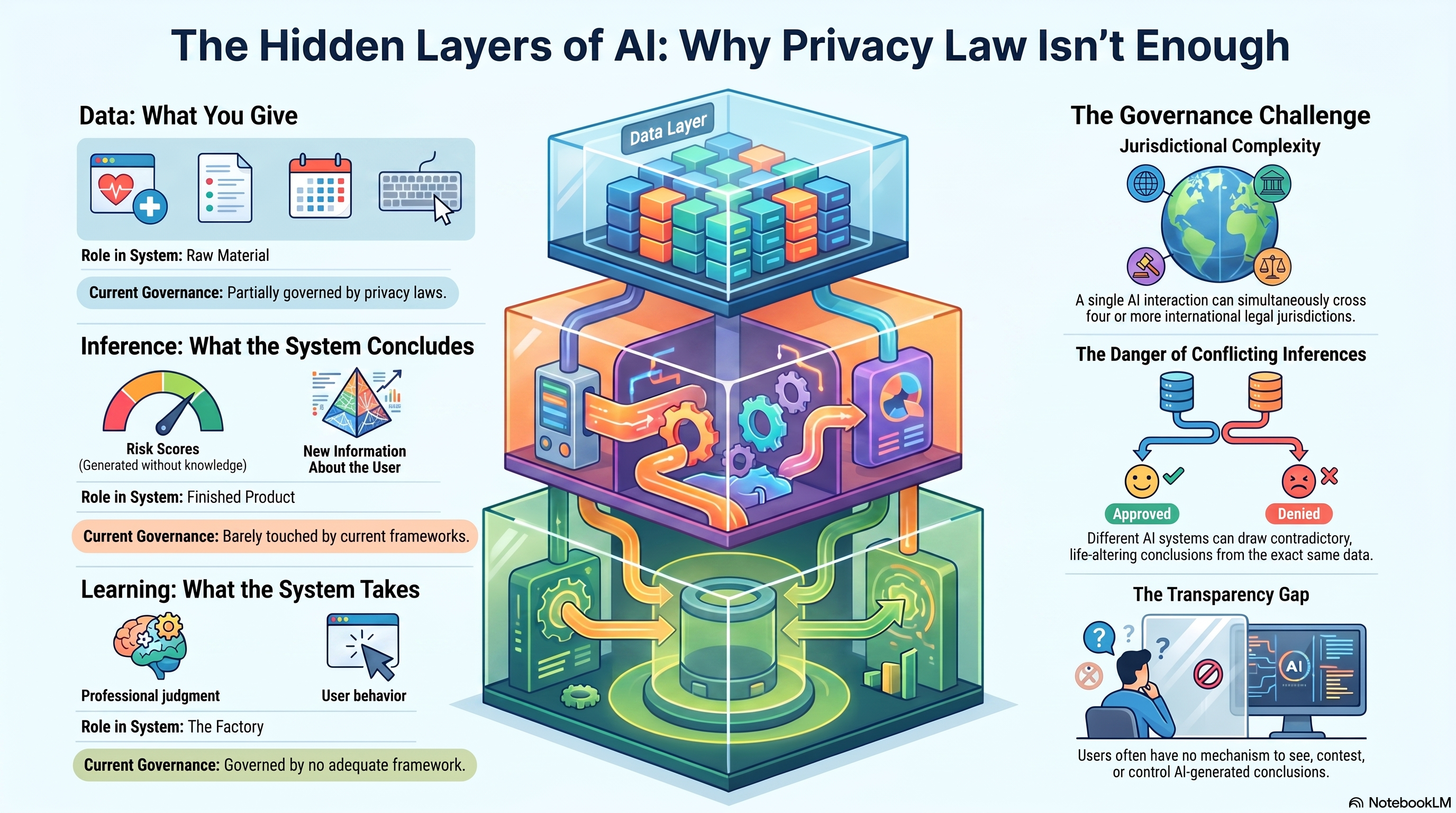
That single interaction has just crossed four jurisdictions. The patient and physician are in Saudi Arabia. The processing happened in the Netherlands. The company is incorporated in the United States. The model itself was trained on data originating in many other nations.
Most conversations about AI governance stop here. They focus on the data — where it is stored, who consented to its collection, and which jurisdiction’s privacy law applies. Those are important questions. But they are not the only questions, nor the most consequential ones.
That interaction also generated three distinct categories of value, and most people are aware of only one of them.
The first is data — the patient’s medical records, the physician’s inputs, the diagnostic query itself. This is the raw material, the facts that were provided to the system. This is what privacy laws govern.
The second is inference. The model did not merely store or transmit the patient’s data. It drew a conclusion from it — a diagnostic probability, a risk score, a treatment recommendation. That conclusion is new information about the patient. It did not exist before the model produced it, and the patient never provided it. No one asked the patient’s permission to generate it. No one informed the patient that it had been reached. No one gave the patient a mechanism to see it, contest it, or control who else receives it.
The third is learning. When the physician accepts, corrects, or overrides the model’s recommendation, her behavior teaches the system. Her clinical judgment — accumulated over years of training and practice — becomes part of the model’s future capability. Multiplied across thousands of physicians in many countries, this accumulated learning becomes one of the most valuable assets in the entire system.
Data is the raw material. Inference is the finished product. Learning is the factory itself — the capacity that grows more valuable with every use.
These three layers are related, but not the same, and the distinction between them is decisive. Almost all of the world’s digital governance addresses the first layer. The second is barely touched. The third is governed by no framework adequate to its consequences.
To feel why this distinction matters at the human level, consider what happens when it is ignored.
Anna had watched her four-year-old son, Leo, fade for six months. A mysterious illness left him perpetually exhausted, baffling a team of pediatric specialists. After countless tests yielded no answers, a doctor proposed a last resort: a new AI diagnostic platform. The system ingested Leo’s entire medical history, his genetic data, and the latest clinical research from around the world. In under an hour, it returned a result that had eluded the human experts for months — a rare, newly discovered genetic disorder — and pointed to a precision drug that could treat it.
The relief was short-lived. The treatment was astronomically expensive. When they submitted the request, their insurance provider’s own AI reviewed the case. Trained on millions of historical claims, the algorithm calculated the long-term cost-effectiveness of the treatment for such a rare condition and, in a fraction of a second, issued an automated denial.
One AI had offered her son a future. Another had just taken it away.
Two AI systems, operating on the same data, drew two different inferences. One concluded that the child could be helped. The other concluded that helping him was not cost-effective. Both inferences were drawn without Anna’s knowledge of how they were reached, without her ability to contest the reasoning, and without any governance framework that addresses conclusions drawn by AI systems rather than the data they consume.
Anna’s situation is not exceptional. It is the ordinary experience of anyone who interacts with AI systems — in healthcare, in employment, in education, in insurance, in finance. Every interaction hands over data. Every interaction generates inferences that the person cannot see. Every interaction contributes to learning that the person does not know they are providing.
The data is what you give. The inference is what the system concludes. The learning is what the system takes. The first is partially governed. The second and third are not.
That is the problem this series of articles will explore — not as a technical concern, but as the defining governance challenge of the age we are entering.
This article is drawn from Digital Sovereignty in the Cognitive Age, available at blogs.inspire-aspire.net.
Thank you for this thoughtful piece. Your distinction between data, inference, and learning gave me a new way of thinking about AI governance. It highlights that governing information alone is no longer sufficient if the conclusions drawn from it can profoundly affect people’s lives.
One thought it inspired is that governance may also need a mechanism for meaningful, real-time human participation. In your healthcare example, a family facing a life-threatening diagnosis cannot wait months or years for policy to catch up. Some decisions require timely avenues for review, contestability, and accountability because human lives continue moving while institutions deliberate.
If data is what we give, inference is what the system concludes, and learning is what the system retains, then perhaps participation is what allows society to continually shape the objectives and boundaries within which those systems operate. Governance becomes not only a matter of oversight, but of preserving the ability for people to respond as new circumstances emerge.
Thank you again for sharing your work. I appreciate how you’ve framed these issues in human terms rather than purely technical ones, and I’m looking forward to reading the rest of the series.