


Imagine you are a health minister in Senegal. You want to build a sovereign AI capability for your national health system, diagnostic tools trained on Senegalese clinical data, running on infrastructure your government controls, governed by your nation’s laws. You have the political will. You have the clinical expertise. You have a population that needs better healthcare. You begin investigating what it would take to build.
You discover very quickly that every component you need is controlled by a small number of companies in a small number of countries, and that your nation’s ability to participate in the AI economy depends entirely on supply chains you have no influence over.
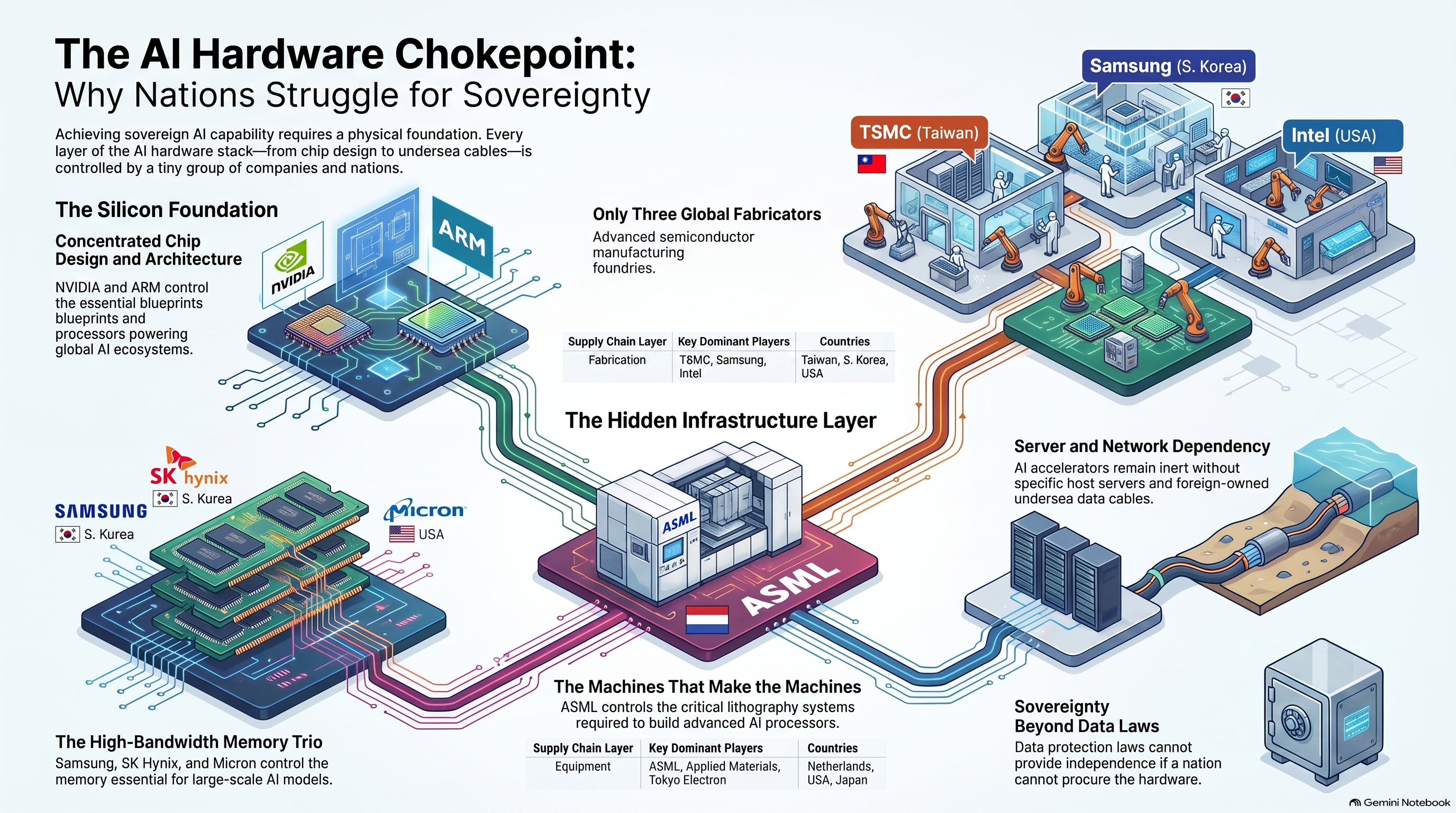
Start with the chips themselves. The processors that power AI (GPUs, TPUs, and specialized accelerators) are designed predominantly by companies in the United States. NVIDIA’s GPUs dominate AI training and inference globally. AMD, Google, and Intel design complementary chips. Beyond these, ARM, a UK company owned by SoftBank, licenses the chip architecture that powers the vast majority of mobile devices and an expanding range of edge AI and data center chips. Entire mobile AI ecosystems in many nations run on ARM-licensed designs.
This architectural dependency is harder to see than fabrication dependency, but it is equally real. When your nation’s phones, tablets, and edge devices all run on an architecture licensed by a single foreign company, the foundation of your digital economy rests on a permission that can, in theory, be withdrawn. ARM has a dual nature: it is both a broadly distributed foundation and a concentrated control point. Existing licenses provide a starting point. But the licensing authority remains in one company’s hands.
Move to fabrication. Designing a chip and manufacturing it are entirely different capabilities controlled by different players. The fabrication of the world’s most advanced chips is concentrated overwhelmingly at the Taiwan Semiconductor Manufacturing Company. Samsung operates advanced foundries in South Korea. Intel is building foundry capacity in the United States. Three companies. Three countries. Controlling the ability to turn a chip design into a physical object. A nation that designs its own chip but cannot fabricate it has intellectual property without physical capability, a blueprint without a factory.
Move to memory. AI models require massive amounts of high-bandwidth memory for training and inference. Three companies produce it: Samsung and SK Hynix in South Korea, and Micron in the United States. Three companies, two countries, controlling a component without which no AI model can operate at scale. Memory is not glamorous. It does not make headlines. But without it, the most sophisticated processor is a machine with nothing to think about.
Move to the equipment used to fabricate chips. ASML in the Netherlands produces the extreme ultraviolet lithography systems essential for the most advanced manufacturing nodes. Applied Materials in the United States produces critical deposition and etching equipment. Lam Research, KLA Corporation, and Tokyo Electron provide additional essential tools. A small number of firms, in a small number of countries, produce the machinery without which no one can fabricate advanced chips. This is the deepest layer of the dependency, not just the chips, but the machines that make the machines that make the chips.
Move to servers. The chips do not operate in isolation. They sit inside servers, predominantly Intel and AMD architectures, that provide the computing platform, memory, input/output, and management layer. Without the host server, the most advanced AI accelerator is inert. Sovereign AI capability requires not just access to accelerators but access to the entire server infrastructure on which they run.
Now add the network layer. The data traveling from the clinician’s tablet to the data center flows through undersea cables, terrestrial fiber, and satellite systems owned and operated by a mix of state-backed and private actors. Increasingly, the same technology companies that operate cloud platforms are funding and controlling the cables, a vertical integration that places connectivity and processing under a single ownership. For many nations, particularly in Africa, primary internet connectivity runs through infrastructure owned by foreign entities or routed through foreign jurisdictions. A dependency at the network level means that data, inference, and learning all transit through chokepoints that the nation does not control.
You, the health minister, look at this landscape and see a chain of dependencies (chips, fabrication, memory, equipment, servers, networks) that no amount of data governance can overcome. You can pass the most sophisticated data protection law in the world. If your nation cannot procure the chips to run sovereign AI infrastructure, the law will govern data processed elsewhere, on someone else’s terms, under someone else’s jurisdiction.
This is not a story about Senegal specifically. It is the structural reality for every nation outside the small circle of chip designers, fabricators, and equipment makers. The global AI economy runs on a hardware foundation controlled by perhaps a dozen companies in perhaps five countries. Every other nation, including most of Europe, is a consumer of that foundation, not a producer of it.
But the dependency, as the next articles in this series will show, is not as permanent as it appears. Constraint is producing innovation. Alternatives are emerging. Open-source architectures are creating paths to sovereignty that cannot be sanctioned. And the nations that consume AI infrastructure are beginning to recognize a commercial leverage they have not yet exercised.
The chips matter. Who controls them matters more. And the story of who controls them is not over; it is changing faster than most people realize.
This article is drawn from Digital Sovereignty in the Cognitive Age, available at blogs.inspire-aspire.net.