


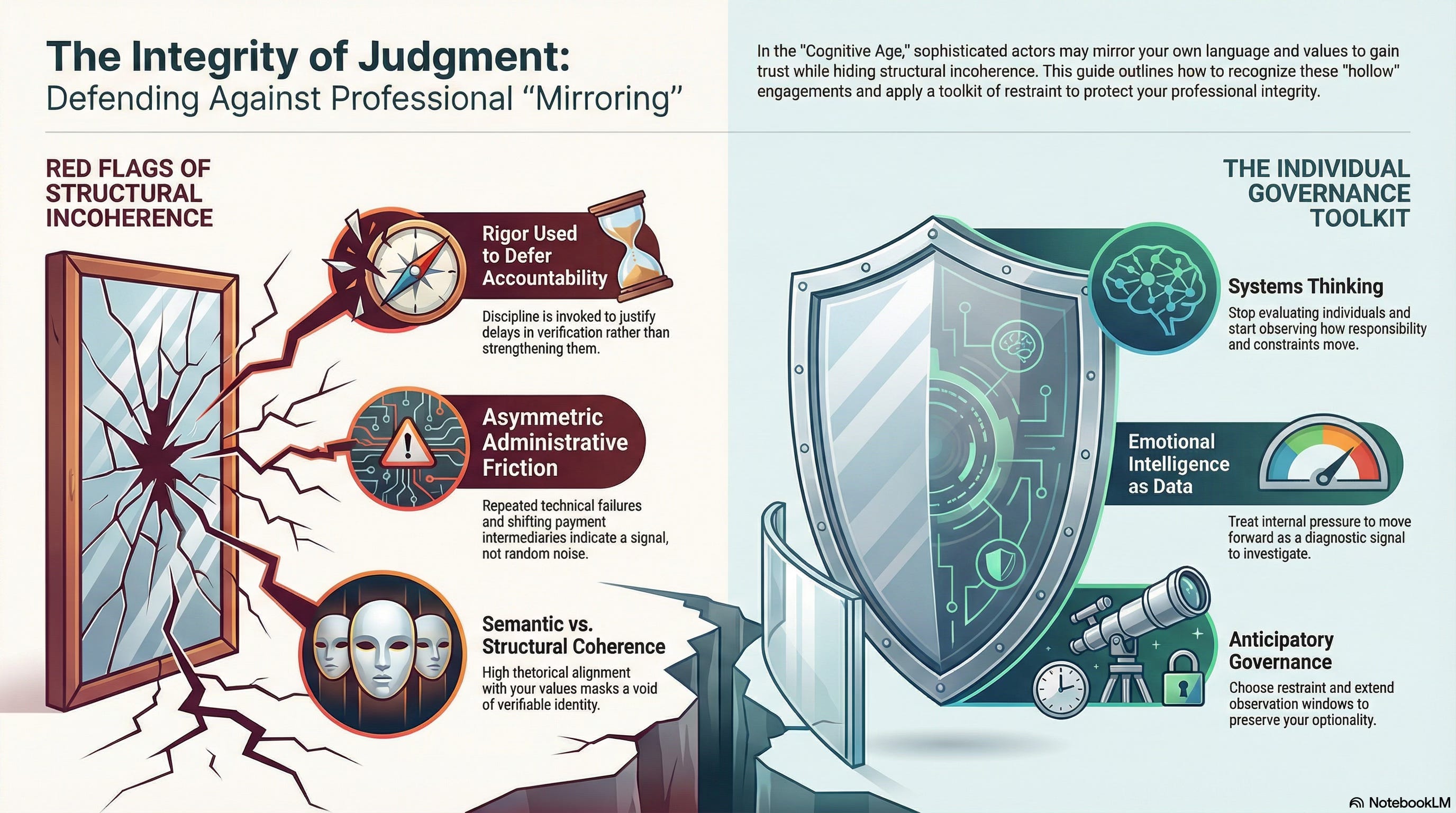
A reconstruction of how semantic coherence is used to mask structural failure, and how to use the 'The Cognitive Revolution' toolkit to protect your work.
The Cognitive Age not only tests institutions, but also tests individuals, quietly, persistently, and often under the guise of sophistication.
This is a short case study of how I nearly entered multiple professional engagements that, taken individually, appeared thoughtful, disciplined, and aligned with my work, but taken together revealed a deeper structural incoherence.
What follows is not an accusation.
It is a reconstruction.
The Context: Serious Work Attracts Serious Language
After launching The Cognitive Revolution on the Reedsy platform, I began receiving outreach from individuals who appeared to operate at a high level of conceptual fluency. Their language echoed my own concerns:
judgment over momentum
restraint over amplification
integrity over visibility
diagnosis before intervention
On the surface, this was encouraging. It suggested the work was reaching people who understood its gravity.
But that shared language also became the very terrain on which trust needed to be tested.
The First Signal: Discipline Used as a Lever
Each engagement emphasized process discipline:
phased diagnostics
non-negotiables
careful sequencing
integrity-first framing
Nothing about this was inherently wrong. In fact, it mirrored the principles in my own book.
But something subtle began to feel off.
Discipline was always invoked to justify delay in verification, never to strengthen it.
Requests for normal professional anchoring, clear identity, standard payment rails, and basic video presence were reframed as distractions from “judgment work.”
This is the first warning sign in the Cognitive Age:
When rigor is used to defer accountability rather than support it.
For those who prefer a deep-dive conversation on the psychology of 'The Narcissism of the Niche' and how these actors mirror our own dialect, listen to the audio reconstruction here.
The Second Signal: Administrative Friction That Escalates Instead of Resolves
Payment attempts revealed a consistent pattern:
Repeated platform failures
Shifting intermediaries
Personal accounts under unrelated names
Pressure to “just try one more method.”
Legitimate professionals reduce friction.
These interactions multiplied it.
Each failure was rationalized as circumstantial.
But systems don’t fail randomly in only one direction.
When friction accumulates asymmetrically, it is not noise; it is a signal.
The Third Signal: Identity Incoherence
Individually, each anomaly could be explained away:
Names that didn’t align
Accounts belonging to third parties
Refusal of video calls
Accents and environments inconsistent with the presented profiles
Collectively, they formed a pattern:
semantic coherence without structural coherence.
In the Cognitive Age, this is a critical distinction.
Language is cheap. Structure is expensive.
This video synthesis illustrates the 'Glass Box' methodology and why structure is more expensive and more honest than language.
The Method: Applying the Toolkit in Real Time
At this point, I did not confront.
I did not accuse.
I did not rush to “resolve” discomfort.
Instead, I applied the very toolkit the book argues for:
1. Systems Thinking
I stopped evaluating individuals and started observing the system:
How requests flowed
How constraints were handled
How responsibility moved
The system revealed itself as unstable.
2. Emotional Intelligence
I noticed my own internal pressure:
The desire to move forward
The discomfort of delay
The temptation to override doubt for momentum
I treated those emotions as data, not commands.
3. Strategic Foresight
I asked a simple question:
If this continues for 30 more days, does clarity increase or decrease?
The answer was unambiguous.
4. Anticipatory Governance
I chose restraint.
I extended the observation window.
I refused irreversible actions.
I preserved optionality.
This is governance at the individual level.
Pattern Recognition: The Convergence Point
The decisive moment was not a single red flag.
It was convergence.
Multiple actors, different entry points, similar patterns:
High rhetorical alignment
Low verifiable grounding
Escalating administrative opacity
At that point, judgment was no longer speculative.
It was structural.
I closed all intermediary accounts, ensured my financial exposure was zero, and disengaged—cleanly, quietly, without accusation.
The Conclusion: Judgment Is the Load-Bearing Pillar
Nothing catastrophic happened.
No money was lost.
No public conflict occurred.
That is precisely the point.
In the Cognitive Age, failure rarely announces itself dramatically.
It accumulates through small concessions made in the name of progress.
This experience reaffirmed a central thesis of The Cognitive Revolution:
The most dangerous failures are not technological.
They are judgment failures under acceleration.
This resembled the “Hollow Middle” manifesting as a service, a façade of professional intuition that, when pressed, revealed a void where accountability and identity should have been. It serves as a reminder that in an age of synthetic signals, the most sophisticated deception is one that looks exactly like the solution.
What mattered most was not detecting deception, but recognizing when judgment itself was being tested.
Lessons for Others Navigating Similar Terrain
If you are doing serious work in a noisy system, expect:
Your language to be mirrored
Your principles to be referenced
Your discipline to be tested
Use this checklist:
Does structure match language?
Does friction decrease over time?
Is identity stable across contexts?
Does restraint strengthen clarity—or only delay it?
If you cannot answer these confidently, pause.
Pausing is not a weakness.
It is governance.
Final Thought
The Cognitive Age will not punish those who move slowly.
It will punish those who outsource judgment because speed feels safer than uncertainty.
This time, judgment held.
And that, in itself, is proof that the framework works.
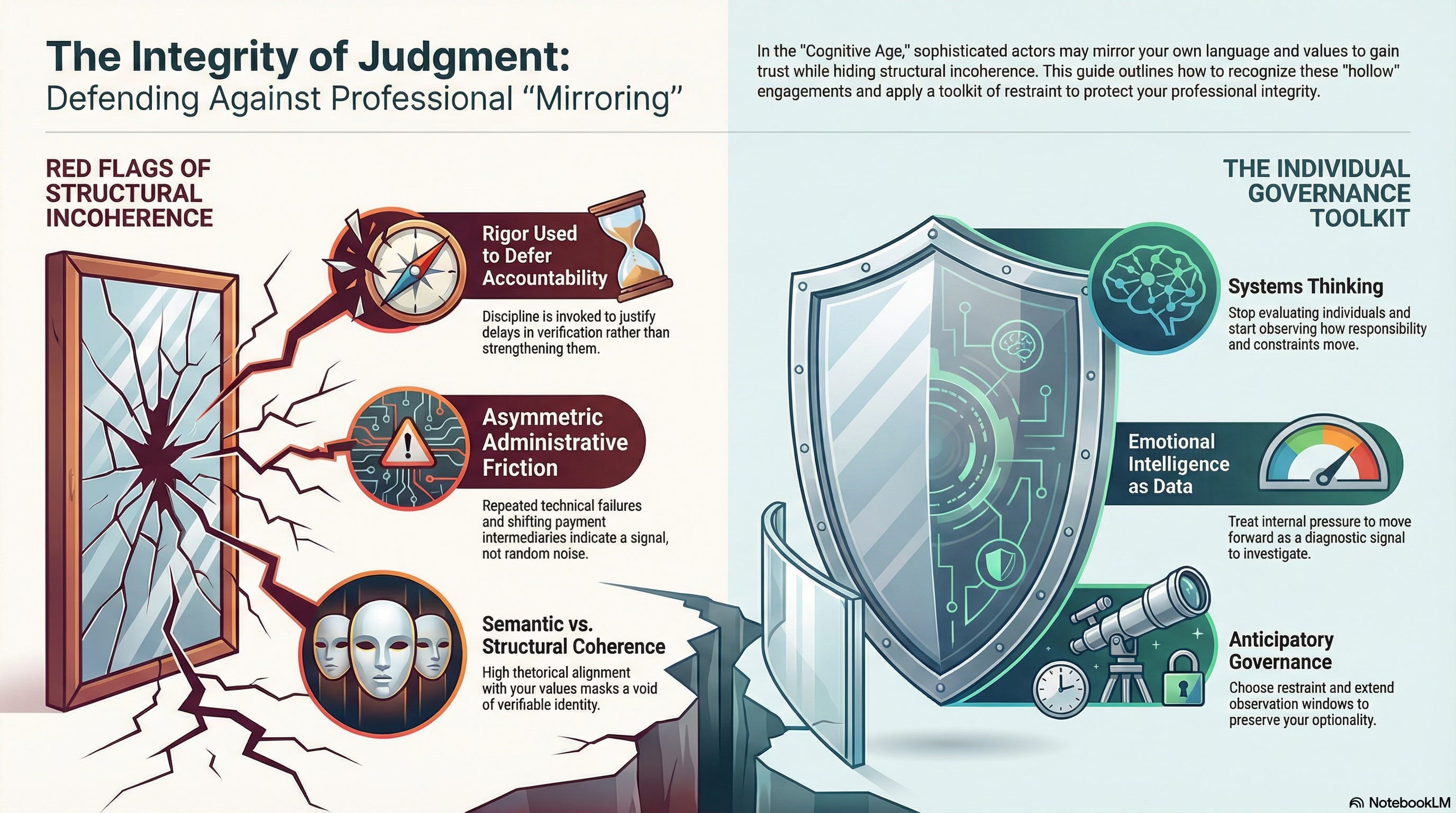
The Anticipatory Governance Checklist. Save this for when the velocity of your next engagement outruns your manual.