


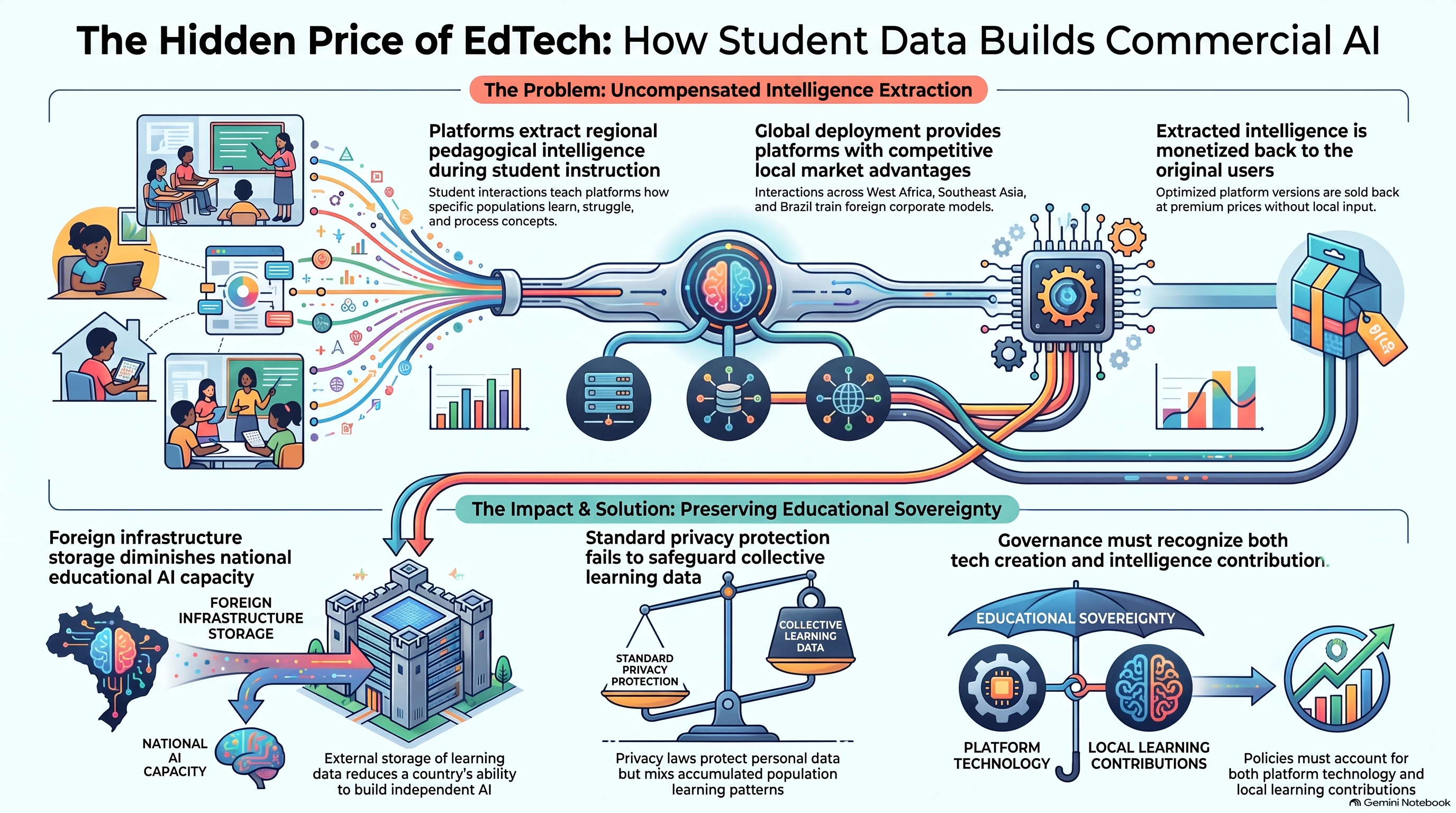
Consider a mathematics platform deployed across Francophone West Africa. Schools in Senegal, Côte d’Ivoire, Burkina Faso, and Niger adopt it because they face a crisis that no curriculum reform can solve quickly enough: they lack trained math teachers. The platform delivers instruction immediately, in French, at a level adapted to each student’s performance. For a school that would otherwise have no math teacher at all, the benefit is immediate and genuine.
But the platform is doing something else at the same time.
Every student interaction generates learning for the platform. Where students stumble reveals which concepts are hardest to teach. Which explanations work in French reveals how language shapes mathematical reasoning. How cultural context influences problem-solving reveals something about pedagogy that no research study conducted in Boston or Berlin could replicate. The students are not just receiving instruction. They are providing it, teaching the platform how mathematics is learned in Francophone West Africa.
The platform captures all of this. It flows to the company’s servers. It is aggregated, analyzed, and incorporated into the model’s future capability. The next version of the platform will teach West African students better because West African students taught it.
Now imagine that the platform releases an “Africa-optimized” version at a premium price. The intelligence inside it (the understanding of how Francophone African students learn mathematics, where they struggle, what works) was generated by the students it is now being sold to. The students were the training data. Their schools are now the customers. The value they generated is being sold back to them at a price they did not set and had no role in determining.
This pattern is not unique to mathematics or to West Africa. It operates wherever educational technology is deployed in contexts where the local alternative is insufficient.
A language learning platform deployed across Southeast Asia learns how Thai speakers acquire English grammar, the specific errors they make, the constructions that transfer from Thai, and the cultural references that aid retention. That understanding becomes the platform’s competitive advantage in the Thai market. The Thai students generated the advantage. They have no claim on it.
An adaptive reading platform used in Brazilian public schools learns how Portuguese-speaking children develop literacy, phonetic patterns, vocabulary gaps, and reading speeds across different ages and socioeconomic levels. That learning makes the platform more effective for Brazilian students. It also makes the platform more valuable as a product, sellable to other Portuguese-speaking markets, by incorporating intelligence generated by Brazilian children through the simple act of learning to read.
In each case, the structure is the same. The platform provides a visible service: instruction. The students provide an invisible service: teaching the platform how their population learns. The first service is paid for. The second is neither recognized, measured, nor compensated.
There is a deeper dimension here that connects to how nations develop. Every country’s educational system produces more than graduates; it accumulates an understanding of how its population learns. Which pedagogical approaches work in this culture. Which concepts are hardest to teach in this language. How socioeconomic background shapes learning trajectories. How rural and urban students differ in their acquisition of specific skills. This accumulated pedagogical intelligence is, in a real sense, a national asset, built over decades of teaching, research, and institutional experience.
When an AI educational platform captures that intelligence through student interactions, it transfers the nation’s accumulated pedagogical knowledge to the platform. The platform’s model becomes more capable. The nation’s capacity to build educational AI correspondingly diminishes because it stores intelligence about its population on another country’s infrastructure, improving a product the nation does not control.
If the platform changes its pricing, discontinues service in the region, or shifts its market strategy, the nation has no alternative that incorporates the pedagogical understanding its students generated. The intelligence went in. It is not coming back.
The educational implications extend beyond economics. When a nation’s entire understanding of how its children learn is held by a foreign platform, the nation’s educational sovereignty is compromised in a way that data governance alone cannot address. Data protection can govern the student’s personal information. It does not govern the pedagogical intelligence derived from millions of students’ interactions.
This is not a rejection of educational technology. The platforms provide real value, and in contexts of severe teacher shortages, they may be the only viable option in the short term. But the learning extraction must be acknowledged, measured, and governed. The students who teach the platform deserve to know they are teaching it. The nations whose pedagogical intelligence is being captured deserve a framework that distinguishes between the service the platform provides and the learning the population contributes.
The platform invented the technology. The students contributed the intelligence that makes it work in their context. Both contributions are real. Governance that recognizes only the first while ignoring the second is not governance. It is extraction by another name.
This article is drawn from Digital Sovereignty in the Cognitive Age, available at blogs.inspire-aspire.net.