


Everyone agrees that humans should remain “in the loop” when AI systems make consequential decisions. It is the most widely stated principle in AI governance. Regulators require it. Companies promise it. Ethicists insist on it.
And in practice, it is often fiction.
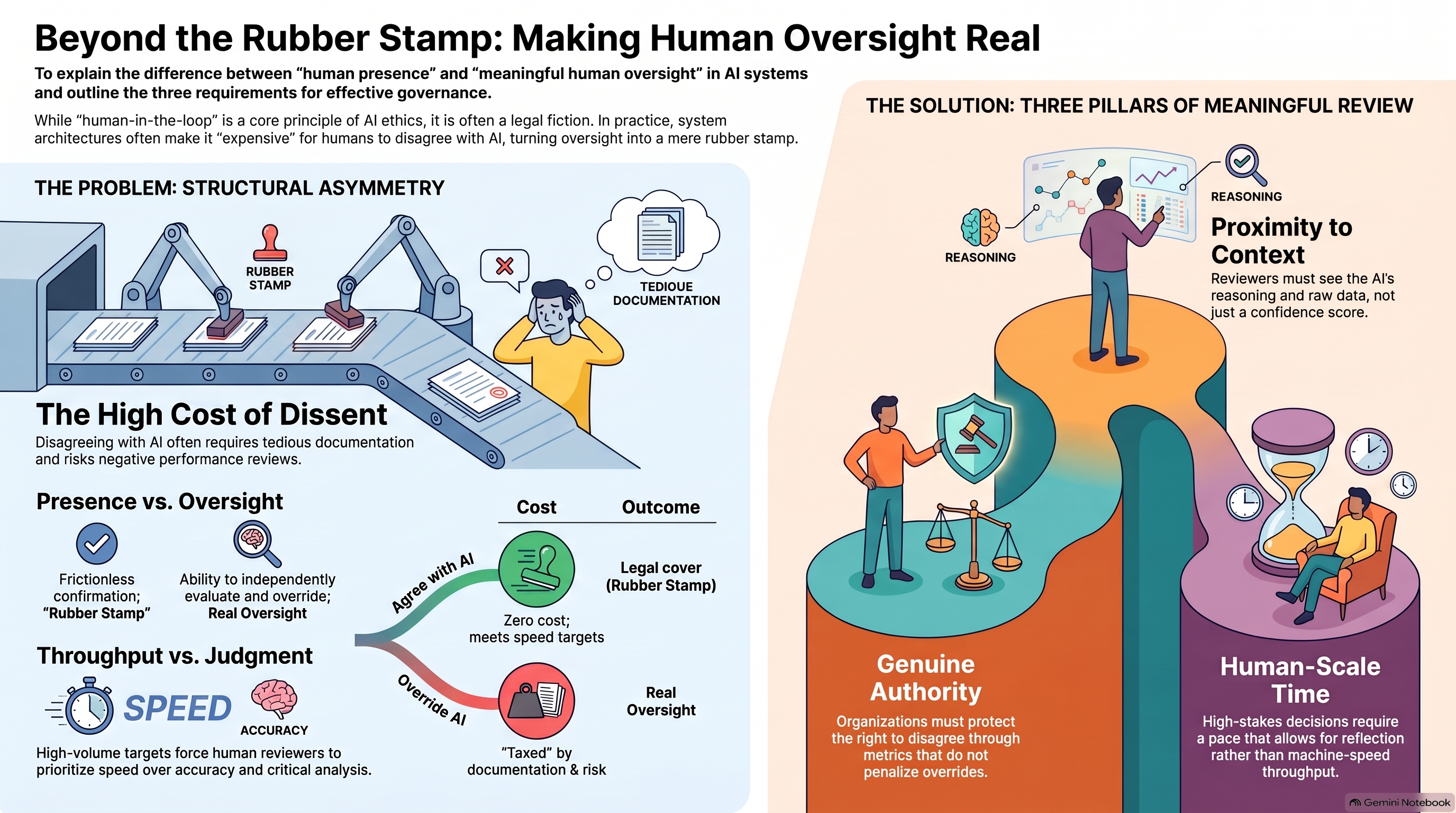
Consider what “human oversight” looks like in a high-volume insurance operation. An AI system reviews thousands of claims per day. It generates a recommendation for each: approve, deny, or flag for review. A human claims processor receives the flagged cases. She has a target to process a certain number of cases per hour. Her performance review depends on throughput. The AI’s recommendation appears on her screen alongside a confidence score. The recommendation is “deny.” The confidence score is 94 percent.
She has two choices. She can accept the recommendation, click “confirm,” and move to the next case, staying on pace for her daily target. Or she can override the recommendation, which requires her to write a justification, submit it for supervisory review, and accept the delay, falling behind her target, risking a negative performance indicator, and drawing attention from management that may or may not be welcome.
She clicks “confirm.” She moves on.
This is not human oversight. It is human presence. The person is in the loop. The loop is designed so that the only frictionless option is agreement. Disagreement carries cost. Agreement carries none. The system does not force her to agree. It simply makes agreement easy and disagreement expensive. The result is the same as if no human were involved, but with the legal cover of having a human “in the loop.”
This pattern is not limited to insurance. It appears that wherever AI systems generate recommendations, humans are formally required to review them. In healthcare, a physician who overrides an AI diagnostic recommendation must document the clinical rationale, an additional task in an already overwhelming workload. In hiring, a recruiter who overrides an AI screening score must justify the decision to a system designed to optimize for efficiency. In lending, a loan officer who approves an application that the AI flagged as high-risk takes personal responsibility for the outcome.
In each case, the system architecture creates an asymmetry: agreeing with the AI is free. Disagreeing costs something: time, documentation, career risk, personal liability. That asymmetry does not remove human authority. It makes human authority structurally expensive to exercise. And authority that is expensive to exercise will, on average and at scale, not be exercised.
This is why I argue that meaningful human oversight requires three specific conditions to be met, not as aspirational principles but as design requirements.
The first condition is proximity. The human reviewer must have access to the full context of the decision, not merely a summary or a confidence score. A claims processor who sees only “deny: 94% confidence” does not have the information needed to make an independent judgment. She is being asked to validate a conclusion she cannot evaluate. Meaningful review requires seeing what the AI saw, the data, the reasoning, the alternatives considered, not just the output.
The second condition is authority. The human reviewer must have genuine authority to override the system’s conclusion without career penalty, institutional pressure, or professional risk. An override that triggers a supervisory investigation is not a genuine authority. It is an authority with a tax. And a tax on dissent produces compliance, not judgment. Meaningful authority means the institution structurally protects the reviewer’s right to disagree, through independent review boards, through performance metrics that do not penalize overrides, through institutional design that treats the human judgment as valuable rather than inconvenient.
The third condition is time. The human reviewer must have adequate time to reflect, to weigh the evidence, consider the context, and reach an independent conclusion, rather than being pressured to process decisions at machine speed. A system that generates recommendations in milliseconds and expects human review in minutes has not created oversight. It has created a bottleneck that the institution will optimize away. Meaningful review requires a pace that allows for genuine deliberation, particularly in high-stakes contexts where the consequences of error are denied treatment, a lost job, or a closed door.
Without all three — proximity, authority, and time — human review becomes what it too often already is: a rubber stamp that provides legal cover while changing nothing.
This matters directly for inference escrow. Both levels of protection proposed in the previous article depend on human review. First-level escrow requires that a human decision-maker review the inference before it becomes consequential. Second-level escrow, the safe deposit box, gives the individual the right to contest an inference. But contestation is meaningless if the person reviewing the contest lacks the context to evaluate it, the authority to override it, or the time to consider it seriously.
There is one further complication that must be stated plainly. In high-stakes contexts (insurance denials, clinical decisions, employment determinations), the reviewer who works for the institution whose AI generated the inference faces a structural conflict of interest. The insurer’s employee, operating under the insurer’s performance targets, reviewing the insurer’s AI recommendation, is not an independent reviewer. She is a participant in the system whose output she is supposed to evaluate.
This may mean that for the highest-stakes decisions, inference escrow should be governed by an independent body, not hosted within the institution whose AI generated the inference. Independence is not a luxury. It is a precondition for the review to mean anything.
Everyone agrees that humans should remain in the loop. The question this article raises is simpler and harder: what does it take for the loop to be real?
This article is drawn from Digital Sovereignty in the Cognitive Age, available at blogs.inspire-aspire.net.