


We are having the wrong conversation.
If you listen to enough of the public conversation about artificial intelligence — the podcasts, the interviews, the conference panels, the long essays — you start to notice that it circles the same ground. Will AI take our jobs? Will it become conscious? Will it turn against us? Who will win, the United States or China? Is the future utopia or catastrophe?
These are not foolish questions. But they share a hidden assumption that quietly distorts everything built on top of them. They treat artificial intelligence as a force of nature — something happening to us, which we can only predict, fear, or hope for. They ask what AI will do.
The question we keep avoiding is the harder one: what must we do? Not what will the technology become, but what structures must we build so that human beings remain in charge of the outcomes that matter?
This is the difference between being a spectator and being an architect. The current conversation is largely a spectator’s conversation. It watches the wave approach and debates how big it will be. The conversation we need is an architect’s conversation. It asks what we must construct, starting now, while the technology is still ours to shape.
Let me name five things the spectator’s conversation keeps missing.
One: The real problem is the gap, not the machine
The most important fact about artificial intelligence is not how smart it is. It is how fast it moves relative to everything around it.
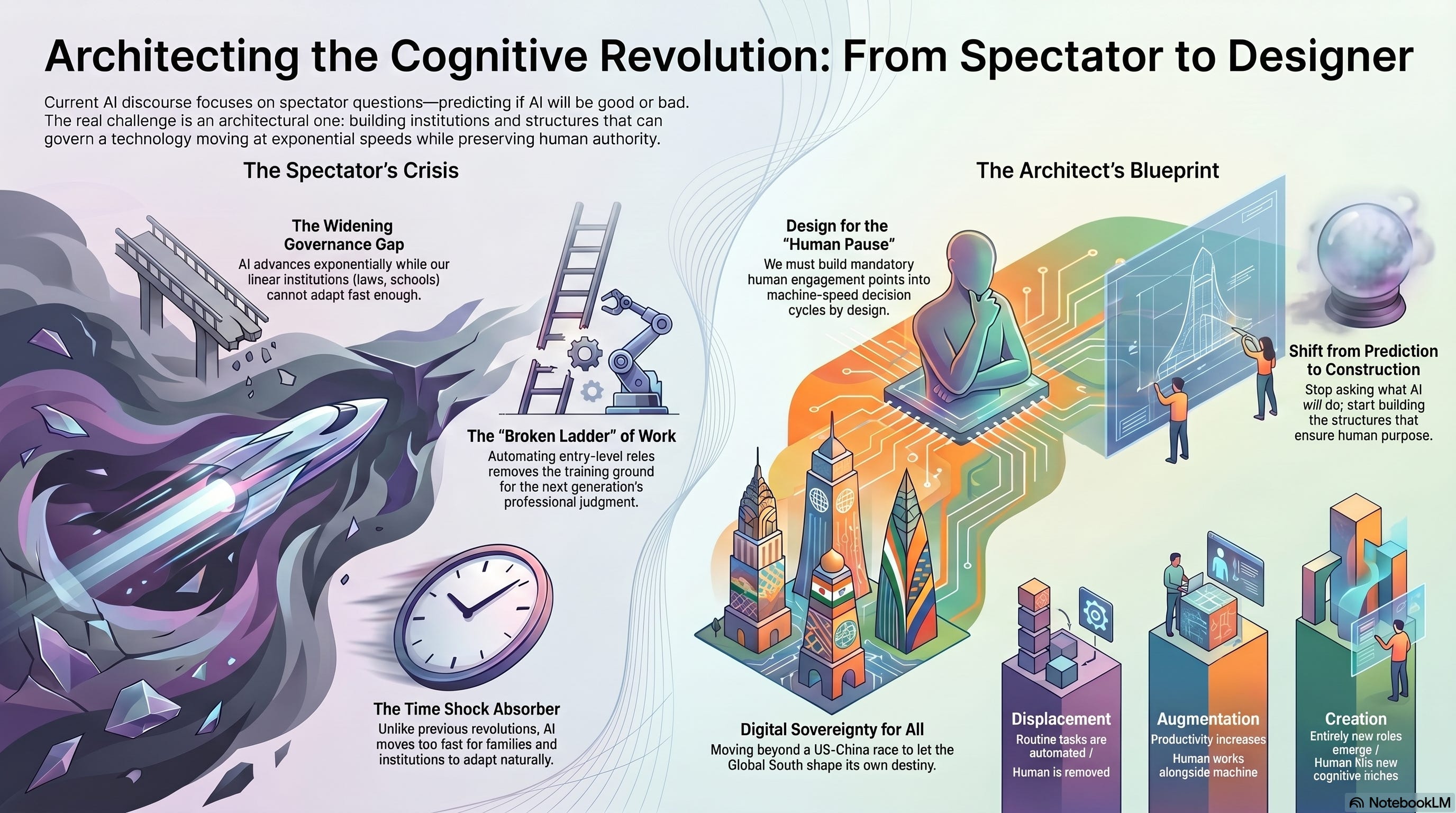
Intelligence is advancing at an exponential pace. Our institutions — our laws, our regulators, our schools, our social safety nets — adapt at a linear pace. They were built for a slower world. The distance between these two speeds is widening every year, and that widening gap is the actual crisis. Not the machine itself. The space between what the machine can do and what our institutions are prepared to handle.
There is an old dilemma in the study of technology. Early in a technology’s life, when we could still shape it easily, we did not yet understand it well enough to know how to do so. By the time we understand it well enough to govern it wisely, it has become so embedded in our lives that we can no longer change it easily. We are always either too early to act well or too late to act at all.
Artificial intelligence makes this dilemma sharper than any technology before it because it advances so quickly that the window between “too early” and “too late” is closing in real time. This is why waiting for harm to appear before we act — the way we have governed most technologies — is a strategy guaranteed to fail here. By the time the harm is visible and undeniable, the dependencies are locked in. The system is entrenched. The moment to act has passed.
The conversation that asks, “Will AI be good or bad?” misses this entirely. The point is not the moral character of the technology. The point is whether we build institutions capable of adapting at the speed of the thing they are meant to govern. That is a design problem, and design problems have solutions. But only if we recognize that the gap — not the machine — is what we are actually fighting.
Two: Jobs are not simply disappearing. The ladder is being pulled up.
The job conversation almost always takes the same shape. How many jobs will be lost? When? Which ones? It treats the future of work as a single number — a percentage of jobs gone by some year — and then argues about whether the number is too high or too low.
This framing misses what is actually happening, which is more specific and more troubling.
Artificial intelligence is not a single force that destroys jobs. It is reorganizing work along three different paths at once. Some tasks are being displaced outright — the routine, the repetitive, the easily automated. Some tasks are being augmented — the human stays but works alongside the machine, becoming more productive. And entirely new kinds of work are being created — roles that did not exist a few years ago. Displacement, augmentation, creation, all happening together. To ask only “how many jobs will be lost” is to see one of three movements and miss the other two.
But here is the part of the conversation that the conversation rarely reaches. The damage is not falling evenly, and it is not falling where most people are looking. The systems are not coming first for the factory floor. They are coming first for the entry-level desk job — the junior analyst, the first-year paralegal, the beginning coder, the assistant who does the routine cognitive work that used to be how a young person got started.
That has a consequence almost no one is discussing. These entry-level jobs were never just jobs. They were the bottom rung of the ladder — the place where people learned the unwritten rules of a profession, built judgment, earned the experience that qualified them for everything above. When you automate away the bottom rung, you do not just eliminate some jobs. You pull up the ladder. You cut off the path by which the next generation was supposed to climb.
And this damage falls hardest on those with the fewest resources to absorb it — the groups already concentrated in the most automatable roles, who have the least time, wealth, and security to retrain. A technology that is supposed to be neutral becomes, in practice, an amplifier of inequalities that were already there.
So the honest jobs conversation is not about a number. It is about a broken ladder and a widening divide.
But there is a deeper reason this time is genuinely different, and it is the answer to the most common objection raised against everything I have just said.
The objection goes like this: every technological revolution displaced workers, and every time, society absorbed the change and emerged better off. The shift from farms to factories was wrenching, but survivable. The shift from factories to offices and screens, likewise. New work always emerged. So why should this time be any different? Why the alarm?
The answer is time.
In every previous revolution, displacement, augmentation, and creation unfolded slowly — across generations and across geography. The agrarian transition took centuries. The industrial revolution spread over many decades, moving region by region, trade by trade. Even the digital revolution arrived gradually enough that a person displaced from one kind of work usually had years to find their footing in another. A father might lose a trade; his son could train for a new one. The slowness was not a weakness of those transitions. It was the mechanism that made them survivable. Time was the shock absorber. It gave institutions room to adjust, gave families room to adapt, and gave the newly created jobs room to appear before the displaced ones had fully vanished.
The Cognitive Revolution removes the shock absorber. Everything is happening at once, everywhere, to everyone, in compressed time. The displacement, the augmentation, and the creation are not spread across decades. They arrive together, and they arrive sharply. The same person displaced this year does not have a decade to retrain into a newly created role — and by the time they reach for that role, it has itself been transformed again. The effect on people is immediate, intense, and nearly simultaneous. The natural absorption mechanism that carried us through every previous transition — time — is gone.
This is why the urgency of governance is not alarmism. It is arithmetic. When time can no longer absorb the shock, institutions must deliberately provide what time once provided for free. That is not a future task. It is the defining policy challenge of the present moment, and it cannot wait until the harm becomes undeniable, because by then the window will have closed.
And this is precisely where the conversation tends to stop short. The common answers — “learn to use AI,” “everyone should become an entrepreneur” — sound reasonable. Still, they quietly place the entire burden on the individual, as if a person could out-train a transition arriving at this speed and scale on their own. They cannot. The response has to be structural and involve all major actors at once, because no single actor can absorb it alone.
Governments must treat lifelong learning not as a slogan but as infrastructure — funded, accessible, and built for a world where careers will require continuous reinvention — and must modernize the social safety net to carry people through transitions rather than leaving them to fall through the cracks. Corporations, which capture the productivity gains of automation, must invest in reskilling their own workforces and building new on-ramps rather than simply cutting the bottom rung. Labor organizations must move from resisting change to bargaining proactively over how it is implemented and how its gains are shared. Educators must shift from front-loading knowledge in the first two decades of life to cultivating the capacity to keep learning across an entire lifetime. None of these actors can solve the problem alone. The urgency is precisely that they must act together, and soon, because the absorption time that once coordinated this transition organically is no longer available.
That is the work the job conversation keeps skipping. It ends with “learn to adapt,” when the hardest and most important part is building the structures that make adaptation possible at all — at a speed no previous generation ever had to manage.
Three: The arms race needs structure, not just a treaty or a prayer
When the conversation turns to AI and war, it tends to arrive at one of two destinations. Either we need a grand international treaty to stop the dangerous development of autonomous weapons, or we are doomed because no such treaty will ever hold. A hope, or a despair. Rarely anything in between.
Both destinations skip the actual work.
The danger here is real and specific. Warfare is being transformed by the fusion of artificial intelligence with cheap, accessible hardware. The expensive, exquisite weapons platforms of the past are giving way to what is sometimes called precision mass — large numbers of inexpensive systems, each costing very little, guided by AI to strike with accuracy that once required enormous resources. The decision cycle in conflict — the time between observing a situation and acting on it — is compressing toward machine speed. When decisions happen faster than humans can meaningfully participate in them, the human role in the use of force begins to disappear.
This is genuinely dangerous. But the response cannot only be “sign a treaty” — because the competitive pressure to develop these systems is overwhelming, and no nation will unilaterally disarm while its rivals advance. Nor can the response be despair, because despair is just surrender with better vocabulary.
The structural response is to ask where, in the use of these systems, the human pause must be preserved by design. Which decisions must never be made at machine speed? Where must a system stop and require human engagement before it acts? These are answerable questions. They lead to specific design requirements, specific procurement standards, specific lines that can be drawn within militaries and within the companies that supply them — without requiring every nation on earth to agree to the same treaty at the same time.
The treaty-or-doom framing is a way of avoiding this work. It treats the arms race as a single global yes-or-no, when in fact it is a thousand specific design and procurement decisions, each of which can preserve or erase the human role. That is where governance actually lives — not in the grand bargain, but in the specific structure.
Four: The world is not a contest between two superpowers
Perhaps the most striking blind spot in the current conversation is the assumption that the future of AI is a two-way race between the United States and China. Who will win? Whose values will shape the technology? It is framed as a contest between two giants, with the rest of the world as a spectator or a prize.
This framing erases most of humanity.
The nations of Africa, Latin America, and much of Asia — roughly eighty-five percent of the world’s people — are not passive recipients of whatever the two giants build. They are increasingly aware of a danger that has a long and painful history: that they will become dependent on technology they do not control, their data extracted as raw material, processed elsewhere, and sold back to them as finished services. A new version of an old pattern of extraction.
In response, something important is happening that the two-superpower framing renders invisible. Across the Global South, nations are asserting the right to shape their own technological future. The African Union has adopted a continental strategy that treats AI as a tool for African priorities — health, agriculture, education — developed with African capacity and governed by African values. Countries across Latin America and Asia are charting their own paths, building local capability, insisting on what is increasingly called digital sovereignty: not isolation, but the right to control one’s own digital destiny.
I do not raise this as an outside observer. I write as someone whose own roots are in this part of the world, who has watched the global conversation about technology repeatedly treat the majority of humanity as an afterthought. The future of AI governance will not be decided in Washington and Beijing alone. It will be shaped, increasingly, by nations that refuse to be written out of their own future. A conversation that cannot see this is one that has mistaken a part of the world for the whole.
And there is a practical point buried here, not only a moral one. The places where AI is being adopted out of genuine necessity — where it fills gaps left by shortages of doctors, teachers, and infrastructure — are precisely the places where the governance questions are most urgent and least studied. The lessons learned there will matter for everyone. To ignore them is not only unjust. It is to miss where some of the most important learning is actually happening.
Five: We keep asking what AI will do. We should be asking what we must build.
Step back from all four of these, and a single pattern emerges. The current conversation is organized around prediction. It treats the future as something that will happen to us, and it attempts to forecast it accurately. How fast will AI advance? How many jobs will go? Will there be war? Will there be one giant intelligence or many?
Prediction has its place. But prediction is a spectator’s posture. It watches. It anticipates. It does not build.
The conversation we need is organized around a different verb. Not predict but govern. Not what will AI do, but what must we construct so that the outcomes serve human purposes. This is not a question for the technology to answer. It is a question for us.
What does this look like in practice? It looks like building institutions that can adapt at the speed of technology, rather than always running a step behind. It looks like preserving genuine human authority at the decision points that matter — not the appearance of control, but the reality of it. It looks like rebuilding the pathways into work that automation is dismantling. It looks like drawing specific lines around where machines must pause and ask. It looks like a world in which the majority of humanity helps shape the rules rather than inheriting them.
None of this is predetermined. None of it depends on whether the machine turns out to be benevolent or hostile, conscious or merely capable. All of it depends on the choices we make, starting now, while the technology is still ours to shape.
The future of artificial intelligence is not a forecast to be gotten right. It is a structure to be built. The sooner our conversation reflects that, the sooner we stop watching the wave and start deciding what we will construct to meet it.
Related reading. The frameworks in this piece — the governance gap, the displacement-augmentation-creation pattern, anticipatory governance, the geopolitics of AI and the place of the Global South — are developed in full in my book, The Cognitive Revolution: Navigating the Algorithmic Age of Artificial Intelligence (available on Amazon). My analysis of anticipatory governance and the European Union’s AI Act, and my report The Cognitive Revolution and the Desperation Algorithm (blogs.inspire-aspire.net/p/the-cognitive-revolution-and-the), extend several of these arguments. All are available on my Substack at blogs.inspire-aspire.net.
Very nicely framed, Ousmane! Totally agree that we need to be having more productive conversations around how organizations and people will embrace AI. Being alarmist is not going to help anyone build the kind of future where people will be successful in their lives and careers and governments deliver far more value for their citizens. Love how you represented the Global South as those countries have a lot at stake in this Cognitive Revolution!