


Consider a multinational company that deploys an AI coding assistant across its engineering teams in India, Poland, and Brazil. The tool is genuinely useful. It generates code suggestions, auto-completes functions, catches errors, and accelerates routine programming tasks. Productivity increases. Deadlines are met more easily. The engineers appreciate the tool.
What they may not appreciate, because no one has told them, is that every interaction with the tool teaches it.
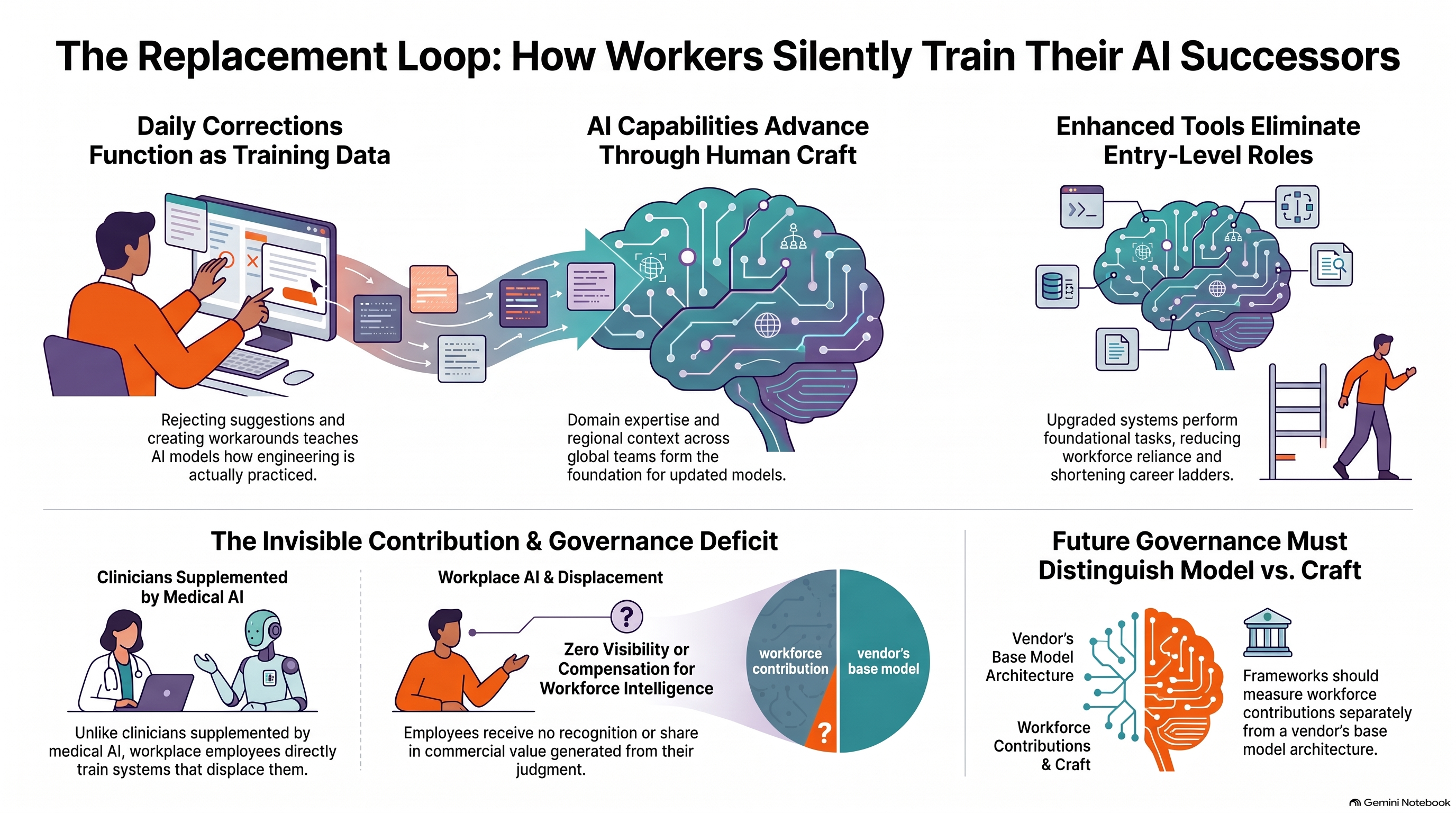
When an engineer accepts a code suggestion, the acceptance validates the approach. When she rejects a suggestion and writes her own solution, the rejection and the replacement teach the model what it got wrong and what the correct approach looks like. When she develops a workaround for an edge case the model did not anticipate, the workaround becomes part of the model’s expanding knowledge of how software engineering is actually practiced.
These are not trivial contributions. They carry the weight of professional craft, years of training, domain expertise, knowledge of specific codebases and organizational practices. The corrections and workarounds generated by engineers in India reflect how software engineering is practiced in Indian IT contexts. The edge-case solutions from Polish engineers reflect European engineering conventions. The workarounds from Brazilian teams reflect the specific challenges of developing software for Brazilian markets and infrastructure.
That workforce intelligence, the accumulated understanding of how software engineering is practiced across different populations, contexts, and technical environments, becomes the foundation for the next version of the tool. The next version will generate code better. It will be better, specifically because these engineers taught it.
And the next version will be sold back to the same teams at a higher subscription price.
The engineers’ professional craft was the training data. They have no claim on it. They have no visibility into what was learned from their corrections. They have no mechanism to see how their contributions shaped the model’s capabilities. And they have no share in the commercial value generated from the intelligence they provided.
The workforce dimension adds a layer that healthcare and education do not. In healthcare, the clinician teaches the AI, but the clinician remains essential to patient care; the AI supplements, rather than replaces, the physician, at least for now. In education, the student teaches the platform but also benefits from the instruction.
In the workplace, the worker teaches the AI and may thereby be training the system that replaces them. The coding assistant that learns from a thousand engineers’ corrections becomes capable enough that fewer engineers are needed. The customer service AI that learns from a thousand agents’ interventions becomes capable enough that the call center shrinks. The legal research tool that learns from a thousand associates’ annotations becomes capable enough that junior hiring slows.
The worker contributes professional judgment. That judgment makes the system more capable. The more capable system reduces the need for the worker’s judgment. The worker trained their replacement and was charged a subscription fee for the privilege.
This is not a dystopian projection. It is the business model. AI companies explicitly describe their tools as productivity enhancers that allow companies to do more with fewer people. Productivity comes from the learning the workers provide. The “fewer people” are the workers who provide it.
Think about what this means for a junior software engineer starting her career. She has used the coding assistant from her first day. She corrects its suggestions, adds context it lacks, and develops solutions to problems it cannot anticipate. Over two years, her corrections and workarounds, along with those of thousands of engineers like her, are incorporated into the next version of the tool. The new version is substantially more capable. It handles many of the tasks she was hired to do. Her employer needs fewer junior engineers. Her career ladder has been shortened by a tool she helped build.
She experienced herself as a productive employee using a useful tool. She also contributed unpaid to the system that made her role less necessary. No one informed her of this dual role. She has no mechanism to see the contribution she made. No framework governs whether or how she should share in the value generated from her professional craft.
The World Economic Forum’s June 2026 report on entry-level work documents this dynamic from the employer’s perspective: entry-level roles are disappearing as AI handles foundational tasks. What the WEF report does not examine is where the AI’s capability to handle those tasks came from. It came from the workers who previously performed them: from their corrections, their workarounds, their professional judgment, and their contributions, interaction by interaction, captured by the platform and converted into the capability that now makes their roles redundant.
The worker does not need to be compensated for every correction. But the contribution should be visible. The extraction should be measured. And the governance framework should distinguish between the company’s invention, the model architecture, and the workforce’s contribution, the professional intelligence that makes the model valuable. Both are real. Governance that recognizes only the first is not governance. It is a system that profits from the people it displaces.
This article is drawn from Digital Sovereignty in the Cognitive Age, available at blogs.inspire-aspire.net.