


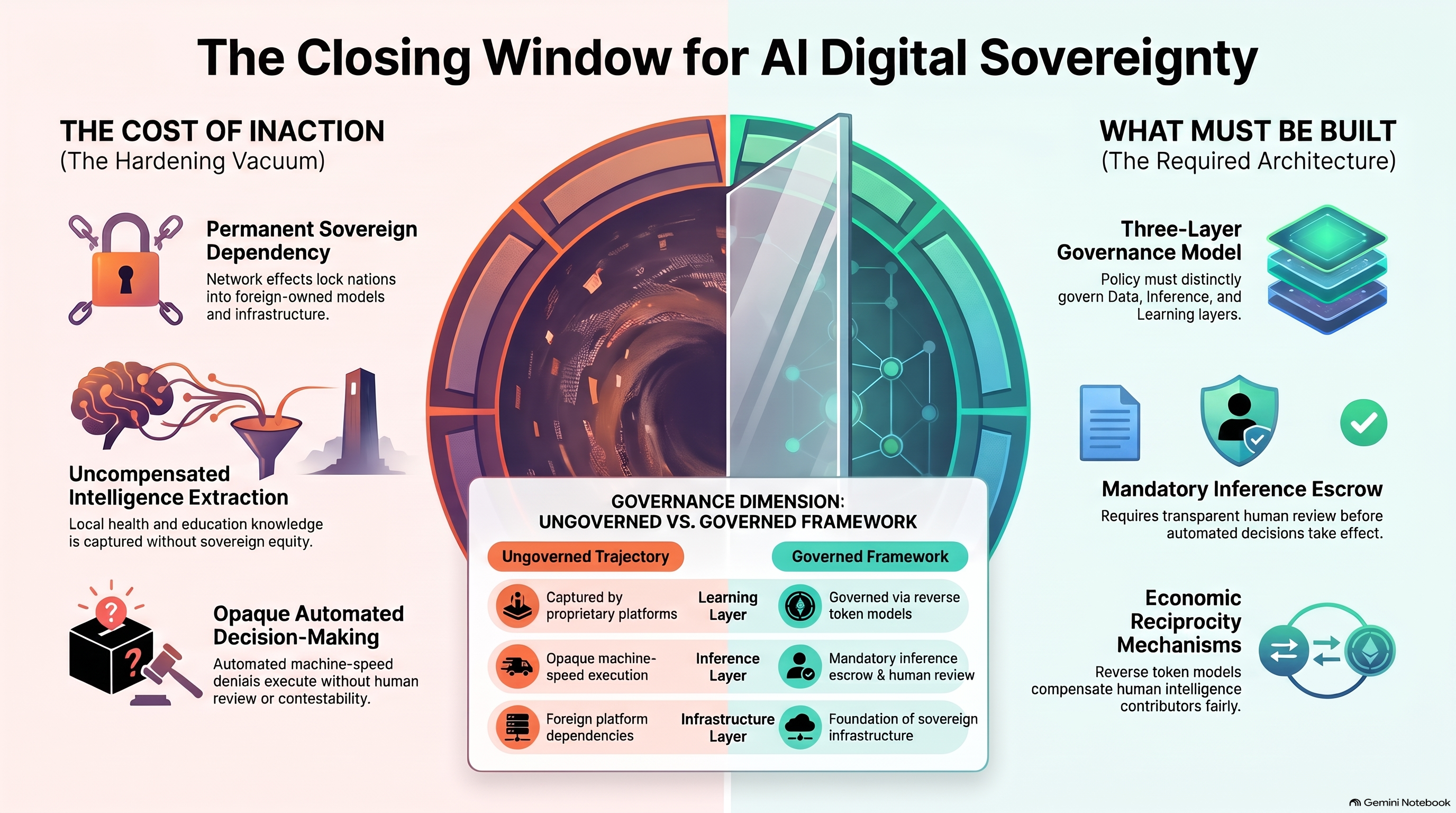
This is the final article in a twenty-part series that has mapped a landscape most people never see: the three layers of value every AI interaction generates, the infrastructure those layers depend on, the governance gap that leaves inference and learning ungoverned, and the mechanisms that could close it.
This article addresses two final questions: what happens if nothing is built, and what must be built before the window closes.
The governance vacuum described in this series is not stable. It is hardening every day into permanent structures. Network effects make dominant platforms harder to challenge with each passing quarter. Model-scale advantages compound with each cycle of learning extraction; the platform that has learned the most learns the fastest, widening its lead continuously. Institutional dependencies deepen as organizations build their workflows, their training, and their decision-making around tools they do not control. Infrastructure concentration narrows sovereign alternatives as companies controlling chips, fabrication, and cloud services extend their positions. And the momentum of established practices resists change; once an industry operates a certain way, reversing course requires more energy than preventing the pattern in the first place.
Return to the scenarios that opened this series.
The Saudi physician we met in Article 1 is one of billions. If the current trajectory continues for five more years, the clinical intelligence derived from Saudi Arabia’s health system will be permanently embedded in foreign-owned models, running on foreign infrastructure, governed by foreign terms. The nation’s capacity to build its own clinical AI will have been quietly foreclosed, not by any hostile act, but by the steady accumulation of a vacuum that no one closed in time.
In Lagos, right now, students are using educational platforms built on learning extracted from students across the continent. The intelligence within the platform — the understanding of how African students think, struggle, and succeed — was generated by students just like them, contributed without recognition, and sold back to their schools at prices negotiated by their governments from a position of dependency rather than sovereignty.
Anna, whose son Leo was denied treatment by an inference she could not see or contest, remains unprotected under current governance. Under the architecture proposed in this series — with inference escrow requiring transparency and human review before an automated denial takes effect, with the Three Conditions ensuring that review is genuine, and with Anna’s right to see and contest the conclusion drawn about her son — the outcome might be the same. Or it might be different. What would not be the same is the silence. The inference would be visible. The reasoning would be accountable. The decision would be subject to human judgment rather than executed at machine speed in the dark. That is not a guarantee of justice. It is the precondition for it.
This framework will face serious objections, and intellectual honesty requires naming them.
From innovation economics: governing learning extraction could reduce incentives to build AI systems, slow innovation, and ultimately harm the populations the governance is meant to protect. This objection has force. The response is the pharmaceutical analogy: Pharmaceutical regulation did not destroy the pharmaceutical industry. It created a governed market that is both commercially viable and subject to oversight. The balance is achievable, but it requires design, not default.
From privacy scholars: extending property-like rights to inferences could create new legal exposure for individuals. If you “own” your inference, can you be compelled to produce it in litigation? These are real tensions. Inference escrow is designed to protect, not to create new exposure; but the design must ensure that ownership functions as a shield rather than a sword.
From open-source advocates: the reverse token model could create an enclosure around what should be a shared resource. The response: the current reality is not a commons. It is proprietary capture by platforms. The choice is not between governed learning and free learning. It is between learning governed by the people who generate it and learning captured by the companies that extract it. Open-source is not in tension with this framework. It is one of the strongest tools the framework can deploy.
What cannot differ, regardless of which governance tradition a society chooses, is the recognition that data, inference, and learning are three distinct layers requiring distinct governance. What cannot differ is that all three depend on infrastructure whose sovereignty is the precondition for everything above it. What cannot differ is the principle that human beings retain a legitimate interest in the intelligence derived from their own activity. And what cannot differ is the understanding that the window for building this governance is finite, and that the cost of delay compounds.
I have proposed specific mechanisms throughout this series: two levels of inference escrow, the reverse token model, weighted contribution scores, contribution thresholds at multiple scales, infrastructure sovereignty as the precondition, digital personhood as the foundation, and a four-lens toolkit as a culturally adaptive starting point. These are offered as starting points for an overdue conversation. Others will propose better mechanisms. The problem is too large for any single mind or tradition to solve alone.
But the conversation must begin from an honest recognition of what is actually being governed. It is not data alone. It is the full spectrum of intelligence that human activity generates — the facts we provide, the conclusions drawn about us, and the knowledge extracted from our behavior — running on infrastructure whose ownership shapes everything above it. Until governance reaches all these layers, digital sovereignty will remain an aspiration, and the value of human intelligence will continue to flow toward those who capture it rather than those who generate it.
The window is open. It will not remain open indefinitely. The architecture must be built.
This article concludes the series drawn from Digital Sovereignty in the Cognitive Age, available in full at blogs.inspire-aspire.net.
Yeah, it's silently closing, unseen, unsaid. What to do?