


When conversations about digital sovereignty focus on chip fabrication, sovereign clouds, and national data centers, the price tags can feel insurmountable — especially for nations in the Global South. Billions of dollars. Decades of investment. Thousands of trained engineers. The implicit message is that sovereignty is expensive, and if you cannot afford the infrastructure, you cannot have independence.
That message is incomplete. Alongside the state-led infrastructure investments described in the previous article, a different kind of sovereignty is being built, not by governments or corporations, but by a global community of developers, researchers, and makers. It is the open-source ecosystem. And it may be the most important long-term path to digital sovereignty for the Global South specifically, because it requires the least capital investment and faces the fewest sanctionable chokepoints.
Consider the full stack that is now available, openly and freely, to anyone with an internet connection.
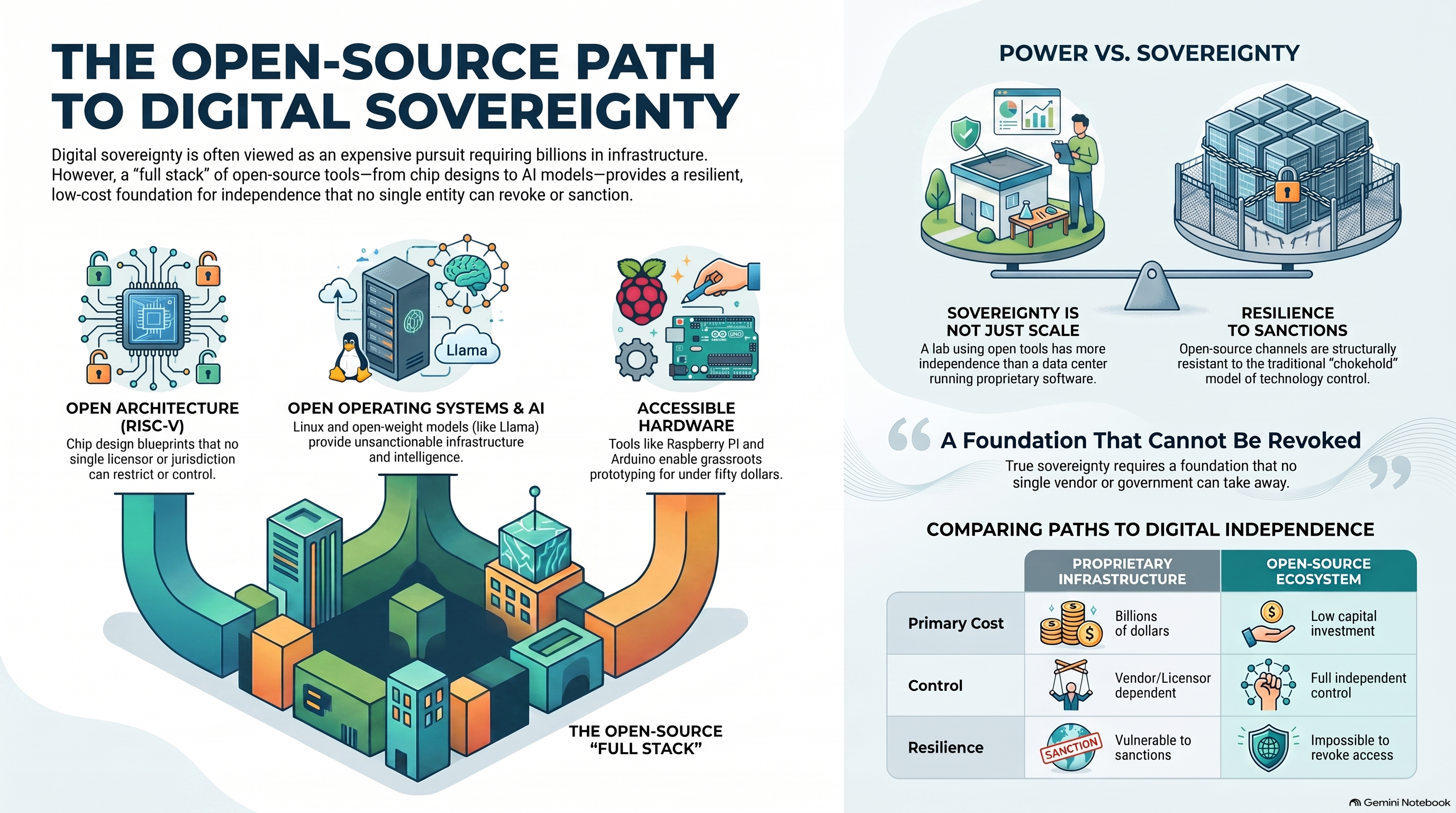
Open architecture: RISC-V provides chip design blueprints that no one can restrict. No licensor to pressure. No jurisdiction to impose controls. Any university, any company, any nation can design chips on RISC-V without asking anyone for permission.
Open operating systems: Linux powers the majority of the world’s servers, supercomputers, and, through Android, the majority of the world’s smartphones. It is free, maintained by a global community of tens of thousands of contributors, and impossible to revoke. No single company owns it. No government can sanction it.
Open AI models: Hugging Face hosts thousands of AI models, including frontier-capable ones, available for download, modification, and deployment. Meta’s Llama, DeepSeek’s models, and Mistral’s European alternatives are released as open-weight models that anyone can use without permission from any licensor. A researcher in Dakar has access to the same model architectures as a researcher in San Francisco.
Open research: arXiv provides free access to the latest research papers in AI and computer science before they appear in journals. The knowledge of how to build, train, and deploy AI systems is publicly available to anyone willing to read it. The methods are not secret. The techniques are not locked behind paywalls. The science is open.
Open tools: GitHub and GitLab host millions of software projects, including AI training frameworks, deployment tools, and production systems, available to anyone. The code that powers the AI economy is, in large part, public. The tools used by Google, Meta, and OpenAI to build their systems are, in many cases, available for anyone to use and modify.
Open hardware: Raspberry Pi puts a capable computer in someone’s hands for under fifty dollars. Arduino provides open-source microcontrollers for sensing and automation. 3D printing enables small-scale hardware manufacturing. Together, these make edge computing, IoT deployment, and grassroots prototyping accessible to virtually anyone, anywhere in the world.
None of these individually constitutes sovereign AI capability. Together, they constitute an alternative infrastructure ecosystem. It is not as powerful as the proprietary one at the leading edge. But it is sovereign in a way that no proprietary system can match, because no single entity can sanction, restrict, or revoke access to any of it.
Consider what this means in practice. A university lab in Senegal can assemble Raspberry Pi clusters, run Linux, deploy open-weight AI models from Hugging Face, train them using freely available research from arXiv and code from GitHub, on a RISC-V architecture that no one can restrict.
The result is not frontier AI. It will not match the performance of models trained on tens of thousands of NVIDIA GPUs in hyperscale data centers. But it is sovereign AI, built on tools no one controls, running on hardware no one can sanction, trained on knowledge no one can restrict. The lab controls every layer of its own stack. It depends on no single vendor, no single government, and no single licensing agreement.
That lab is, in a meaningful sense, more sovereign than a government data center running a proprietary SaaS AI on rented foreign cloud infrastructure — even though the data center costs a thousand times more. The government data center has scale and performance. The university lab has independence and control. The difference between the two lies in the distinction between power and sovereignty. They are not the same thing.
Knowledge is disseminating faster than at any time in human history, through channels that are structurally resistant to control. The traditional chokehold model (control the technology, control the user) worked when knowledge was scarce, and channels were gated. That era is ending. The open-source movement has made it structurally impossible to fully control access to the tools of the AI economy.
This does not mean the open-source path is sufficient on its own. It is not. Frontier AI models require compute resources that Raspberry Pi clusters cannot provide. National health systems require reliability and scale that open-source tools alone cannot guarantee. The proprietary infrastructure has advantages at the leading edge that the open-source ecosystem has yet to match.
But the path exists. It is growing. It is being walked by researchers and developers in every country on earth. And for nations and institutions that lack the billions required for sovereign cloud programs or domestic chip fabrication, the open-source ecosystem offers something no proprietary system can: a starting point that no one controls and no one can take away.
Sovereignty does not require building everything from scratch. It requires having a foundation that cannot be revoked. The open-source ecosystem is that foundation.
This article is drawn from Digital Sovereignty in the Cognitive Age, available at blogs.inspire-aspire.net.