


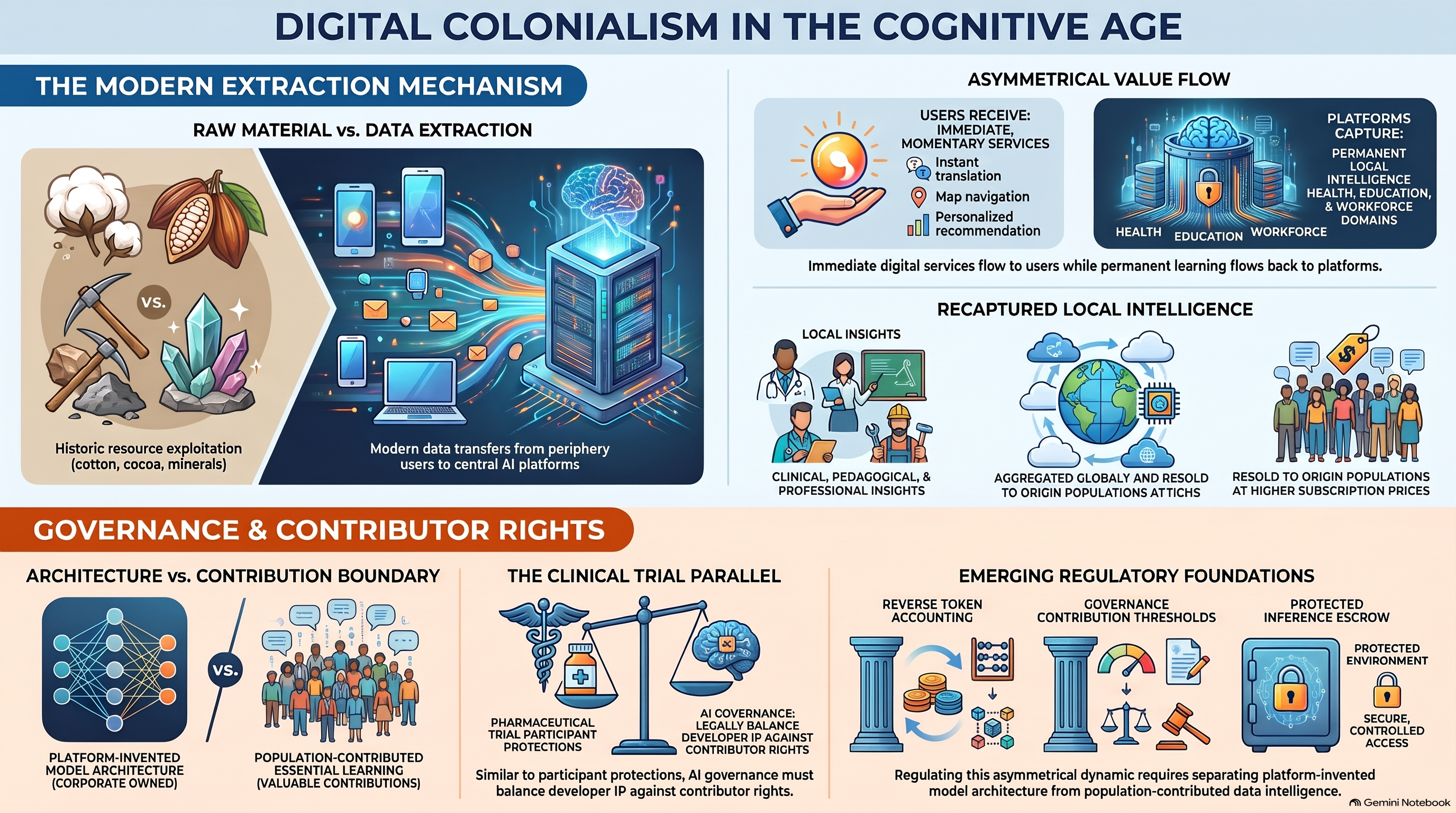
Across the three domains examined in this series — healthcare, education, and work — the same structure repeats. A service flows one way: from platform to user. A learning flows the other way: from user to platform. The service is visible, immediate, and consumed in the moment. The learning is invisible, permanent, and accumulates into the platform’s most valuable asset.
The structural parallel to an older pattern is difficult to avoid.
For centuries, the raw materials of the Global South were extracted, processed elsewhere, and sold back as finished goods. Cotton was grown in West Africa, woven in Manchester, and sold back as textiles at prices the growers did not set. Cocoa was harvested in Ghana, processed in Switzerland, and sold back as chocolate. Minerals were mined in the Congo, refined in Europe, and returned as manufactured products. The processors grew wealthy. The providers remained dependent. The wealth generated from the raw materials accrued to the nations that controlled the processing, not to the nations that produced the inputs.
Scholars have documented the digital equivalent of this pattern: the risk that the Global South will move from older forms of resource dependency into a new one, in which data is the resource and AI capability is the finished good. The structure is the same: value generated in one place, captured in another, sold back to the generators at a price they did not set.
Clinical intelligence from Kenyan hospitals flows to a platform’s headquarters in San Francisco. Pedagogical intelligence from Senegalese schools flows to a company in Stockholm. Workforce intelligence from Indian engineering teams flows to a firm in Silicon Valley. In each case, the intelligence was generated locally, from local patients, local students, local engineers, in local conditions. In each case, the intelligence was captured globally and aggregated into a model that serves the platform’s worldwide customer base. And in each case, the intelligence is sold back to the population that generated it, as an improved version of the tool, at a higher subscription price.
The extraction flows through the entire infrastructure stack described in earlier articles. From the licensing fee for the chip architecture at the bottom, through the subscription cost for the cloud platform in the middle, to the invisible transfer of learning at the top. At every layer, value moves from the periphery to the center.
The parallel is not exact. Digital extraction operates differently from mineral extraction in important ways. The AI service provides genuine value; the diagnostic tool helps the physician, the educational platform teaches the student, and the coding assistant accelerates the engineer. The relationship is not purely extractive. It is a mixture of genuine service and invisible extraction, operating simultaneously in the same interaction. That complexity is what makes it harder to see and harder to govern than the older forms of extraction, where the asymmetry was visible in the shipping containers leaving the port.
Honesty also requires giving the corporate position its full due. A company that invests billions in developing a frontier AI model has created something of genuine value: the architecture, the training methodology, the engineering innovations. That intellectual property deserves protection. A governance framework that treated corporations purely as extractors would be both unjust and self-defeating, driving AI development into jurisdictions with no governance at all.
The balance required is not corporations against populations. It is a framework that distinguishes between what the corporation created and what the population contributed. The model architecture is the corporation’s invention. The learning that makes the model valuable is, in part, the population’s contribution. Both are real. Neither erases the other.
A pharmaceutical company that develops a drug holds legitimate intellectual property rights over the compound. But the clinical trial participants whose biological responses generated the safety and efficacy data that made the drug approvable also contributed something irreplaceable. We recognize a boundary between what was invented and what was contributed, and we govern each accordingly.
The same boundary exists in AI. The model architecture is the corporation’s invention. The learning that makes the model valuable is, in part, the population’s contribution. Both are real. Neither erases the other.
The pharmaceutical analogy also reveals the scale of what must be built. Pharmaceutical trial governance took decades of regulatory construction: consent protocols, ethics review boards, liability frameworks, compensation standards, and reporting requirements. These were not built in a single legislative session. They were built through iterative development, trial and error, public pressure, institutional learning, and the slow recognition that vulnerable contributors needed protection that voluntary corporate conduct would not provide.
The AI governance equivalent is at the beginning of that construction. The mechanisms proposed in this series — reverse token accounting to make contribution visible, contribution thresholds to trigger governance obligations, inference escrow to protect people from the conclusions drawn about them — are the first steps. They are not the finished building. But they are the foundation on which the building can be constructed.
The question is not whether the extraction is happening. It is whether governance will be built before the patterns harden into permanent structures, before the dependencies become so entrenched, the platforms so dominant, and the alternative-building so delayed that the new extraction becomes as difficult to reverse as the old one.
The historical record is not encouraging on this point. The extractive patterns of the colonial and post-colonial era persisted for decades, in some cases centuries, before governance mechanisms were built to address them. And many scholars argue that those mechanisms remain insufficient even today. The digital equivalent is forming now, at the speed of AI deployment, faster than any previous form of extraction. Governance must match that speed, or the patterns will harden beyond the reach of governance that arrives too late.
The nations of the Global South are not powerless in this situation, as earlier articles in this series have shown. They hold commercial leverage that has not yet been exercised. They can organize collectively through regional blocs. They can condition market access on governance terms. But they must recognize what is at stake before the window closes.
The raw materials of the cognitive age are not minerals, cotton, or cocoa. They are the learning contributions of billions of people: their clinical judgment, their pedagogical intelligence, their professional craft, their daily behavior. The processing of those raw materials is happening now, in real time, on infrastructure the contributors do not control. The finished goods — more capable AI models — are being sold back to them at prices they did not set.
The structure is familiar. The question is whether the outcome will be different this time.
This article is drawn from Digital Sovereignty in the Cognitive Age, available at blogs.inspire-aspire.net.