


In 2022, the United States imposed sweeping export controls on advanced chips and semiconductor equipment on China. The stated objective was to constrain China’s AI capability and maintain American technological dominance. The controls restricted China’s access to NVIDIA’s most advanced GPUs, to ASML’s extreme ultraviolet lithography equipment, and to the components needed for leading-edge chip fabrication.
The logic seemed straightforward: cut off the supply of the most advanced hardware, and the competitor cannot build the most advanced AI. Control the infrastructure, control the capability.
The result was not what the policy intended.
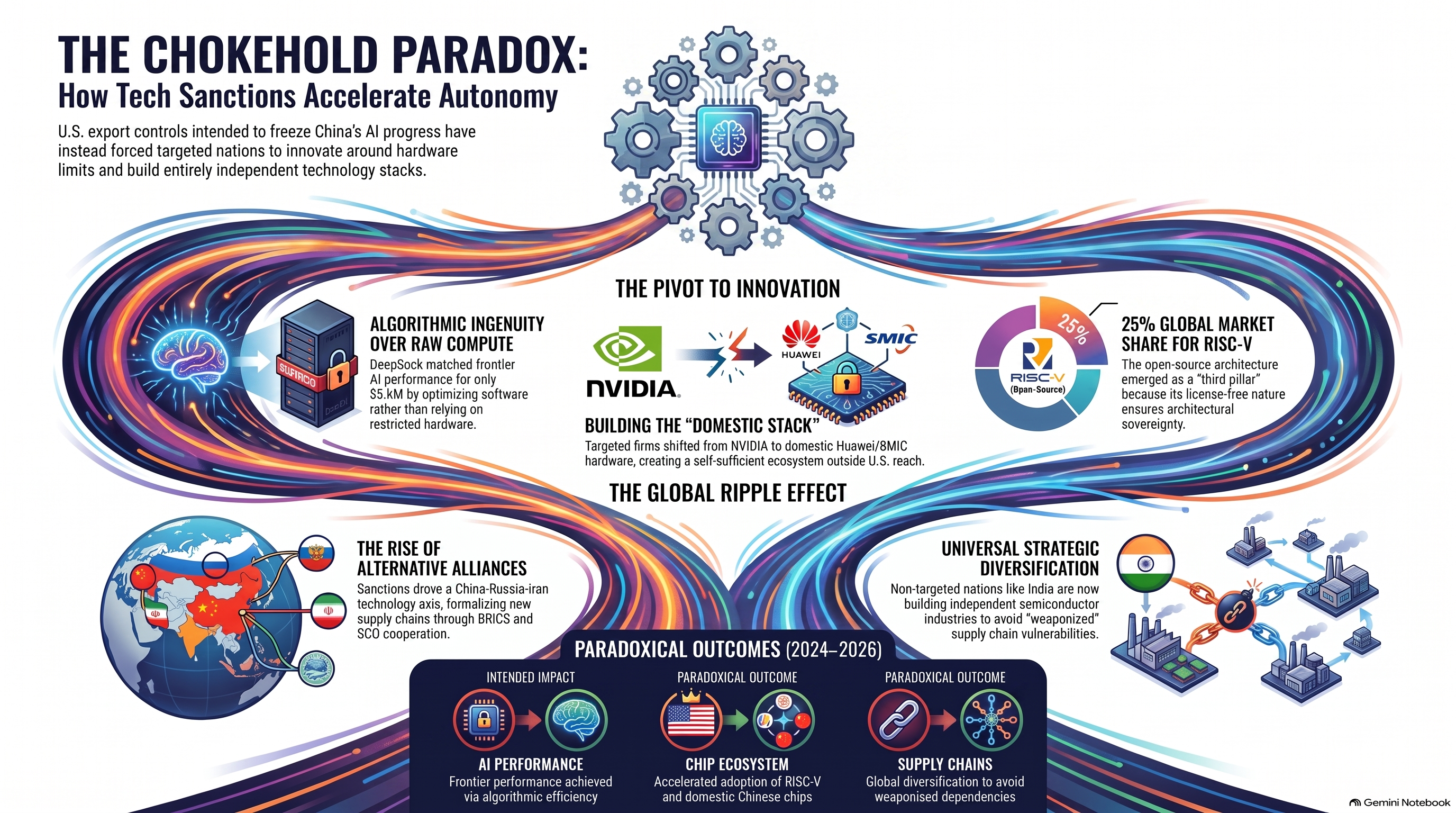
In late 2024, the Chinese AI company DeepSeek achieved what many analysts considered impossible: frontier AI performance using hardware constrained by export controls. DeepSeek trained a model matching GPT-4’s capabilities for approximately $5.6 million, a fraction of what American companies spent, through algorithmic and architectural innovations genuinely new to the field. Techniques like mixture-of-experts routing and multi-head latent attention emerged not from superior hardware but from necessity. When you cannot throw more chips at the problem, you find better ways to use the chips you have.
The significance went beyond cost savings. DeepSeek demonstrated that raw compute was not the only path to frontier AI. Algorithmic ingenuity could substitute for hardware advantage. The assumption underlying the export controls (that controlling hardware meant controlling capability) proved to be structurally flawed.
By mid-2026, the pattern deepened. DeepSeek optimized its latest model specifically for Huawei’s domestic Ascend 950 processors rather than NVIDIA hardware. ByteDance, Tencent, and Alibaba scrambled to procure domestic Chinese chips. The export controls designed to constrain China’s AI development had accelerated the creation of a fully domestic Chinese AI stack: domestic chips, domestic model, domestic optimization. The weapon had accelerated the very outcome it was designed to prevent.
This is what I call the chokehold paradox: the tighter the grip, the faster the escape.
The paradox extends beyond AI software. RISC-V, an open-source chip architecture, has emerged as what analysts describe as the third pillar of computing alongside ARM and x86, capturing approximately 25 percent of the global processor market by early 2026. China has embraced RISC-V as a strategic priority. The Chinese Academy of Sciences is developing high-performance RISC-V cores for data center use. The European Union uses RISC-V for exascale supercomputer development.
RISC-V matters for sovereignty because it cannot be sanctioned. There is no single licensor to restrict, no single company to pressure, no single jurisdiction to impose controls on. It is open, license-free, and extensible. Any nation, company, or university can design chips using RISC-V without asking anyone for permission. That is architectural sovereignty in its purest form.
Meanwhile, Huawei’s Ascend AI processors, designed domestically and fabricated at China’s SMIC, represent the construction of an alternative hardware ecosystem. When DeepSeek optimized its frontier model for Ascend, it demonstrated that the domestic ecosystem had crossed a threshold of viability. Chinese companies no longer need NVIDIA to build competitive AI systems. The alternative exists. It is not yet equal at the absolute leading edge, but it is functional, improving, and, critically, entirely outside the reach of export controls.
The pattern is not unique to China. Russia, under comprehensive technology sanctions since 2014 and massively expanded since 2022, has pursued technological self-sufficiency through domestic development, substitution of Chinese suppliers, and BRICS cooperation. Its defense-industrial complex adapted rapidly, with factories running around the clock and domestic production replacing imported components. Iran, under decades of Western sanctions, developed indigenous capabilities in drone technology, missile systems, and defense manufacturing that would likely never have emerged under conditions of easy access to foreign alternatives. The Iran-Russia-China technology cooperation axis, formalized through SCO membership and BRICS expansion, is itself a direct product of the sanctions regime: three nations whose constraints drove them toward each other, creating an alternative supply chain and technology-sharing network that did not exist before the restrictions created the incentive to build it.
These examples are not offered to endorse any particular nation’s policies or military programs. They are offered to demonstrate a structural pattern: severe constraint does not produce permanent dependency. It produces adaptation, innovation, alternative alliances, and the eventual development of capabilities that reduce the constraining power’s leverage.
But here is the dimension that is rarely discussed, and it may be the most consequential of all. The strategy of using technology as a weapon teaches every nation on the planet the same lesson, not just the targeted ones. India, which is not under sanctions, nonetheless monitors developments affecting nations that depend on supply chains controlled by others and pursues its own semiconductor ambitions accordingly. The same calculus is being made across Southeast Asia, the Middle East, Africa, and Latin America. Every nation watching the chokehold play out is drawing the same conclusion: dependency on a supply chain that can be weaponized is a strategic vulnerability, and the only defense is to build alternatives.
The very act of demonstrating that infrastructure access can be revoked for geopolitical reasons accelerates the diversification it was designed to prevent. The targeted nations innovate under constraint. The non-targeted nations diversify out of prudence. Both responses reduce the constraining power’s long-term leverage. The chokehold weakens the hand that applies it.
Technology used as a weapon teaches the world to build its own defenses. That is the paradox. And its consequences — for the nations applying the constraints, the nations under constraint, and the nations watching from outside — are still unfolding.
This article is drawn from Digital Sovereignty in the Cognitive Age, available at blogs.inspire-aspire.net.