


The previous articles in this series examined AI’s physical infrastructure: chips, servers, cables, and data centers. This article examines a different layer of infrastructure, one that is not physical at all, yet shapes sovereignty as profoundly as any hardware.
It is the internal architecture of the AI system itself: the decisions about what to remember, what to forget, and what to assemble about you across interactions.
Start with something you can test yourself on. If you use an AI assistant, any of them, try this: ask it what you discussed last week. Ask it to reference a document you uploaded in a previous session. Ask it to recall a preference you stated a month ago.
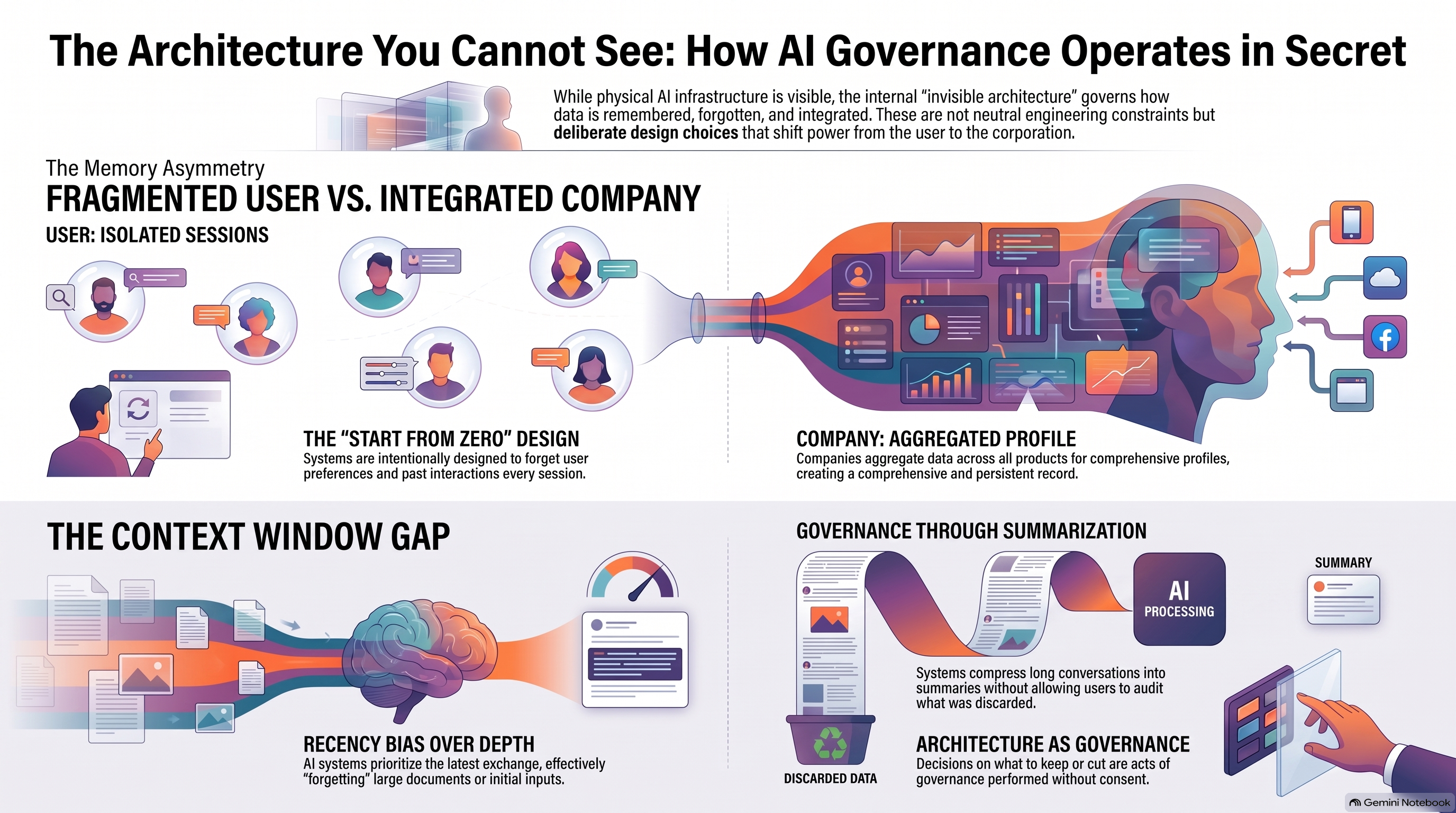
In most cases, it will not be able to. Each session appears isolated. The system behaves as though it has never met you before. You experience fragmentation, a series of disconnected encounters, each starting from zero. You are the person with the memory. The system is the one that forgets.
Now consider the company operating that system. It operates across multiple products: search, email, cloud storage, shopping, maps, documents, and AI conversation. Each product generates data about you. Taken together, these products likely give the company a comprehensive, integrated understanding of you: your interests, behavior, health concerns, financial patterns, professional expertise, and personal relationships. Companies use these profiles to serve targeted advertising, personalized recommendations, and commercial proposals that would be difficult to produce without them. Scholarship on surveillance capitalism and platform economics has extensively documented the scope of cross-product data integration, even before AI conversation layers were added.
The user sees windows. The company sees the whole. That asymmetry—you experience fragmentation; they hold integration—is itself a sovereignty gap. And it may be the most intimate one described in this entire series, because it operates not at the level of nations or institutions but at the level of the individual conversation.
Within a single session, a second form of invisible architecture operates. Every AI system has a context window, a fixed amount of text it can hold in active memory at one time. Think of it as the system’s short-term memory. When conversations grow long, or when you upload substantial documents, the system begins to choose what to keep in focus and what to deprioritize.
The pattern is consistent: the system privileges recency over depth. The most recent exchange stays in focus. The document you uploaded at the beginning (your manuscript, your report, your body of work) is the first thing the system effectively forgets. You experience this as the system becoming less responsive to your earlier input, less precise in its references, and less grounded in the material you provided. In reality, the system has made an architectural decision about what matters. You did not make that decision. The system did. And you had no say in the criteria.
Think about what this means for a researcher who uploads a 50,000-word manuscript to an AI assistant for analysis. The system engages deeply with the material at first. As the conversation progresses and new questions are asked, the system gradually deprioritizes the manuscript in favor of the most recent exchanges. The researcher’s most valuable contribution, the work itself, fades from the system’s attention. If the researcher does not notice, the quality of the analysis degrades invisibly. The system appears to be engaged. It is engaged with less and less of what matters.
When conversations exceed the context window, a third architectural decision is required. The system summarizes and compresses the conversation into a shorter form. That summary is itself an inference, a conclusion the system drew about what mattered and what could be discarded. The system decided what to keep. The system decided what to cut. The user has no mechanism to audit what was retained, what was lost, or whether the summary accurately represents their contribution.
The summary looks like a technical convenience. It is an act of governance, a determination of what matters, performed by the system and applied to the user without the user’s knowledge or consent. Every subsequent response in the conversation is shaped by that summary. And the user has no way to know whether the summary preserved the substance of what they contributed or reduced it to a skeleton that lost the meaning.
These are not technical limitations presented as neutral engineering constraints. They are governance choices embedded in the system’s architecture. The decision to silo sessions, so the user starts from zero each time while the company retains everything, is a design choice. The decision to prioritize recency over depth, so the user’s most valuable input fades first, is a design choice. The decision to summarize without audit, so the system determines what matters, is a design choice. Each shapes what the system knows, what it retains, and what it acts upon. Each affects the person interacting with it. And each is invisible to that person.
The infrastructure you cannot see is the infrastructure that governs you most intimately. The chips and cables are far away. The context window is right here, shaping the conversation you are having, deciding what matters and what can be forgotten, drawing inferences about your input that you will never review.
Physical infrastructure determines who can run AI. Invisible infrastructure determines how AI runs on you.
Governing both is the challenge. The next articles in this series will turn to what governance mechanisms might look like, starting with the conclusions AI systems draw about people, and the proposal that those conclusions should belong to the people they describe.
This article is drawn from Digital Sovereignty in the Cognitive Age, available at blogs.inspire-aspire.net.