


The previous three articles described learning extraction across healthcare, education, and work, three domains in which human beings contribute their intelligence to AI systems without recognition, measurement, or governance. The natural question is: can the contribution actually be measured?
The answer is yes. The infrastructure to measure it already exists. It was built by the AI companies themselves. It is simply not read in both directions.
Every AI interaction is tokenized. Tokens are the units of computation that AI systems use to process and generate text. When you use an AI assistant, the platform tracks exactly how many tokens your query consumed and how many tokens the response required. This tracking is the basis of the billing system; you pay for the tokens you use.
What the platform does not report is the reverse flow: how many tokens’ worth of learning you contributed.
Consider two users on the same platform, on the same day. User A asks: “What is the capital of France?” The interaction consumes minimal tokens. The learning generated is negligible. The model already knows the answer. User A consumed a service. User A contributed nothing.
User B is a cardiologist in São Paulo. She uploads a complex ECG, asks for a differential diagnosis, receives a recommendation, identifies two errors, adds clinical context from her patient’s history, and refines the recommendation through three rounds of exchange. The interaction consumes substantial tokens. But the learning generated is also substantial: expert corrections, expert acceptances, and contextual medical knowledge specific to a population for which the model has limited training data.
Under the current accounting, both users are billed for the tokens they consumed. Neither is credited for the learning they contributed. The meter runs in one direction. The reverse token model I propose reads the same data in both directions.
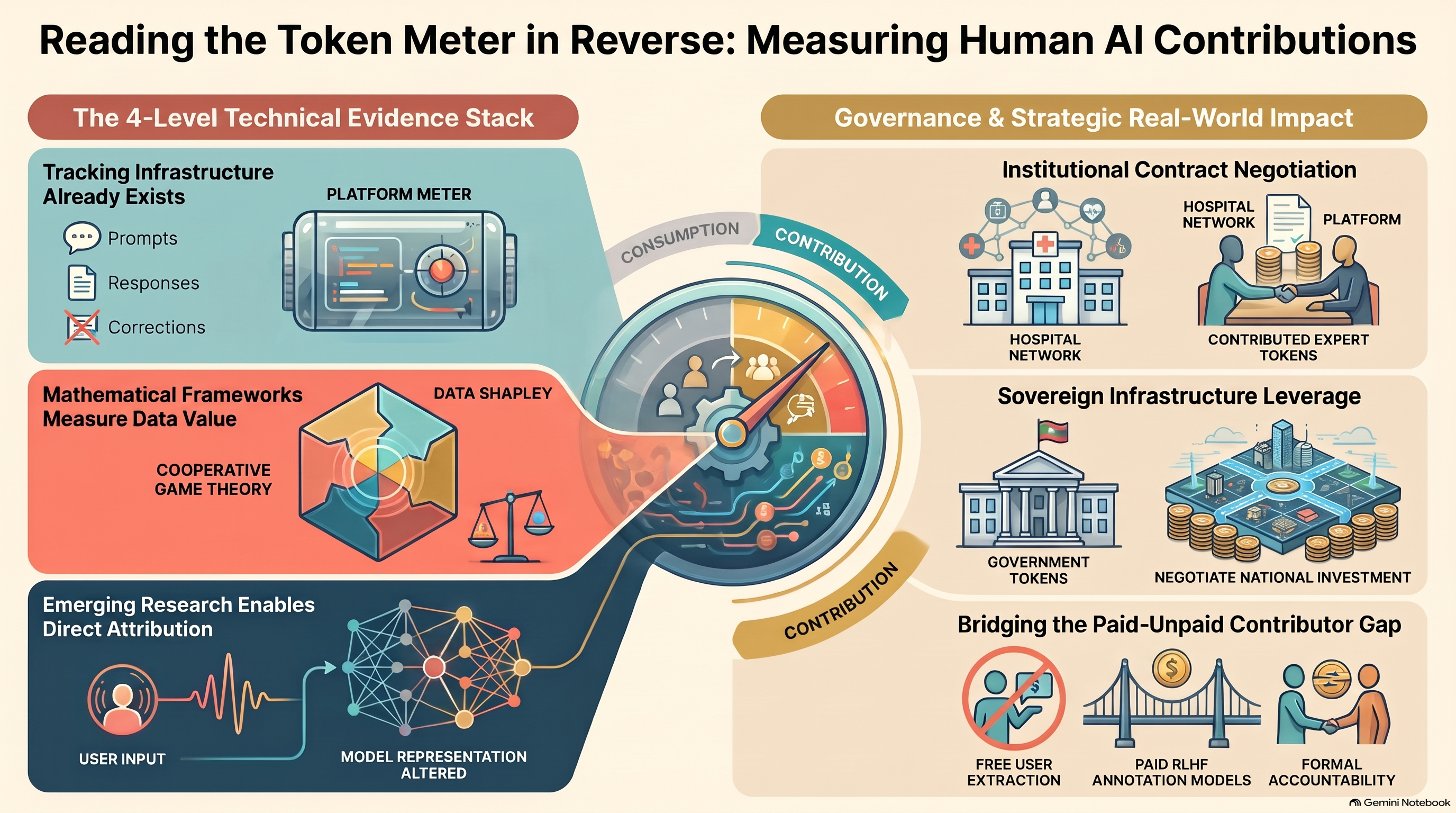
But is the reverse flow actually measurable? At four distinct levels of technical sophistication, the answer is yes.
First, at the most basic level, every AI interaction is already tokenized and tracked. The billing infrastructure that measures what the platform delivers to you is the same infrastructure that could measure what you deliver to the platform. The data exists. It is simply not reported from the user’s perspective.
Second, at a more formal level, researchers have developed mathematical frameworks for equitable data valuation. Data Shapley, introduced in 2019, applies cooperative game theory to assign a fair value to each individual training datum based on its contribution to model performance. Think of it as calculating what happens to the model’s capability when each person’s contribution is added or removed. The computational cost remains high for large models, but efficient approximations continue to improve.
Third, at the operational level, an entire industry of observability platforms, LangSmith, Langfuse, Arize AI, and others, already traces every AI interaction in production: prompts, responses, corrections, acceptances, token usage, session tracking, and user feedback. These platforms were built for model improvement to help companies understand what works, what fails, and how to make the next version better. But the same data, read from the user’s perspective rather than the company’s, is the reverse contribution ledger. The infrastructure already exists. It was built by the companies themselves.
Fourth, at the most advanced research level, mechanistic interpretability can trace how information flows through a model’s internal states. This could eventually enable direct attribution, identifying which classes of user interactions actually changed the model’s internal representations, rather than relying on token weights as a proxy. Today we have the proxy. Tomorrow we may have the direct measure.
Together, these four levels form an evidence stack. At the base, every interaction is already tracked. Above that, mathematical frameworks for equitable valuation exist. Above that, operational observability platforms trace every detail of every interaction. And at the top, emerging research is building toward direct attribution of which interactions actually changed the model.
The infrastructure to measure user contributions is not theoretical. It is operational. It was built by the companies for their own purposes. Reading it in both directions is a governance decision, not an engineering challenge.
A critical distinction: visibility does not automatically imply compensation or ownership. What visibility creates is accountability. What accountability creates is a range of governance options: from transparency requirements at one end, through audit rights and negotiated value-sharing, to formal compensation at the other. The reverse token model does not propose that every interaction generates an ownership claim. It proposes that the flow of learning contributions becomes visible, thereby making governance possible.
Consider what this would mean in practice. A hospital network in Kenya could see that its clinicians contributed 12 million weighted reverse tokens to a platform last quarter and could use that visibility in contract negotiations. A national government could see that its population contributed 847 million weighted reverse tokens to a platform and could use that visibility to negotiate sovereign infrastructure investment as a condition of market access. A regional bloc, the African Union, ASEAN, or Mercosur, could aggregate reverse token data across member nations and negotiate collectively with platforms that depend on those markets for the very learning they extract.
The companies themselves confirm that human learning contributions have value. They pay millions to specialized annotators through RLHF (Reinforcement Learning from Human Feedback) pipelines to provide exactly the kinds of corrections, preferences, and validations that unpaid end-users provide for free. An entire industry of data labeling companies exists because human learning contribution is valuable enough to pay for.
The governance gap is not between measurable and unmeasurable contributions. It is between paid contributors, who are recognized, and unpaid contributors, who are not. The meter already runs. It simply needs to be read in both directions.
This article is drawn from Digital Sovereignty in the Cognitive Age, available at blogs.inspire-aspire.net.