


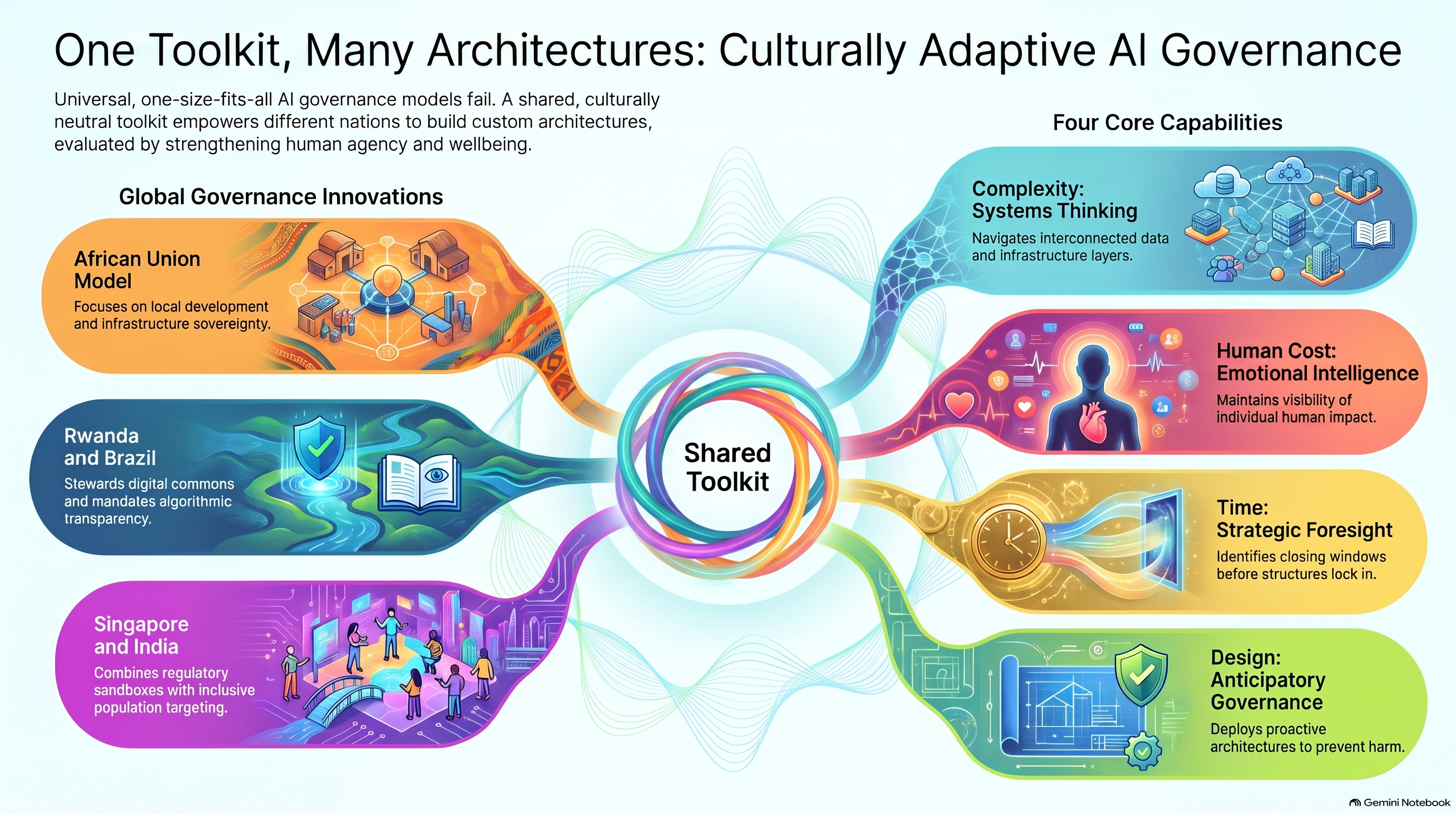
An AI governance framework that works only in Brussels will not govern AI in Nairobi. A framework designed for Beijing will not function in São Paulo. A framework built in Washington will not translate to Dhaka. The temptation, and it is a strong one, is to design a single, universal governance architecture and expect the world to adopt it. The history of that approach, in development, in trade, and in institutional design, is a history of failure.
This article argues for something different: a shared toolkit from which different societies build different architectures, suited to their own values, institutions, and developmental realities.
Nations in the Global South are already doing this, and their approaches deserve attention as governance innovations in their own right, not as incomplete copies of Western or Chinese models.
The African Union’s Continental AI Strategy begins from development priorities: how can AI serve African health systems facing physician shortages, African agriculture facing climate disruption, and African education facing infrastructure gaps? Governance is built around the conditions of those deployments, not around abstract principles imported from elsewhere. The strategy calls for sovereign infrastructure, local capacity-building, and intra-African data sharing, reflecting a community-oriented approach to sovereignty that neither the Western model nor the Chinese model fully captures.
Rwanda’s AI Governance Framework emphasizes protecting what it calls the “digital commons”, treating the data and intelligence generated by Rwandan citizens as a national resource to be stewarded rather than extracted. Brazil pairs ambitious AI deployment with explicit guardrails, including sovereign infrastructure and a national center for algorithmic transparency. Singapore works with industry to build governance that is operational rather than aspirational, tested through regulatory sandboxes that allow experimentation within bounded conditions. India prioritizes inclusion, directing AI toward the populations historically excluded from the benefits of technological change.
These frameworks share a pragmatic, outcome-oriented starting point. They do not ask, “What rights should individuals have?” or “What should the state control?” but “What does our population need, and how do we build governance that delivers it without creating new dependencies?” That question is closer to the shared criterion I propose, human and societal wellbeing, than either of the dominant models typically achieves.
The diversity of governance models is not a problem to solve. It is the natural expression of different societies constructing different relationships among the person, the community, the corporation, and the state. What is needed is not a single architecture but a common starting point: a shared set of tools from which different societies can build different structures, while retaining enough common language to cooperate across traditions.
The governance challenge described in this series has four distinct dimensions. Each demands a specific capability.
The first dimension is complexity. Data, inference, learning, and infrastructure form an interconnected system where changes at one layer ripple through the others. Seeing these interdependencies — the whole rather than the parts — is the contribution of systems thinking.
The second dimension is human cost. Behind every governance failure in this series is a person: the man who never learns why doors stay closed, the patient whose desperation produces the richest data, the student whose learning patterns become someone else’s asset. Keeping these realities visible to whoever designs governance is the contribution of emotional intelligence, understood not as a private sentiment but as a governance capability.
The third dimension is time. The governance vacuum is hardening into permanent structures through network effects, institutional dependencies, and infrastructure concentration. Understanding what locks in and where the windows for action are closing is the contribution of strategic foresight.
The fourth dimension is design. The mechanisms proposed in this series — inference escrow, reverse token accounting, contribution thresholds — are proactive architectures designed to prevent harm before it becomes entrenched. Building governance that acts before irreversibility rather than after it is the contribution of anticipatory governance.
These four lenses emerged from the problem itself. They are the capabilities the governance challenge demands. Other toolkits will address the same dimensions differently, and the field will be richer for it. What these four offer is a starting point that is not culturally specific: ways of seeing and reasoning that any tradition can adopt without abandoning its own values.
The shared criterion — the test that applies across all traditions — is whether the governance architecture actually serves the well-being of human beings and the societies they belong to. Not whether it protects individual rights in the abstract. Not whether it strengthens state power in the abstract. But whether, in practice, it leaves people and their societies better off, or whether it serves chiefly those who hold power, whether corporate or governmental.
A framework built from individual rights can fail this test if those rights become instruments wielded by the powerful. A framework built from state sovereignty can fail this test if that sovereignty becomes disconnected from the people it claims to serve. The test of governance lies in its consequences for human lives.
The toolkit is shared. The architectures built from it will differ. The criterion for evaluating them is the same: does it strengthen human agency or erode it? That question belongs to every society. The answer belongs to each.
This article is drawn from Digital Sovereignty in the Cognitive Age, available at blogs.inspire-aspire.net.