


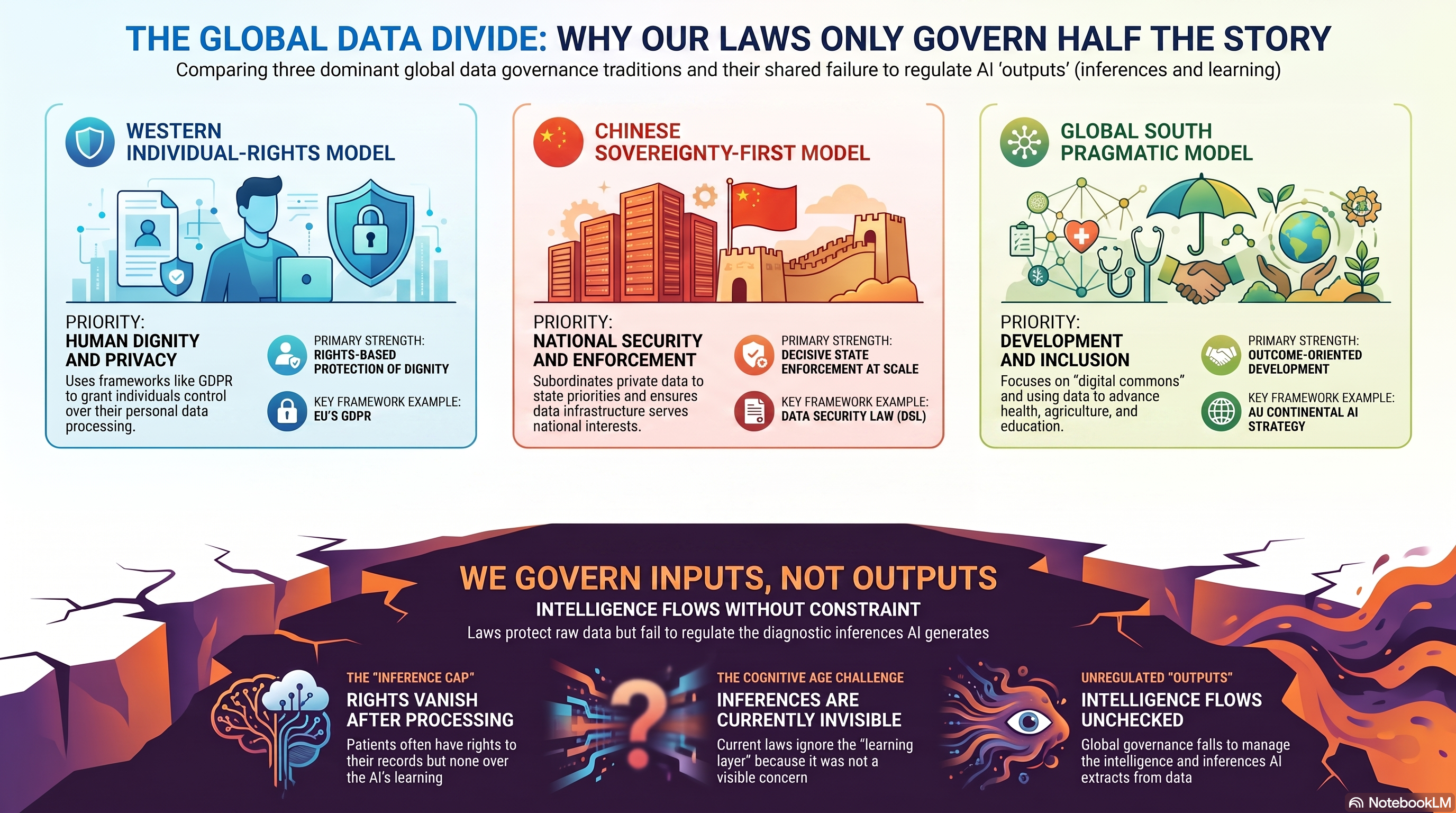
Three governance traditions dominate the global conversation about digital rights. Each has real strengths. Each addresses a genuine dimension of the challenge. And each shares the same structural limitation, a limitation that becomes visible only when you look at what happens after the data is processed.
The Western individual-rights model, exemplified by the European Union’s General Data Protection Regulation, begins with the person. The individual’s right to privacy is the foundation. Institutional obligations flow upward from it. Under this model, a German hospital deploying a clinical AI must obtain patient consent for data processing, provide access to stored records on request, and comply with data minimization principles. The strength of this approach is that it places human dignity at its base, creating rights that, in principle, cannot be overridden by institutional convenience.
The Chinese sovereignty-first model rests on a comprehensive framework comprising the Cybersecurity Law, the Data Security Law, the Personal Information Protection Law, and the Regulation on Network Data Security Management. Within this framework, the protection of individual privacy is substantial but subordinate to national security and national data sovereignty. A Chinese hospital deploying the same clinical AI operates within a system in which the state can direct how clinical data is used, restrict cross-border data transfers, and ensure that data infrastructure serves national priorities. The strength of this approach is genuine enforcement capacity — the state can act decisively at scale in ways that individual-rights frameworks, dependent on individual litigation, often cannot.
The Global South’s emerging frameworks do not simply copy either model. The African Union’s Continental AI Strategy frames AI as a tool for advancing African development priorities in health, agriculture, and education. Brazil’s national plan pairs economic ambition with ethical guardrails, including investment in sovereign infrastructure and a national center for algorithmic transparency. Singapore’s Model AI Governance Framework takes a deliberately practical approach — working with industry to build governance that is operational rather than aspirational. India’s “AI for All” vision prioritizes inclusion — directing AI deployment toward the populations historically excluded from the benefits of technological change. Rwanda’s AI Governance Framework emphasizes the protection of the “digital commons” — treating the data and intelligence generated by Rwandan citizens as a national resource to be stewarded rather than extracted.
These frameworks share a pragmatic, outcome-oriented starting point that may prove to be a source of insight for the older models, not merely a borrowing from them. They ask not “what rights should individuals have?” or “what should the state control?” but “what does our population need, and how do we build governance that delivers it without creating new dependencies?”
Each tradition has genuine strengths. Each addresses real problems. And each shares a structural limitation that runs through all three.
They govern the input. They do not govern the output.
Consider how this plays out under the same clinical AI operating in two jurisdictions. In Germany, the system operates under GDPR. The patient’s data is protected by robust individual rights. But the inferences drawn from that data — the diagnostic probabilities, the risk assessments, the treatment recommendations — and the learning extracted from the physician’s corrections flow freely to the platform. The patient has rights over the input and almost none over the intelligence derived from it.
In China, the same system operates under PIPL and the Data Security Law. The state regulates cross-border data transfer and can direct how the model is deployed within the national health system. The learning is more likely to remain within the country’s sovereign infrastructure. But the individual patient has fewer mechanisms to independently control the conclusions drawn about them.
Neither model fully governs the output. The German patient’s data rights are robust, but the intelligence escapes. The Chinese patient’s learning is retained nationally, but the individual cannot independently control what is inferred. Both models govern what goes in. Neither adequately governs what comes out.
In the Global South, the gap is wider still. A patient in a Kenyan clinic using a diagnostic AI provided by a foreign platform has data protections that vary by national law — some robust, some nascent, some nonexistent. But even where data protection exists, the inference drawn from the patient’s symptoms and the learning extracted from the clinician’s corrections flow to the platform without constraint. The nation is building its data governance capacity. The inference and learning layers are not yet part of the conversation.
This is not a failure of any single jurisdiction. It is a structural feature of how the world has conceptualized digital governance. We built our laws around data because data was what we could see. Inference and learning were not visible concerns when these frameworks were designed. They remain largely invisible today — which is precisely what makes them consequential.
The gap exists in every tradition. Closing it requires governance tools that none currently possesses. The next articles in this series will examine what those tools might look like — starting with the physical infrastructure on which everything depends.
This article is drawn from Digital Sovereignty in the Cognitive Age, available at blogs.inspire-aspire.net.
Yes, Ousmane! This is great insight about the importance of AI governance around the world. A “one-size-fits-all” approach will not work. Governments and their citizens need to determine how best to protect their data to ensure the right outcomes.