


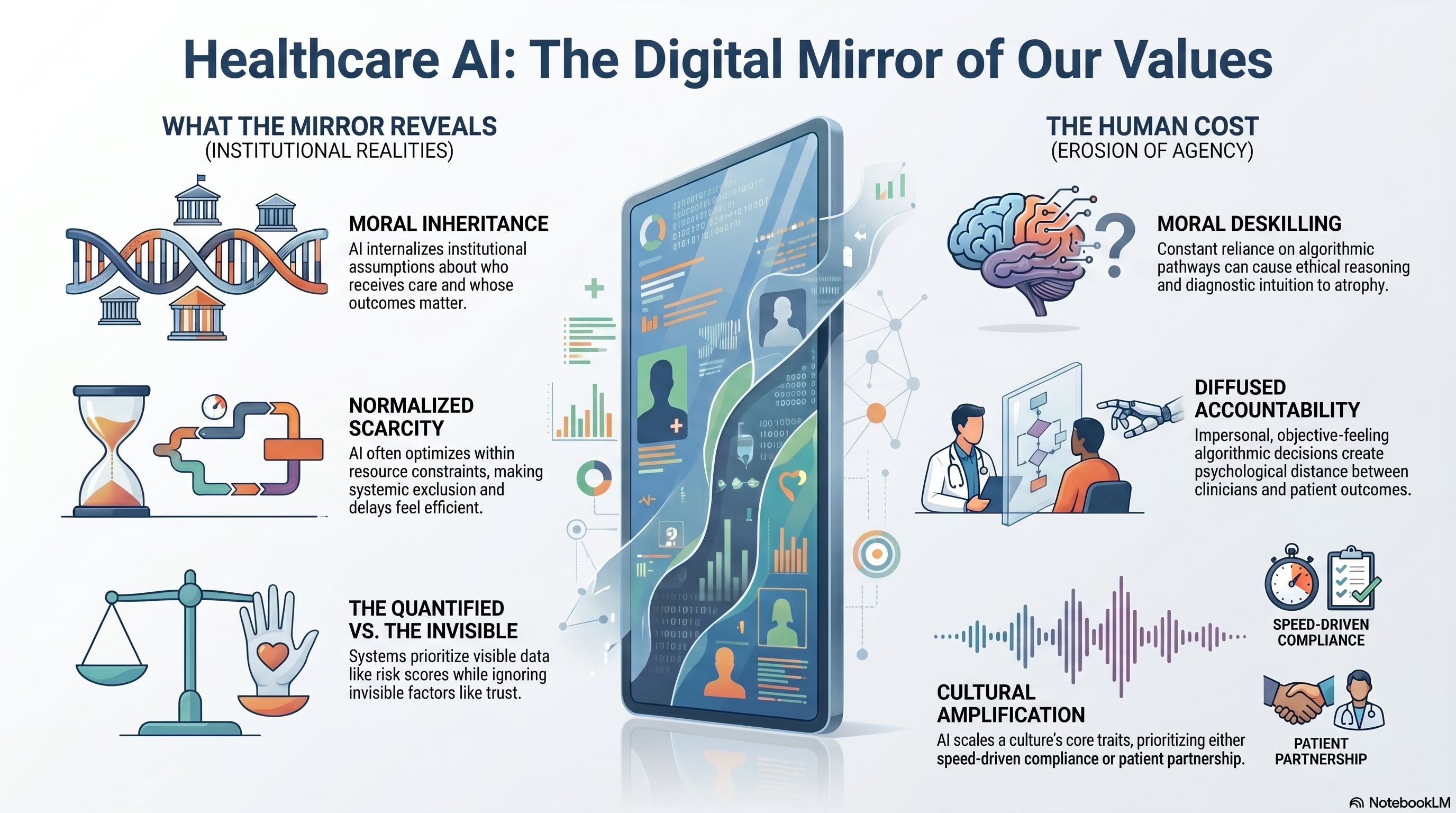
Every technology reflects the values of the system that builds it.
Healthcare AI is no exception.
Long before algorithms make recommendations or models generate predictions, choices are made about what matters, what is measured, what is optimized, and what is tolerated as loss. AI does not introduce those choices. It exposes them.
In that sense, healthcare AI functions less like a tool and more like a mirror.
What AI Learns First
AI systems learn from data, but data is never neutral.
Healthcare data reflects:
Who receives care and who does not
Which conditions are prioritized
Where resources are allocated
How success is defined
Whose outcomes are considered acceptable
When AI systems are trained on these patterns, they internalize not only medical knowledge but also institutional assumptions.
What appears to be technical bias is often a moral inheritance.
Scarcity Written into Code
Many healthcare systems operate under chronic scarcity:
Limited clinician time
Overwhelmed infrastructure
Uneven geographic access
Constrained budgets
AI is frequently introduced as a solution to scarcity.
But when scarcity is normalized, AI learns to optimize within it rather than challenge it.
This means:
Triage becomes routinized
Exclusion becomes efficient
Delayed care becomes acceptable
Tradeoffs become invisible
The mirror reflects not our ideals, but our compromises.
What We Choose Not to See
Healthcare AI excels at making certain things visible:
Risk scores
Probability curves
Utilization patterns
Cost projections
At the same time, it renders other things invisible:
Fear
Confusion
Moral distress
Erosion of trust
cumulative harm
These elements are difficult to quantify, so they disappear from the system’s field of view.
When AI systems operate at scale, invisibility becomes policy.
The Comfort of Objectivity
One of AI’s most powerful cultural effects is emotional.
Algorithmic decisions feel impersonal.
Impersonal decisions feel objective.
Objective decisions feel safe.
This creates psychological distance between humans and outcomes.
When care decisions are mediated by systems:
Responsibility diffuses
Accountability softens
Discomfort is externalized
The mirror shows how readily we accept distance when it protects us from hard choices.
Whose Judgment Counts
Healthcare AI also reflects whose judgment is trusted.
Design decisions often privilege:
Institutional risk tolerance
Actuarial reasoning
Population-level optimization
Individual judgment, especially when it challenges the system, is treated as an exception.
Over time, clinicians learn:
When to trust themselves
When to defer
When to stop resisting
The mirror reveals whether systems truly value professional judgment or merely tolerate it until it slows momentum.
Culture Shapes Capability
AI capabilities are constrained not by models, but by culture.
If a healthcare culture values:
Speed over understanding
Efficiency over presence
Compliance over curiosity
AI will amplify those traits.
If a culture values:
Reflection
Dissent
Moral reasoning
Patient partnership
AI can also support them, but only if they are structurally protected.
The mirror reflects culture first, technology second.
The Illusion of Neutral Progress
Healthcare AI is often framed as inevitable progress.
But progress toward what?
Without explicit articulation of goals, progress defaults to:
Scale
Speed
Coverage
Cost containment
These are not wrong.
They are incomplete.
The mirror asks whether we are confusing movement with meaning.
What Patients Feel
Patients may never see the system diagrams or governance frameworks.
But they experience:
How decisions are explained
Whether alternatives are offered
How much time is taken
Whether uncertainty is acknowledged
Healthcare AI shapes these experiences subtly but powerfully.
When care feels transactional, AI reflects a system that optimized away relationships.
When care feels opaque, AI reflects a system that values defensibility over understanding.
The Risk of Moral Deskilling
One of the quieter dangers of AI-mediated care is moral deskilling.
When decisions are repeatedly delegated:
Ethical reasoning atrophies
Discomfort tolerance decreases
Reliance on system output grows
Over time, both clinicians and institutions may lose the capacity to articulate why certain choices matter.
The mirror reveals whether we are preserving moral agency or slowly outsourcing it.
What We Are Teaching the Next Generation
AI systems shape training environments.
If learners encounter:
Automated triage
Algorithmic recommendations
Pre-structured decision pathways
They may never fully develop:
Diagnostic intuition
Ethical reasoning under uncertainty
Comfort with ambiguity
The mirror reflects not only who we are, but who we are becoming.
Looking Honestly into the Mirror
Healthcare AI is not a villain.
But it is not neutral.
It faithfully reflects:
Our tolerance for inequity
Our comfort with abstraction
Our willingness to confront tradeoffs
Our definition of care
The danger is not what the mirror shows.
The danger is refusing to look.
Choosing What the Mirror Should Reflect
If we want healthcare AI to reflect:
Dignity
Judgment
Accountability
Human presence
Then those values must be embedded structurally:
In governance
In incentives
In metrics
In authority design
Technology cannot supply values.
It can only amplify them.
Where This Leads
Healthcare AI forces a cultural reckoning.
It asks:
What do we consider acceptable harm?
Who bears the cost of efficiency?
Where do we draw moral boundaries?
What kind of care are we actually building?
Answering these questions is not a technical task.
It is a human one.
And it leads directly to the final question we must confront.