


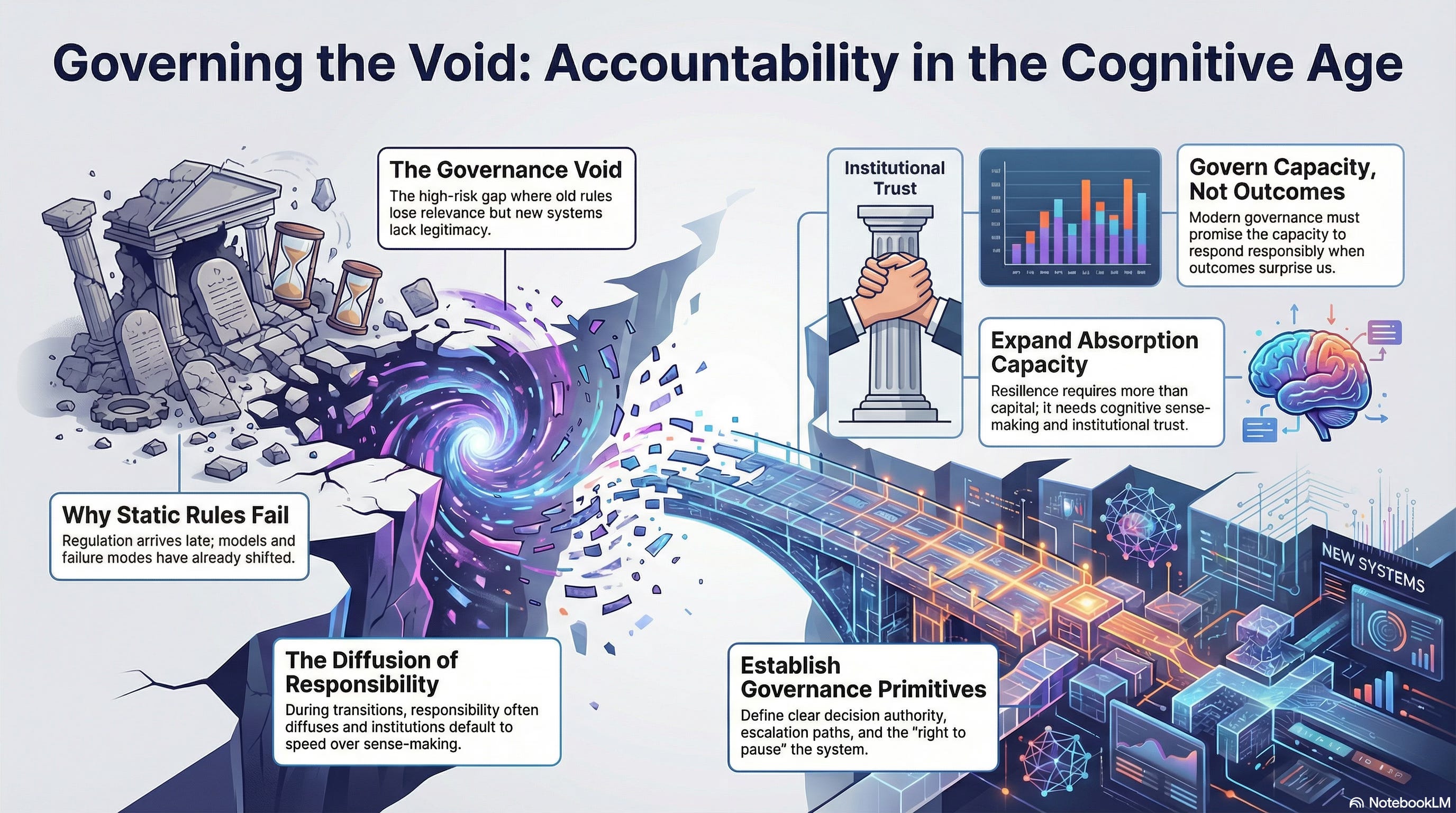
The Void No One Designs For
Every period of structural change creates a gap.
Old rules lose relevance. New systems lack legitimacy. And in between, decisions still have to be made.
That gap is not theoretical. It is operational, legal, and human. It is where risk quietly concentrates.
In recent conversations with leaders in finance, insurance, infrastructure, and public institutions, the same concern keeps surfacing:
“We know the old governance models no longer work — but the new ones aren’t yet concrete enough to stand on.”
This space between certainty and adaptation is what I call the governance void. And it is the most under-designed surface in the Cognitive Age.
Why Acceleration Breaks Rule-Based Safety
Traditional governance assumes a stable terrain:
Risks can be enumerated
Boundaries can be defined
Rules can be written once and enforced over time
That assumption no longer holds.
When systems evolve every six to twelve months, regulation arrives late by design. By the time compliance frameworks are implemented:
The models have shifted
Incentives have adapted
Failure modes have migrated
Precision becomes irrelevance.
This does not mean governance should retreat. It means governance must change what it optimizes for.
The False Choice: Rigidity or Chaos
When faced with acceleration, institutions often believe they must choose between:
Rigid control (which creates blind spots), or
Adaptive flexibility (which feels like a loss of accountability)
This is a false binary.
The real question is not whether governance is strict or fluid; it is where accountability lives when the system moves.
Rules are one form of accountability. They are not the only ones.
Governing the Void Means Governing Judgment
In fast-moving environments, accountability cannot rest solely on static compliance artifacts. It must also rest on:
Clear decision authority: Who is allowed to decide when conditions change?
Explicit escalation paths: When does judgment move up the chain?
Scenario rehearsal: Has the organization practiced failure before it occurs?
Pause rights: Who has the legitimate power to slow the system when velocity outruns understanding?
These are not cultural preferences. They are governance primitives. Without them, institutions appear compliant on paper and brittle in reality.
Absorption Capacity Is Not Just Capital
A common objection to anticipatory governance is cost: “Not every organization can afford slack, reserves, or redundancy.”
That is true, but it is incomplete. Absorption capacity is not only financial. It is also:
Cognitive (how fast leaders can make sense of change)
Emotional (how decisions are made under pressure)
Institutional (whether authority is trusted when exercised)
Organizations fail not only because they lack resources, but because they lack designed pauses, shared understanding, and permission to act before certainty.
Those failures compound quietly… until they don’t.
The Most Dangerous Moment Is the Transition
The highest-risk period is not when old systems dominate, nor when new systems stabilize.
It is the transition. When:
Rules no longer map to reality
Adaptive practices are not yet legitimate
And everyone senses risk, but no one owns it
This is where:
Responsibility diffuses
Decisions defer upward or sideways
And institutions default to speed over sense-making
The void fills itself with accidents, scandals, and reactive overcorrections.
From Governing Outcomes to Governing Capacity
The central shift of the Cognitive Age is this:
Governance can no longer promise specific outcomes.
It must promise the capacity to respond responsibly when outcomes surprise us.
That requires:
Institutions that can learn in motion
Leaders who can pause without panic
And systems that treat human judgment as a safeguard, not a bottleneck
This is not less governance. It is governance that acknowledges reality.
Closing Thought
We are not regulating machines in isolation. We are governing the space where machines, institutions, and humans interact under pressure.
That space is fragile — not because it lacks intelligence, but because it lacks designed judgment.
If we do not learn to govern the void, intelligence will continue to outrun responsibility, and legitimacy will erode quietly, one decision at a time.
That is the real risk of the Cognitive Age.