


For decades, progress in healthcare has been defined by efficiency.
Shorter hospital stays.
Faster diagnostics.
Higher throughput.
Lower costs per case.
These achievements matter. They have saved lives and expanded access. But as artificial intelligence accelerates healthcare systems beyond human tempo, a deeper question emerges:
Is efficiency still the right north star?
In the Cognitive Age, the answer is increasingly no.
The Limits of Efficiency
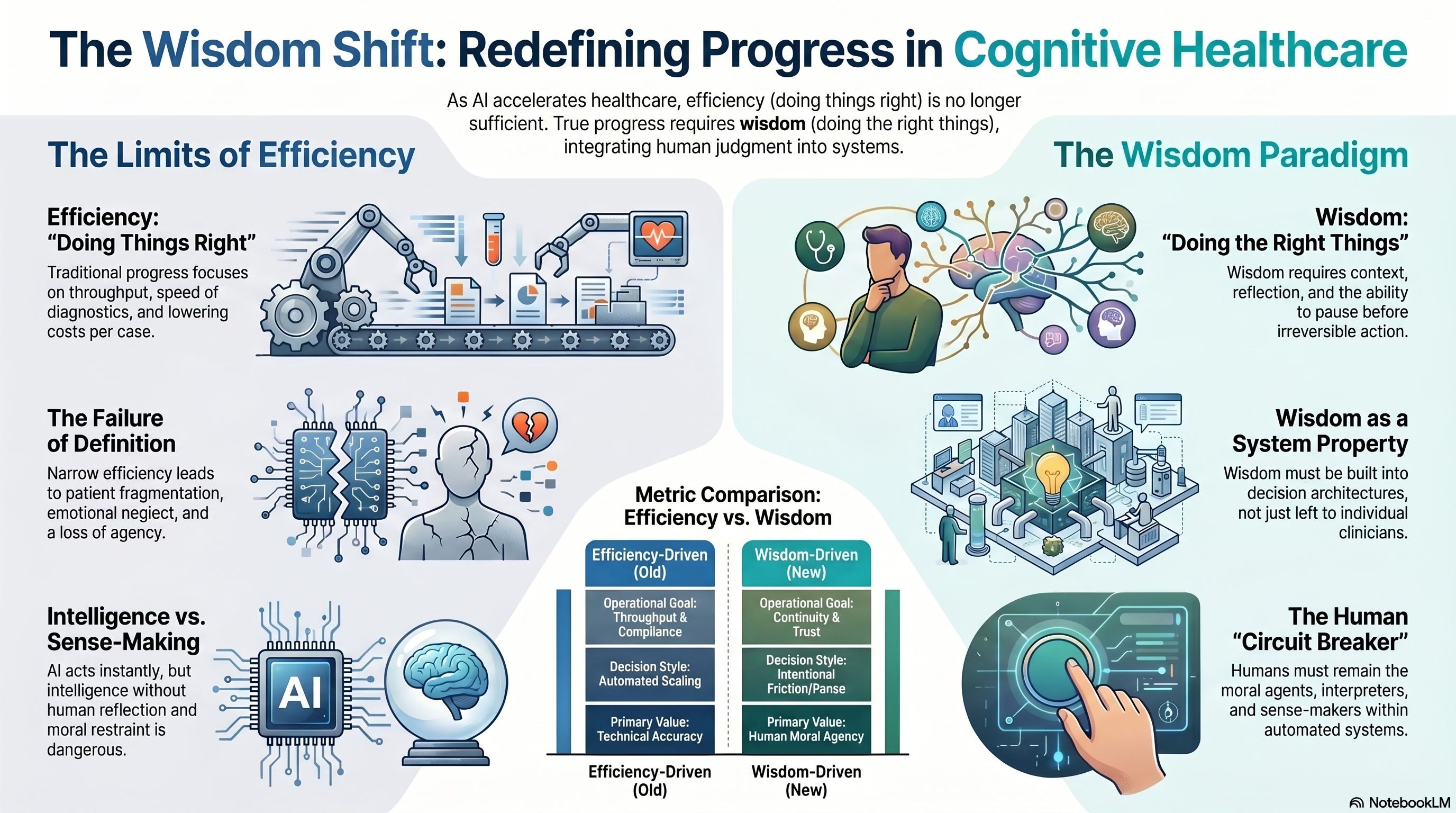
Efficiency is about doing things right.
Wisdom is about doing the right things.
Healthcare systems have become extraordinarily efficient at:
Processing patients
Standardizing decisions
Optimizing workflows
Scaling protocols
Yet many patients experience:
Fragmentation
Opacity
Emotional neglect
Loss of agency
This is not a failure of execution.
It is a failure of definition.
When progress is defined narrowly, systems improve in ways that feel increasingly disconnected from care.
When Intelligence Outruns Sense-Making
AI introduces a new asymmetry into healthcare: systems can now act faster than humans can understand.
Predictions update continuously.
Recommendations arrive instantly.
Decisions propagate across institutions in seconds.
This is a triumph of intelligence.
But intelligence without sense-making is dangerous.
Wisdom requires:
Context
Reflection
Moral deliberation
Restraint
None of these scales naturally.
Why Healthcare Is the Test Case
Healthcare is where the Cognitive Revolution becomes unavoidable.
Because healthcare decisions:
Involve irreversible consequences
Affect vulnerable people
Operate under asymmetrical knowledge
Carry moral weight beyond statistics
If we cannot design wise systems here, we will not design them anywhere.
Healthcare exposes the limits of purely technical progress.
The Cognitive Revolution Is Not About Smarter Machines
The Cognitive Revolution is often misunderstood as an arms race for better models.
It is not.
It is about the reconfiguration of decision-making under acceleration.
As AI systems take on more cognitive labor, humans face a choice:
Abdicate judgment
Or redesign systems to protect it
Progress is no longer measured by what machines can do.
It is measured by what humans remain capable of doing well.
Wisdom as a System Property
Wisdom is often framed as an individual trait.
In modern healthcare, that framing no longer works.
No clinician, no matter how skilled, can counteract:
Misaligned incentives
Runaway optimization
Institutional momentum
Opaque automation
Wisdom must be designed into systems.
This means:
Placing friction where values matter
Slowing decisions when stakes are high
Preserving human authority at critical junctures
Ensuring accountability survives automation
Wisdom is not softness.
It is a structural discipline.
Redefining Progress Metrics
If healthcare is to move from efficiency to wisdom, progress metrics must change.
This includes measuring:
Patient understanding, not just outcomes
Trust, not just compliance
Continuity, not just throughput
Moral clarity, not just legal defensibility
These measures are imperfect.
They resist automation.
That resistance is a feature, not a bug.
The Role of Governance in Wisdom
Wisdom does not emerge spontaneously.
It requires governance.
Healthcare AI governance must move beyond safety checklists and compliance frameworks toward:
Decision architecture
Authority design
Escalation pathways
Accountability preservation
Governance is how societies encode restraint.
Without it, intelligence accelerates blindly.
Designing for Pause
One of the most radical design choices in the Cognitive Age is the pause.
Pause before action.
Pause before scale.
Pause before irreversible harm.
In healthcare, pause protects:
Diagnostic humility
Ethical reasoning
Patient participation
AI systems must be designed not only to act, but to wait.
Progress that cannot pause is not progress.
It is momentum.
The Human Role, Reclaimed
The future of healthcare is not human versus machine.
It is human as:
Interpreter
Moral agent
Sense-maker
Circuit breaker
AI can extend human capability.
It cannot replace human responsibility.
Wisdom lies in knowing the difference.
What We Owe Patients
Patients do not ask for perfect systems.
They ask for:
Honesty
Care
Understanding
Dignity
A wise healthcare system does not eliminate uncertainty.
It helps people live with it.
AI must support this, not undermine it.
Progress Reimagined
True progress in healthcare is not:
Faster decisions
Smoother workflows
Larger models
It is:
Better judgment under pressure
Systems that respect human limits
Technology that preserves moral agency
Institutions that remember why they exist
Efficiency got us here.
Wisdom must take us forward.
The Closing Question
As healthcare enters the Cognitive Age, the defining question is no longer technical.
It is philosophical.
What kind of intelligence do we want guiding human lives?
If the answer is only “more,” we will lose something essential.
If the answer includes wisdom, restraint, and humanity, then AI can become not just powerful but worthy of trust.
That is the real measure of progress.