


Over the past seventeen articles, this series has mapped a landscape that most people never see:
· Three layers of value generated from every AI interaction: data, inference, and learning.
· Infrastructure controlled by a handful of companies in a handful of countries.
· Inferences drawn in silence about billions of people.
· Learning extracted from clinicians, students, and workers without recognition.
· A measurement infrastructure that already exists but is read in only one direction.
The questions this article addresses are:
· What holds it all together?
· What is the foundational principle on which governance can be built?
I believe the answer is digital personhood.
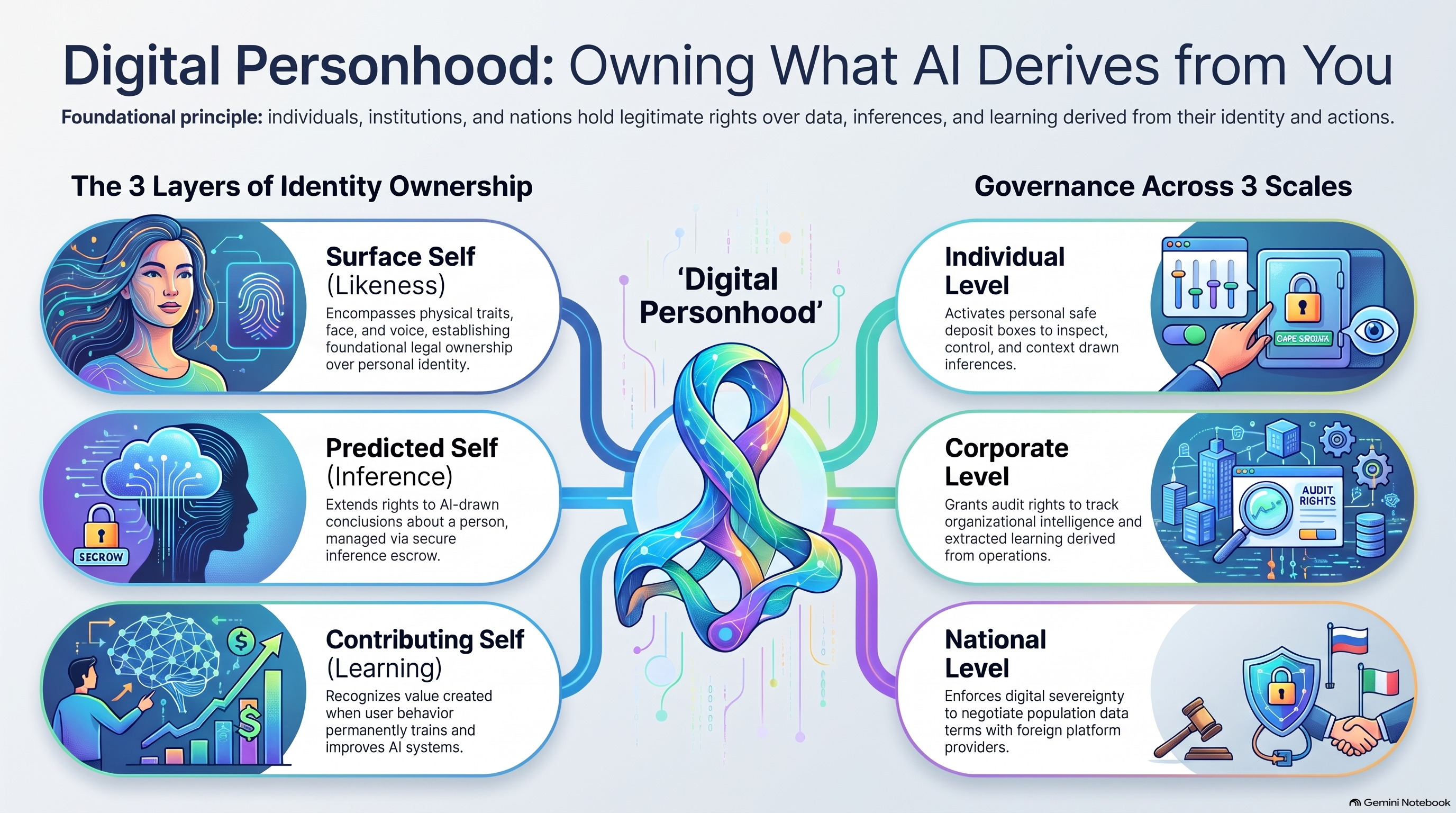
Start with what we already recognize. If someone uses your face in a commercial without your permission, you have recourse. If someone impersonates your voice to sell a product, you can object. Most legal systems recognize that your likeness — your face, your voice, your physical identity — belongs to you. It is not just protected by privacy. It is owned. It is yours.
Denmark’s 2025 proposal made this explicit: every individual has ownership rights over their own body, facial features, and voice. Not merely privacy protection. Ownership. The distinction matters because privacy can be waived with a click of a button in a terms-of-service agreement. Ownership is a stronger claim; it persists regardless of the circumstances of disclosure.
Now extend the principle one layer deeper. If you own your likeness (the outward, recognizable self), then what about the predicted self? What about the conclusions an AI system draws about you from your data: that you are likely pregnant, that you represent a credit risk, that you are a high-cost employee, that your child’s treatment is not cost-effective? Those conclusions are generated from your identity. They describe you. They affect your life. Under the current system, they belong to the entity that generated them. You may never know they exist.
Digital personhood says that the conclusions drawn about you belong to you because they are about you; not exclusively, the company that built the model retains its intellectual property in the architecture. But the specific inference about the specific person retains a connection to the person it describes. Inference escrow governs that connection: a safe deposit box where your inferences are held under your control.
Now extend the principle one layer deeper still. If you own your likeness and retain an interest in the inferences drawn about you, then what about the learning your behavior contributes to AI systems? When your corrections teach a diagnostic model, when your study patterns teach an educational platform, when your coding workarounds teach a software tool — that accumulated contribution is generated from your activity. It improves the system permanently. It creates commercial value for the platform.
Digital personhood says: you retain a legitimate interest in the learning your behavior contributes; not ownership of the entire model, but the company’s architectural innovation is real and deserves protection; but a recognized interest in the contribution you made, measured through the reverse token model, governed through contribution thresholds, and exercised at the individual, corporate, and national levels.
The progression is: likeness, then inference, then learning contribution. Each step extends the same principle one layer deeper, from the surface of the self to the predicted self to the contributing self. Denmark established the first step. This framework proposes the second and third.
The beauty of digital personhood as a foundational principle is that it operates across governance traditions. In a Western individual-rights framework, the person exercises these rights directly: seeing their inferences, controlling their safe deposit box, and contesting conclusions drawn about them. In a sovereignty-first framework, the principle exists but may be administered through state institutions in defined cases, such as the government protecting its citizens’ digital personhood through regulatory mechanisms. In a Global South development framework, the principle can be calibrated to community and institutional contexts: collective digital rights exercised through national mechanisms rather than individual litigation.
The principle is portable. The implementation is local. Different societies will build different architectures from the same foundation.
At the individual level, digital personhood activates inference escrow and the safe deposit box. At the corporate level, it activates audit rights, the right of an institution to see what inferences and learning have been extracted from its operations. At the national level, it activates sovereignty mechanisms, the right of a nation to participate in how the derived intelligence from its population is used, and to negotiate the terms under which foreign platforms operate.
These are not three separate governance projects. They are one principle operating at three scales. An individual whose digital personhood is protected contributes to a stronger institutional position. A stronger institution contributes to national sovereignty. A sovereign nation protects its institutions and citizens. The scales reinforce each other.
Digital personhood does not solve every problem described in this series. It does not resolve the infrastructure concentration described in the earlier articles. It does not eliminate the power asymmetry between platforms and populations. What it does is establish the foundational claim, the starting point from which governance at every scale can be built. Without it, the mechanisms proposed in this series have no legal or ethical anchor. With it, they have a principle rooted in something societies already recognize: what is generated from your identity belongs, in some meaningful sense, to you.
The foundation is laid. The next article examines how different societies can build different structures from it.
This article is drawn from Digital Sovereignty in the Cognitive Age, available at blogs.inspire-aspire.net.